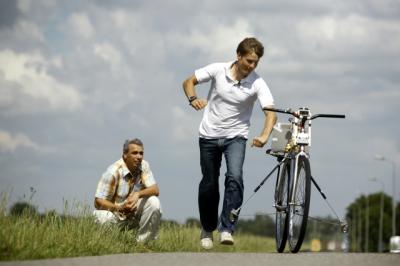





Everyone knows how a bicycle works - or so we think. But for 150 years why a moving bicycle can, all by itself, be so stable has been something of a mystery.

"Bicycle manufacturers have never been able to say precisely how a bicycle works," explains Dr Arend Schwab of the Faculty of Mechanical, Maritime and Materials Engineering (3mE). "They have always had to refine their designs purely through experimentation. In our model, they can enter into the computer all of the various factors that influence the stability and handling of their bicycle.

The majority of patients who undergo male to female sex-change surgery are happy with the results, despite the fact that complications are common, according to a study of over 200 patients in the September issue of the urology journal BJU International.

A research team from the Departments of Urology and Psychiatry at University Hospitals of Leicester NHS Trust, UK, explored the initial experiences of 222 patients who had undergone surgery and 70 who took part in detailed follow-ups.

They found that 88 per cent of patients were happy with their surgery at their first post-operative clinic visit, seven per cent were unhappy and five per cent made no comment.

"We've never seen anything quite like it," says solar physicist Lika Guhathakurta from NASA headquarters.

Last week she sat in an audience of nearly two hundred colleagues at the "Living with a Star" workshop in Boulder, Colorado, and watched in amazement as Saku Tsuneta of Japan played a movie of sunspot 10926 breaking through the turbulent surface of the sun. Before their very eyes an object as big as a planet materialized, and no one was prepared for the form it took.

"It looks like a prehistoric trilobite," said Marc De Rosa, a scientist from Lockheed Martin's Solar and Astrophysics Laboratory in Palo Alto, Calif.

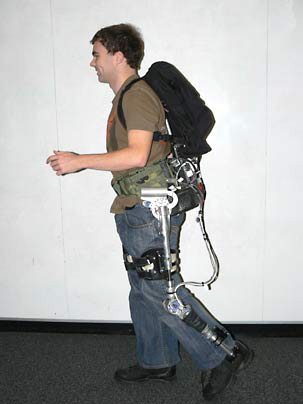
Researchers in the MIT Media Lab's Biomechatronics Group have created an exoskelton device to lighten the burden for soldiers by transferring that weight directly to the ground, effectively taking a load off the back of the person wearing the device.

In the September issue of the International Journal of Humanoid Robotics, the researchers report that their prototype can successfully take on 80 percent of an 80-pound load carried on a person's back, but there's one catch: The current model impedes the natural walking gait of the person wearing it.

"You can definitely tell it's affecting your gait," said Conor Walsh, a graduate student who worked on the project, but "you do feel it taking the load off and you definitely feel less stress on your upper body."

Whether it’s a mugger or a friend who jumps out of the bushes, you’re still surprised. But your response — to flee or to hug — must be very different. Now, researchers have begun to distinguish the circuitry in the brain’s emotion center that processes surprise from the circuitry that processes the aversive or reward “valence” of a stimulus.

C. Daniel Salzman and colleagues published their findings in the September 20, 2007 issue of the journal Neuron.

“Animals and humans learn to approach and acquire pleasant stimuli and to avoid or defend against aversive ones,” wrote the researchers. “However, both pleasant and aversive stimuli can elicit arousal and attention, and their salience or intensity increases when they occur by surprise.

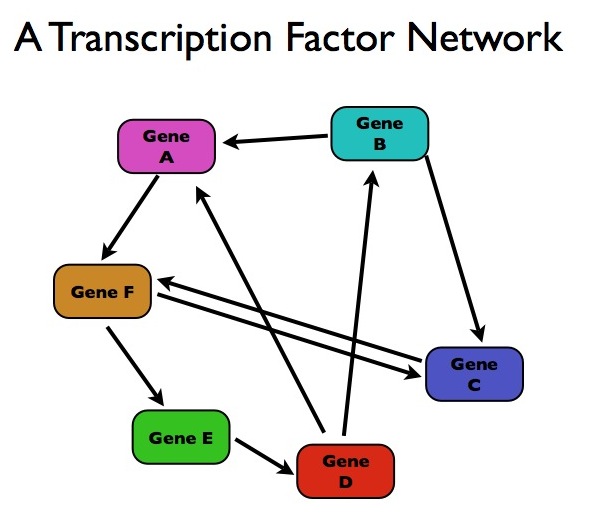
Evolution carries out an incredibly tricky balancing act: the genetic program of a species has to be resistant to small changes, yet also susceptible to the adaptive remodeling of natural selection. The human genome is so robust that over 6 billion variations give rise to viable organisms that have successfully traversed the complex developmental program that produces a live human infant from a single cell. Yet the human genome is the product of major evolutionary innovation, even over the relatively short period since the human and chimp lineages diverged. How can genomes be robust and malleable at the same time?

A team of researchers has determined through analysis of the earliest known hominid fossils outside of Africa, recently discovered in Dmanisi, Georgia, that the first human ancestors to inhabit Eurasia were more primitive than previously thought.

The fossils, dated to 1.8 million years old, show some modern aspects of lower limb morphology, such as long legs and an arched foot, but retain some primitive aspects of morphology in the shoulder and foot. The species had a small stature and brain size more similar to earlier species found in Africa.

"Thus, the earliest known hominins to have lived outside Africa in temperate zones of Eurasia did not yet display the full set of derived skeletal features," the researchers conclude.

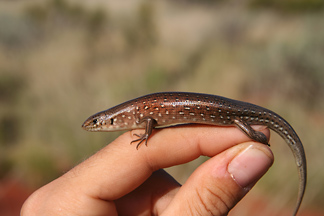
A new study of finger-sized Australian lizards sheds light on one of the most striking yet largely unexplained patterns in nature: Why is it that some groups of animals have evolved into hundreds, even thousands of species, while other groups include only a few?

The study takes a look at Australia's most diverse group of vertebrates -- more than 252 species of lizards called skinks. Researchers at the Cornell Lab of Ornithology have found evidence that the "drying up" of Australia over the past 20 million years triggered this explosive diversification.


Skinks have incredible species diversity throughout the Australian deserts. In fact, this group contains so many species that most do not even have a common English name.

I haven't been screwing off. Here is my report from the third conference for Strategically Engineered Negligable Senescence, the brainchild of cell biologist Aubrey DeGrey, as it appeared in the Times of London:

This summer two Cambridge undergraduates approached Aubrey de Grey, an outspoken expert on ageing, in his favourite pub, hoping for an informal chat. “Er, sorry, Dr de Grey?” one of them said. “I just wanted to say that I heard your lecture about antiageing medicine and that I thought it was brill . . .”

“Then what are you doing about it?” de Grey replied.

“What?” his student admirer said, clearly puzzled.

A win for embryonic stem cell research may be the kind of symbolic pyrrhic victory politicans engage in after bold action is no longer necessary.

It may not be necessary if research from Weill Cornell Medical College in New York City holds up. They say adult stem cells found in a male patient's testicles might someday be used to create a wide range of tissue types to help him fight disease -- getting around the need for more controversial embryonic stem cells.

Using spermatogonial progenitor stem cells (SPCs) obtained from the mouse's testes, the researchers were able to redirect the cells' development in the lab to form so-called "multi-potent adult spermatogonial-derived stem cells" (MASCs).

