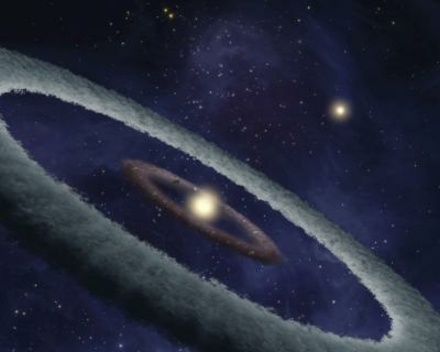
I'm torn. There's two ways I would make a new smash video game, "Astronomy Hero".
In the first, you are doing night observing runs, trying to accumulate enough light from each target while evading clouds. Different targets appear at different times of night, and you have to balance whether to finish a given target (accumulate enough photons) or switch to something that just appeared in hopes that you can do better there. Targets of different brightness or dimness require different 'stare' times that you're focusing on them, so you're constantly trying to maximize total on-target time while making sure the more valuable targets get done.
If you want to solve big network security problems, sometimes it pays to think small - as in ants.
A concept called 'swarm intelligence' adapts quickly to changing threats and it uses 'digital ants' to wander through computer networks looking for those threats, such as computer 'worms', those self-replicating programs designed to steal information or facilitate unauthorized use of machines. When a digital ant detects a threat, it doesn't take long for an entire army of ants to converge at that location, which also draws the attention of human operators who step in to investigate.
You may feel like you're not in the same league as Albert Einstein or Charles Darwin (note: statistically, you are not) but you probably share one thing if you are reading this article; patterns of correspondence.
A new Northwestern University study of human behavior says that people who wrote letters in olden days using pen and paper did so in a pattern similar to the way people use e-mail today. The study in Science seeks to find the similarity of these two seemingly different activities, with the underlying pattern of human activity linking letters and e-mails.
Very
sound advice from systems biologist Uri Alon:A common mistake made in choosing problems is taking the first problem that comes to mind. Since a typical project takes years even it if seems doable in months, rapid choice leads to much frustration and bitterness in our profession. It takes time to find a good problem, and every week spent in choosing one can save months or years later on.
Well, it seems that someone has finally decided that with all this talk of "end-times" and the "rapture" it was important that we have a more scientific approach to determining how close we actually are to such events.
Hence we have the
Rapture Index, which is billed as "The prophetic speedometer of end-time activity". By going to this site, you can quickly see what the Rapture Index value is and determine whether to sit down with a cup of coffee and await the end, or whether you still need to go to work.
Do you really care about the human race ? I do, and probably I do more than you do. Well, not more than you, maybe -I do not know you personally!-; but I know where you come from: the class of human beings presently alive. And I think that most of the people on this planet just believe they care about mankind, but they actually care just about themselves.
A commenter on a
previous post seems to have objected to the claim that evolutionary science makes predictions.
gimme 5 examples of predictions, i mean real predictions: not fit the model hogwash
Marilyn
Here's a list that I put together in around 10 minutes.
1) That a transitional fossil linking fishes and tetrapods would be found in rocks of a specific age (from the Devonian) and formed in freshwater environments.
CONFIRMED.
Today I gave my lecture on mammal diversity and evolution in the 4th year vertebrate course. We have been talking a fair bit about
paraphyletic groups, common vs. scientific names, and so on. Within this context, we explored the issue of whether we're "descended from monkeys", by taking a look at a phylogeny of relevant primates:
An article in LiveScience entitled "
Evolution Can't Go Backward" has highlighted an experiment done to determine whether a protein could be "unmutated" (i.e. returned to its original state) and regain its ancestral functions.
The results indicated that this reversibility wasn't possible because of other mutational factors that occurred during the entire time interval rendering a return to a primordial form impossible
1.
This does raise an interesting question and suggests some possible misunderstandings about what this actually means.
A few years ago, I was spending a good bit of my time on context-based services. User context — also called “presence” — is information, which changes over time, about the current state of a user or other thing (it could be a car, say, or a sensor, or a computer system; the presence people call it a “presentity”).