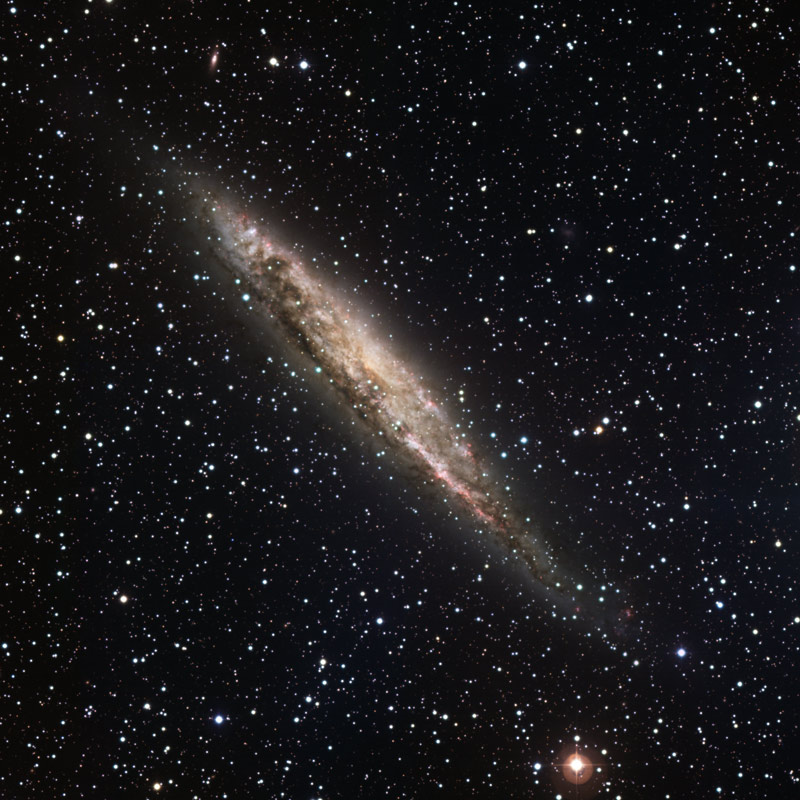
A new image of nearby galaxy NGC 4945 shows that it looks a lot like our own Milky Way.
NGC 4945 seems to be a spiral galaxy with swirling, luminous arms and a bar-shaped central region, though NGC 4945 has a brighter center that likely harbors a supermassive black hole which is devouring reams of matter and blasting energy out into space.
One component of interstellar clouds emitting unusual infrared light known as the Unidentified Infrared Bands (UIRs) is a gaseous version of
naphthalene, the chief component of mothballs back on Earth, according to research led by Michael Duncan, Regents Professor of Chemistry at the University of Georgia, along with doctoral student Allen Ricks and Gary Douberly, now an assistant professor in the department of chemistry at UGA.
The UIRs have been seen by astronomers for more than 30 years, but no one has ever identified what specific molecules cause these patterns.
The Eastern Seaboard had higher than normal sea levels in June and July and a new NOAA technical report blames persistent winds and a weakened current in the Mid-Atlantic .
After observing water levels six inches to two feet higher than originally predicted, NOAA scientists began analyzing data from select tide stations and buoys from Maine to Florida and found that a weakening of the Florida Current Transport—an oceanic current that feeds into the Gulf Stream—in addition to steady and persistent Northeast winds, contributed to this anomaly.
There were a number of reasons carbon dioxide got singled out as a primary contributor to global warming and a key one was that it was the easiest problem to fix in Europe - more nuclear power and closing Soviet-era factories made goals achievable. The US had no quick fix, since environmentalists dislike nuclear power in America, and with world leader China exempt from emissions caps, the effort to curb CO2 basically stalled.
A giant galaxy, so distant that it is seen as it was 12.8 billion years ago, is as large as the Milky Way and contains a supermassive black hole with at least a billion times as much matter as our Sun.
The discovery, in a paper in the journal Monthly Notices of the Royal Astronomical Society by University of Hawaii astronomer Dr. Tomotsugu Goto and colleagues, lays claim to the most distant supermassive black hole ever found.
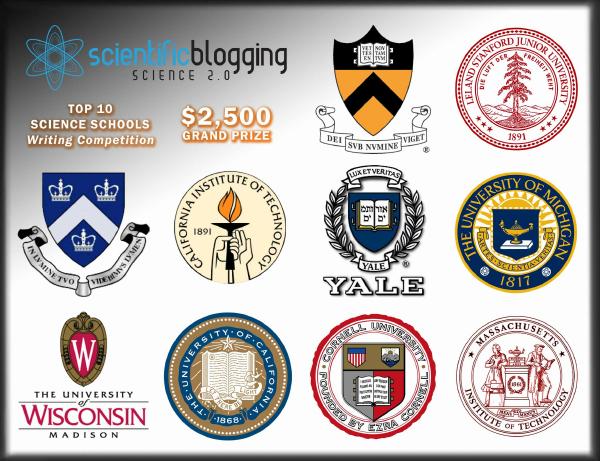
Today marks the start of the (first)
Scientific Blogging University Writing Competition. We decided to do this because, since our inception, the scientific community has been incredibly gracious about embracing Science 2.0.
The top question we have been asked in emails is 'What should I write about?' and the answer is, we don't know. Since the contest covers 11 schools and all science disciplines we have no idea what will resonate with the audience. Whatever you write should have some popular interest - no one wins "American Idol" doing Gregorian chants, for example - but it's your own voice so you have to write what is interesting to you.
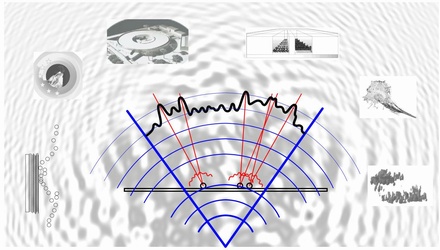
Researchers at the University of Warwick have found what could be the signal of ideal wave 'surfing' conditions for individual particles within the massive turbulent ocean of the solar wind, a discovery that could give a new insight into just how energy is dissipated in solar system sized plasmas such as the solar wind and could provide significant clues to scientists developing fusion power which relies on plasmas.
The research, led by Khurom Kiyanai and Professor Sandra Chapman in the University of Warwick’s Centre for Fusion, Space and Astrophysics, looked at data from the Cluster spacecraft quartet to obtain a comparatively “quiet” slice of the solar wind as it progressed over an hour travelling covering roughly 2,340,000 Kilometers.
Sherlock Holmes used a variety of tools to deduce what he needed to know about people in general and criminals in specific. It turns out he could learn a lot by how people act in a virtual reality setting playing a form of 'hide and seek', say two University of Alberta researchers.
Experimental psychologist Marcia Spetch and computer scientist Vadim Bulitko recently published an article in Learning and Motivation say they mapped the decision-making process involved in hiding and searching for objects, which could obviously lead to more realistic game environments and even new tools for law enforcement.
Protein S, a well-known anticoagulant protein, also contributes to the formation and function of healthy blood vessels, say researchers at the Salk Institute for Biological Studies. They found that mice lacking protein S suffered massive blood clots, but also had defective blood vessels that allow blood cells to leak into the surrounding tissue.
There are more than 200 known human mutations and polymorphisms in the gene coding for protein S, which was arbitrarily named after Seattle, the city of its discovery. The resulting deficiencies predispose carriers to deep venous thrombosis, strokes at an early age, recurrent miscarriages, and pre-eclampsia, and are associated with several autoimmune diseases, most prominently systemic lupus erythematosus.
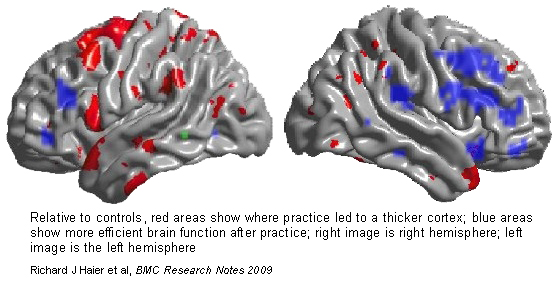
The magic of brain imaging has allowed researchers to correlate a thicker cortex in Tetris players with increased brain efficiency due to ... playing Tetris. The researchers from Mind Research Network in Albuquerque writing in BMC Research Notes used brain imaging and Tetris to investigate whether practice makes the brain efficient because it increases gray matter.