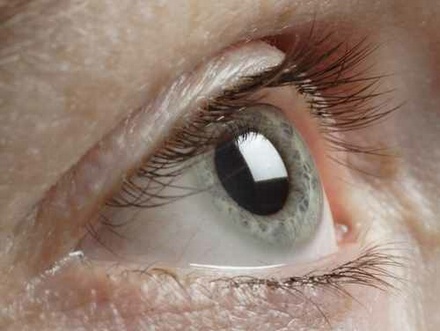
Fish and some amphibians possess a unique sensory capability that allows them to 'feel' objects around them without physical contact and see in the dark.
Colloquially this is called a 'sixth sense' but scientifically it is called a lateral-line system.
A team in the physics department of the Technische Universitaet Muenchen say they are able to explore the fundamental basis for this sensory system. The goal of that would not be to solve M. Night Shyamalan movies faster but rather, through biomimetic engineering, better equip robots to orient themselves in their environments.
A new study in the Journal of Child Psychology and Psychiatry says nearly 15 percent of preschoolers have high levels of depression and anxiety.
Their investigation also said depressed pre-schoolers were more likely to have mothers with a history of depression. So is that actual depression or learned social behavior that seems like depression?
Being a kid is not easy, of course, despite what parents think. But is finding pre-school depression in high numbers due to better diagnosis or, in the cases of rampant ADD prescriptions in the 1990s, a new field looking for patients? If it's better diagnosis, finding it earlier may be a help.
Researchers writing in, ironically, the journal Addiction have associated abstaining from alcohol with an increased risk of depression.
Doesn't make sense, right? Excessive alcohol consumption has been linked to poor physical and mental health but they cite evidence saying that levels of alcohol consumption that are too low may also be associated with poor mental health possibly - obviously, abstainers may have other issues or even be reformed heavy drinkers.
You may recall the “China Brain” thought experiment about consciousness, which goes something like this: if each person in China were to mimic the activity of a neuron using cell phones to communicate with one another, would this China-sized brain like Chinese food? I may be missing some of the philosophical nuances in the question, but as a one-time philosopher, I know enough about consciousness to know I have nothing remotely worthwhile to say about it.
One of the cool things about neuroscience is that its validating some theories of psychology and even psychoanalysis.
When I wrote
The Chemistry of Connection in 2007 and 2008, I made some leaps, tying together psychology and sociology, which are based on observation, with animal studies showing that mothering helps determine the distribution and sensitivity of oxytocin receptors in the brain. For one thing, I tied the oxytocin response -- the release of oxytocin in the brain in response to positive social interactions -- to attachment styles.
A new study from Baylor College of Medicine validates this link.
Years back, conversing with a now long-retired dean, I happened to let slip the words “common sense.” He replied, “It’s been a long time since I heard that phrase uttered on this campus, much less seen it practiced.”
He had a point.
A number of stories caught my eye today and I wanted to write about each of them, but did not want to overwhelm the blog list like someone else who shall remain nameless (but happens to play rugby) does on occasion. The first unifying thread I noticed was that all deal with the letter D. So, like Kathy Griffin, the D-list it is.
Drug dispensers: Vending machines in prison - Pepsi, Coke ... Viagra?
Really, what could go wrong in this scenario? Images of the Fonz whacking the jukebox played in my mind, but replace the Fonz with a convict and the jukebox with a vending machine dispensing prescription drugs...
In 1935 one of the founders of modern genetics, J. B. S. Haldane, studied men in London with the blood disease hemophilia and estimated that there would be a one in 50,000 incidence of mutations causing hemophilia in the gene affected – the equivalent of a mutation rate of perhaps one in 25 million nucleotides across the genome.
Others have measured rates at a few further specific genes or compared DNA from humans and chimpanzees to produce general estimates of the mutation rate expressed more directly in nucleotides of DNA.
16 scientists report today the first direct measurement of the general rate of genetic mutation at individual DNA letters in humans and show that those early estimates were spot on.
Today I wish to offer you the figure attached at the bottom of this article, which shows a combination of recent determinations of the rate at which the Tevatron proton-antiproton collisions produce single top quarks.
A team of researchers say long held beliefs about how stars are formed have been just a myth, and they say this astronomy myth got busted using a set of galaxies found with CSIRO's Parkes radio telescope.
When interstellar gas collapses to form stars, the stars range from massive to minute. Since the 1950s many astronomers have believed that in a family of new-born stars the ratio of massive stars to lighter ones was always about the same — for every star 20 times more massive than the Sun or larger, you'd get 500 stars the mass of the Sun or less.