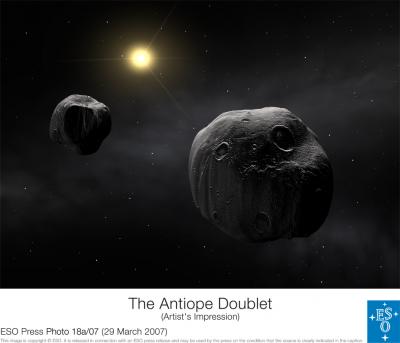






Combining precise observations obtained by ESO's Very Large Telescope with those gathered by a network of smaller telescopes, astronomers have described in unprecedented detail the double asteroid Antiope, which is shown to be a pair of rubble-pile chunks of material, of about the same size, whirling around one another in a perpetual pas de deux. The two components are egg-shaped despite their very small sizes.

The asteroid (90) Antiope was discovered in 1866 by Robert Luther from Dusseldorf, Germany. The 90th asteroid ever discovered, its name comes from Greek mythology.

Scientists at MIT have created an ocean model so realistic that the virtual forests of diverse microscopic plants they "sowed" have grown in population patterns that precisely mimic their real-world counterparts.

This model of the ocean is the first to reflect the vast diversity of the invisible forests living in our oceans-tiny, single-celled green plants that dominate the ocean and produce half the oxygen we breathe on Earth. And it does so in a way that is consistent with the way real-world ecosystems evolve according to the principles of natural selection.

What would large women think if a dress sold for lower cost to women of smaller sizes?

Common sense says this would turn them off.

But swimmers react well to items claimed to improve speed if they know the product is given away free to Olympic swimmers.

If you perceive the person getting the good deal as being smarter than you, you are okay with it. You are even more likely to pay full price.

Astronomers at the Naval Research Laboratory (NRL) have produced the first images of the sky from a prototype of the Long Wavelength Array (LWA), a revolutionary new radio telescope to be constructed in southwestern New Mexico. The images show emissions from the center of our Galaxy, a supermassive black hole, and the remnant of a star that exploded in a supernova over 300 years ago. Not only a milestone in the development of the LWA, the images are also a first glimpse through a new window on the cosmos. "First light" is an astronomical term for the first image produced with a telescope. It is a key milestone for any telescope because it indicates that all of the individual components are working in unison as planned.

Scientists have identified three different signals that indicate damage to chloroplasts— the photosynthetic factories of plant cells that give plants their green color —but little is known about how the signal gets passed on to the nucleus. Scientists at the Salk Institute for Biological Studies made a big step towards explaining how chloroplasts let a cell's nucleus know when things start to go wrong at the periphery so nuclear gene expression can be adjusted accordingly.

Multiple distress signals converge on a single pathway and channel the information to a nuclear master switch, the scientists report in the March 29 issue of Science Express. In response, hundreds of genes involved in photosynthesis are simultaneously shut off to ease the chloroplast crisis.

The city of London, with funding from the European Space Agency, has launched AirTEXT, which delivers air pollution alerts and health advice via SMS text messages.

AirTEXT is a free service aimed at those who have been diagnosed with asthma, emphysema, bronchitis, heart disease or angina as well as for those who live or work in London. The service has operated in the Borough of Croydon, the largest borough by population, since July 2005 and has received a positive response with 80 percent of users saying it has helped them manage their symptoms better and reduce their exposure to air pollution.

Fewer big sharks in the oceans led to the destruction of North Carolina’s bay scallop fishery and inhibits the recovery of depressed scallop, oyster and clam populations along the U.S.

For all the current emphasis on standardized testing and teaching requirements, the quality of elementary school instruction is mediocre at best, according to a study from the NICHD Study of Early Child Care and Youth Development study published in the March 30 issue of Science magazine.

"Any given child has less than a 20 percent chance of having a rich classroom experience consistently through elementary school," says Robert C. Pianta, lead researcher and Novartis US Foundation Professor of Education in the University of Virginia Curry School of Education. And for low-income children, the percentage is even less.

Crumpled kitchen foil that lays flat for reuse. Bent bumpers that straighten overnight. Dents in car doors that disappear when heated with a hairdryer. These and other physical feats may become possible with a technique to make memory metals discovered by researchers at the University of Illinois.

Normally, when a piece of metal – such as a paperclip – is bent, the change in shape becomes permanent. But, when heat is added to bent metal films having the right microstructure, the researchers found, the films return to their original shapes. The higher the temperature, the sooner the metal films revert. "It’s as though the metal has a memory of where it came from," said Taher A.

Scientists from Cardiff University have revealed new clinical data showing that Cod Liver Oil really is effective in slowing the destruction of joint cartilage in patients with osteoarthritis.

The groundbreaking clinical study was led by Professor Bruce Caterson and Professor John Harwood of the School of Biosciences, and Professor Colin Dent, Orthopaedic Consultant, University of Wales College of Medicine.

For the first time, the clinical study provides unique human evidence (in vivo) of the effectiveness of Cod Liver Oil in the management of osteoarthritis.

