



Biofuels have been an increasingly hot topic on the discussion table in the last few years. In 2003 the European Union introduced a Directive suggesting that Member states should increase the share of biofuels in the energy used for transport to 2% by 2005 and 5.75% by 2010. In 2005 the target was not reached and it will probably not be reached in 2010 either (we are in 2006 at approximately 0.8%), but anyway the Directive showed the great interest that the European Commission places on biofuels as a way to solve many problems at once. The new European energy strategy, presented on 10th January 2007, establishes that biofuels should represent at least 10% of the energy used for transport.

The buildup of greenhouse gases in Earth’s atmosphere and oceans continues to provoke changes in the natural environment that scientists have been working to measure for decades. Global increases in temperature are just one facet of a much larger issue that scientists at the Rosenstiel School of Marine and Atmospheric Science are dedicated to uncovering. "The Marine Inorganic Carbon Cycle," a paper recently published in the journal Chemical Reviews, attempts to quantify over 60 years of research, reviewing a vast array of science that brings into question the Earth’s natural ability to rebound from the increase in inorganic carbon dioxide in the atmosphere and oceans.

Dr.

Americans in their early to mid-50s today report poorer health, more pain and more trouble doing everyday physical tasks than their older peers reported at the same age in years past, a recent analysis has shown.

So do baby boomers just complain more than their ancestors or are they actually worse off?

The research, published in print and online this week by the nonprofit National Bureau of Economic Research (NBER), was supported by the National Institute on Aging (NIA), a component of the National Institutes of Health.

The study was conducted by Beth J. Soldo, Ph.D., Olivia Mitchell, Ph.D., and John McCabe, Ph.D., of the University of Pennsylvania, and Rania Tfaily, Ph.D., of Carleton University, Ottawa, Ontario.

Researchers at Texas A&M University are shedding light on a rare form of early blindness, identifying the cells involved and paving the way for possible therapies to treat or even prevent what is currently an incurable disease.

The findings, funded by Fight for Sight and the National Institutes of Health, are published in the March 5-9 online Early Edition (EE) of the Proceedings of the National Academy of Sciences.

Since his post-doctoral days at Harvard University, Texas A&M biologist Dr. Brian Perkins has been studying protein transport within photoreceptors—the rod and cone cells that allow organisms to detect their visual worlds—in zebrafish, a vertebrate whose eye physiology is essentially identical to that of a human.

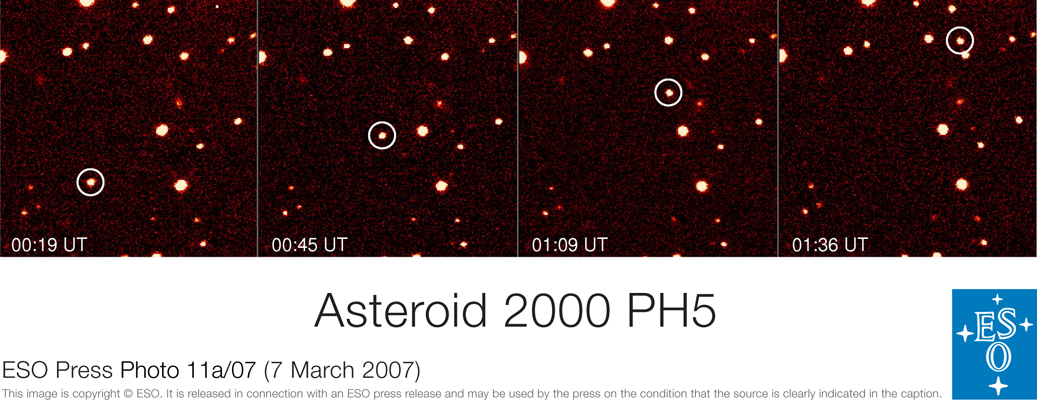
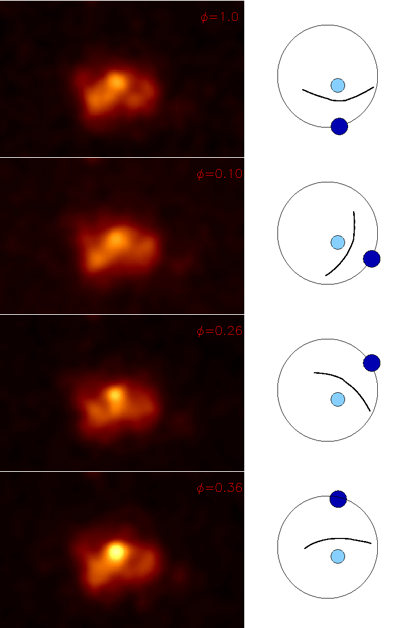
For the very first time, astronomers have witnessed the speeding up of an asteroid's rotation, and have shown that it is due to a theoretical effect predicted but never seen before. The international team of scientists used an armada of telescopes to discover that the asteroid's rotation period currently decreases by 1 millisecond every year, as a consequence of the heating of the asteroid's surface by the Sun.

Imagine two stars with winds so powerful that they eject an Earth's worth of material roughly once every month. Next, imagine those two winds colliding head-on. Such titanic collisions produce multimillion-degree gas, which radiates brilliantly in X-rays. Astronomers have conclusively identified the X-rays from about two-dozen of these systems in our Milky Way. But they have never seen one outside our galaxy — until now.

Thanks to the European Space Agency's XMM-Newton X-ray observatory, with help from NASA's Chandra X-ray Observatory, an international team led by Dr Yaël Nazé of the Université de Liège in Belgium has found such a system in a nearby galaxy. This galaxy, the Small Magellanic Cloud, orbits the Milky Way and is located about 170 000 light-years from Earth.

Having a twin sister could put male saiga antelopes at a reproductive disadvantage, says new research published today. The study shows that male twins with a sister are born lighter than those with a brother, making them smaller than the optimal size for males. The research also shows that saigas are the supermums of the hoofed animal world with no other similar species investing more in their offspring during pregnancy.

The study's results call into question current understanding of the development of male and female foetuses of this species, and give scientists a new insight into the importance of sibling sex and what implications this may have for the animals as they mature.

David Houle touched on this in his Berkeley and Nanotechnology article and now lots of other people are wondering the same thing. Will it be regarded as hazardous materials or tools of big corporate evildoers or as benevolent forces for change in society?

"The U.S. public's perception of nanotechnology is up for grabs. It could divide along the lines of nuclear power, global warming and other contentious environmental issues absent a major public education and engagement effort by industry, government, civic groups and scientists.

Several hundred images taken with NASA's Hubble Space Telescope have been woven together into a rich tapestry of at least 50,000 galaxies. The Hubble view is yielding new clues about the universe's youth, from its "pre-teen" years to young adulthood.

The snowstorm of galaxies in the Hubble panorama does not appear evenly spread out. Some galaxies seem to be grouped together. Others are scattered through space. This uneven distribution of galaxies traces the concentration of dark matter, an invisible web-like structure stretching throughout space.

I don’t normally write much about the social sciences, apart from education. But some of the research results in these sciences are strange and interesting, and it seems a shame to do nothing with them. So I’ve devised a little quiz. I’m going to leave it up here for a week, before posting the answers and where they come from.

I'll also offer a prize to one person who gets all twenty answers correct. This is a copy of The Writers’ and Artists’ Yearbook 2007, which has eight hundred pages of contacts and advice on getting started in newspapers, magazines, books, online and broadcast media.

It’s a good book. So good I bought it twice.

Right, here we go:


