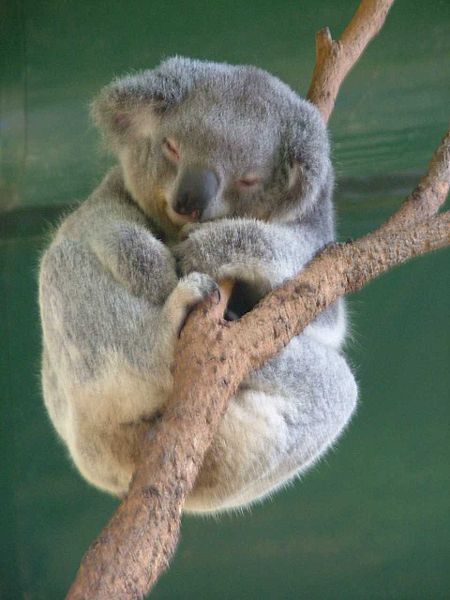





Koalas have a reputation of being lazy animals (see figure 1). Of course, sleeping about 19 hours a day, and spending 3 out of the 5 remaining hours eating, only adds to their ‘street rep’. But even these lazy marsupials have to mate. And that’s when it gets interesting (at least to some biologists).


Figure 1: Sleeping koala. Awww...

(Source: Wikimedia Commons, author: Dingy)


RETRACTION: I have decided to retract three blogs (Deriving … 4/5, 5/5, 6/5+1). I was unable to figure out a reasonable statement concerning gauge symmetry. When the blogs were initially written, I focused on the field equations, mainly the Gauss-like law, and ignored the force equations entirely. Finding a solution that works with the the field and force equations were not looked for. A consistent proposal should do all three things (fields, forces, and solutions) with grace. I have concluded it is not possible to achieve these goals with the Lagrangian as written, hence the retraction.
Hard Times For Unscientific Blogging

Pseudo-skeptic claims of Arctic ice recovery have been followed by further losses in the real world.  Evidence of global warming is accumulating to such an extent that the web's unscientific bloggers have to work really hard to find anything to write about.  Times are so hard that Anthony Watts was recently reduced to writing a very lengthy anacoluthon-style dust-speck-spotting article about how Al Gore didn't make a video in one take.  Horror of horrors!  And what are we to conclude from Watts' analysis?  The experiment portrayed is valid!

We've all read about efforts to provide amputees with robotic limbs and we know that  deep brain stimulation can relieve a range of Parkinson and OCD symptoms - a Tel Aviv University researcher has combined those ideas and gone a step farther and successfully implanted a robotic cerebellum into the skull of a rodent with brain damage, restoring its capacity for movement.

In the 1990s, under the guise of wage protectionism, the Clinton administration got legislation passed that made it far more difficult for immigrants to get a work visa.  The concern was that a foreign worker would work in the US for less.  Result overall: Jobs instead went overseas.

Impact in science; we now spend $5 billion a year on STEM programs, trying to convince American children who are inclined to be doctors that they should instead be scientists, while foreign science students educated in the US are forced to go back home where they become competitors to the US.
The reportedly faster than light neutrinos at OPERA may be a systematic error, but if these and those data of other neutrino experiments are correct, they hint at a phenomenon that propagates with very many times, perhaps millions of times the speed of light.


Researchers recently monitored the behavior of thousands of people as they sang along to more than a thousand tunes and say they have uncovered the common traits in songs that are most 'catchy'.

That's right. If you like to song along to some songs more than others, there is a sort-of science reason why; it helps to be a man, though ironically with a higher-pitched voice.

The four core elements that trigger people's inclination to sing, according to musicologist Dr. Alisun Pawley and psychologist Dr. Daniel Mullensiefen are:
Being in media, it's easy to get inundated with convincing opposing data and so it's easy to understand why it can be confusing for the public who don't have hours each day to sift through it all. Over a decade ago, for example, people were concerned that American students tested poorly against students in Asia.  No Child Left Behind, which established education performance standards for states, therefore had terrific bipartisan support when it was instituted - it passed 384–45 in the House and 91-8 in the Senate.  Educators were that convincing in their concerns that students were losing ground worldwide.

To PhD or not to PhD? It seem this is a question many students face. Perhaps the results of the first Eurodoc Survey can help some of them with their decision. Eurodoc, or the European Council of Doctoral Candidates and Junior Researchers, is an international federation of 34 national organizations of doctoral candidates, founded in Girona (Spain), and, since 2005, it has its seat in Brussels (Belgium).

From December 2008 until April 2009, Eurodoc concucted a survey among doctoral candidates in 12 European countries. The final report summarizes the answers of over 7500 respondents from Austria, Belgium, Croatia, Finland, France, Germany, the Netherlands, Norway, Portugal, Slovenia, Spain and Sweden.


Sample Profile


Scientists want more children.  Seriously, that's not my headline, that's the conclusion reached by Ecklund and Lincoln back in August in the online PLos ONE journal.  Put simply, science as a career is not very kid-friendly, so older scientists feel regret over not having as many kids, and younger scientists make plans to leave science in favor of better work-life balance.


