




Edward Calabrese, an environmental toxicologist at University of Massachusetts Amherst,  says he has evidence that oNobel Prize winner Hermann Muller knowingly lied when he claimed in 1946 that there is no safe level of radiation exposure.

We've often defended Jean-Baptiste Lamarck.  Publishing 50 years before Darwin, he can be forgiven for not having 'the greatest idea anyone ever had' and in the last few years,  geneticists have gotten on board as well and no longer dismiss out of hand his belief that acquired traits can be passed on to offspring.

Much of the pre-Darwin thinking was teleological and that is why natural selection in evolution met so much resistance.  But science quickly won and Lamarck's theory of transformation went onto the ash heap of biological history. Yet in the last decade, we have learned that the environment can leave traces in the genomes of animals and plants, in the form of epigenetic modifications.

Cancer patients quickly find themselves learning a new language and, keen to trust in science and medicine, they sometimes don't take time to fully understand their treatment options, and the risks and benefits of each choice, because they know doctors are busy. 

A commentary in the Journal of the National Cancer Institute outlines 10 things health care professionals can do to improve the way they communicate information about treatment risks to patients and that means patients can keep these in mind when talking with their doctors.

We like to think some things are constant, like temperature, and they are as long as everyone agrees.  That does not mean they are accurate.  The metric system is a famous example of a flawed measurement that nonetheless became popular.

Temperature is based on a chemico-physical material property, not on an unchangeable fundamental constant. Some physicists would like to change that.  They call themselves  metrologists - measurement artists who want to be as precise and change the field of worldwide temperature measurement.

Devices that monitor the human body's processes are being researched and tested for biological sensing or for prosthetics but materials scientists at the University of Washington have taken that a step farther.  They have built a transistor that uses protons and could communicate directly with living things. But the current prototype has a silicon base and could not be used in a human body, so don't get prepared to cyberpunk yourself just yet.

Currently sensing technology typically uses electrons, negatively charged particles, rather than protons, which are positively charged hydrogen atoms, or ions, which are atoms with positive or negative charge. 

People may complain about tax breaks for successful energy companies but the one thing worse is spending real money on lousy ones.   Yet it has happened because advocacy is taking precedence over science.

The recent Solyndra LLC collapse is not the first time this has happened, nor can it be blamed solely on the Obama administration simply due to his zeal for alternative energy - the Department of Energy began the loan guarantee program in 2006 when there was a Republican Congress and a Republican senate and in 2005 the wasteful ethanol subsidies and mandates were put into law.

Retroviral proteases are a class of enzymes that play an important role in the maturation and proliferation of the AIDS virus. As such, this class of enzymes is a subject of intense research. The efforts, however, were hindered by a fundamental problem: nobody knew exactly what these enzymes looked like.

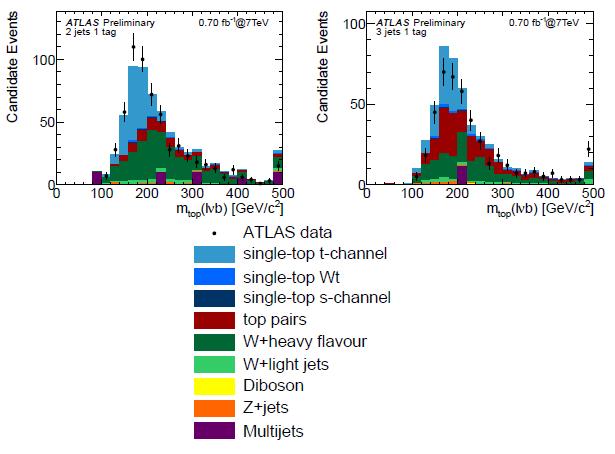
A well-known HEP rule says that yesterday's searched new processes will be tomorrow's annoying irreducible backgrounds; but since I am an optimist, I always see the glass half-full and feel compelled to add that today they are pleasing high-statistics signals. Take single top quark production: the Tevatron experimentalists (you can include me in the lot) banged their head for a decade trying to measure it; they finally succeeded, but the signal always remained a small excess of events in the tail of a highly-refined multi-variable discriminator.
Last time I blogged, I discussed entropic gravity and ended with the prediction that we will witness some more opposing and supportive views on entropic gravity before the dust will settle on the subject. The moment I wrote these words, a critical article on Verlinde's entropic gravity idea appeared, soon followed by a an article that brushes aside all earlier entropic gravity criticism based on neutron experiments. 

Think someone is bored if they yawn? Perhaps their brain is just overheating.

A study led by Andrew Gallup, a postdoc in Princeton University's Department of Ecology and Evolutionary Biology, says yawning frequency varies with the seasons and that people are less likely to yawn when the heat outdoors exceeds body temperature.  Conclusion: yawning could serve as a method for regulating brain temperature.

