





Belief systems are the stories we tell ourselves to define our personal sense of "reality".  Every human being has a belief system that they utilize, and it is through this mechanism that we individually, "make sense" of the world around us.

There are two forms such belief systems can take;  evidence-based or faith-based.  
The Lacey Act is one of few government regulations I have praised for its effectiveness.  Few government regulations are actually designed to help anyone, they are either designed to hobble someone in order to artificially level the playing field or they are designed to boost a special interest.  This act levels the playing field, but for the benefit of companies that are ethical.

A new study, published in Science, describes a multi-gene synthetic circuit that can distinguish between cancer and non-cancer cells, after which it can target the cancer cells for destruction. Through recognizing five intracellular cancer-specific molecules, the circuit is able to accurately identify cancer cells, which, after detection, are destroyed.

Finding the right combination of molecules was challenging. Looking among microRNA molecules, which are post-transcriptional regulators, the researchers were eventually able to find one miRNA combination that was typical for HeLa, or cervical cancer, cells. The combination is made up out of five specific miRNAs, and is sufficient to identify HeLA cells among healthy cells (see figure 1).


Haute couture through history?  It is when St. Pölten takes the Catwalk!

If your only knowledge of Stone Age fashion is stricly limited to old Flintstones cartoons, you are in luck.  On September 23rd the University of Applied Sciences (UAS) in St. Pölten, Austria will be parading clothing from over ten millennia, a journey through time and the world of fashion.


Wilma Flintstone - fashion maven from the Stone Age.  © Hanna-Barbera.
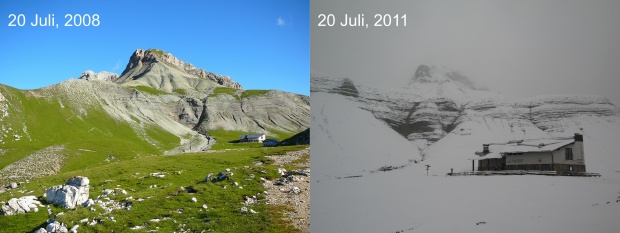
Mountains sure aren´t what they used to be. Take  the Dolomites in the Veneto Region of Italy and Austria; 140 to 90 million years ago, they were part of the sea floor rather than mountains. 

Over millions of years, deposits were then formed from calcareous shells of marine life from the Mesozoic era. Tectonic forces later caused these sediments to rise upward to the mountaintops of today´s well-known and popular Southern Alps. The mountain range contains one of the most complete and most accessible geological records - also being one of the richest in fossils - from the Cretaceous period in Europe. This record was scientifically analyzed in-depth for the first time within the framework of a project supported by the Austrian Science Fund FWF.
In Physics Today's 'We love you, you're perfect, now edit', three editors give advice to potential science writers.  Their advice includes the 3 holy rules:

  1) know who you are writing for
  2) meet your deadlines
  3) be polite


... and expands on it a bit.  Am I to steal another's writing instead?  No, so go read the piece.  That's what links are for.

Bias in science academia is a big topic, but it's selective.  If there are fewer women, it is regarded as a hostile environment but if there are no Republicans that is their choice.  

Penn State researchers have added something new into the mix - hormones.  If you are a woman who wanted to be a physicist, you may have been fighting your own sex hormones to do it, they say.  They did it by looking at people's interest in occupations that exhibit sex differences in the general population and are relevant to science, technology, engineering and mathematics (STEM) careers.

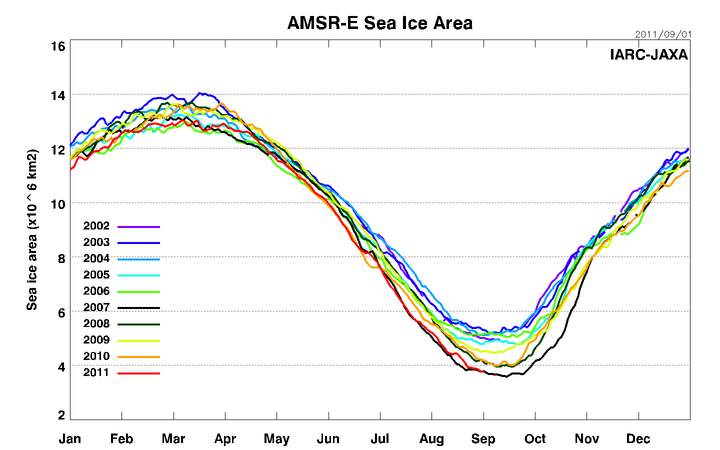
Arctic Ice September 2011

My March 2011 forecasts were quite wide of the mark.  For the first part of the Arctic summer much of the western Arctic saw lower than expected temperatures.  Despite the low temperature start-off, the Arctic is about to see either the lowest ever end of season extent, or the 2nd lowest since 2007.

In June, I wrote:
Much depends on the Arctic weather, but it looks likely that the September ice minimum will be amongst the three lowest.  If the melt in July and August proceeds as it has done on average over the last decade, then the 2007 record minimum may well be beaten.
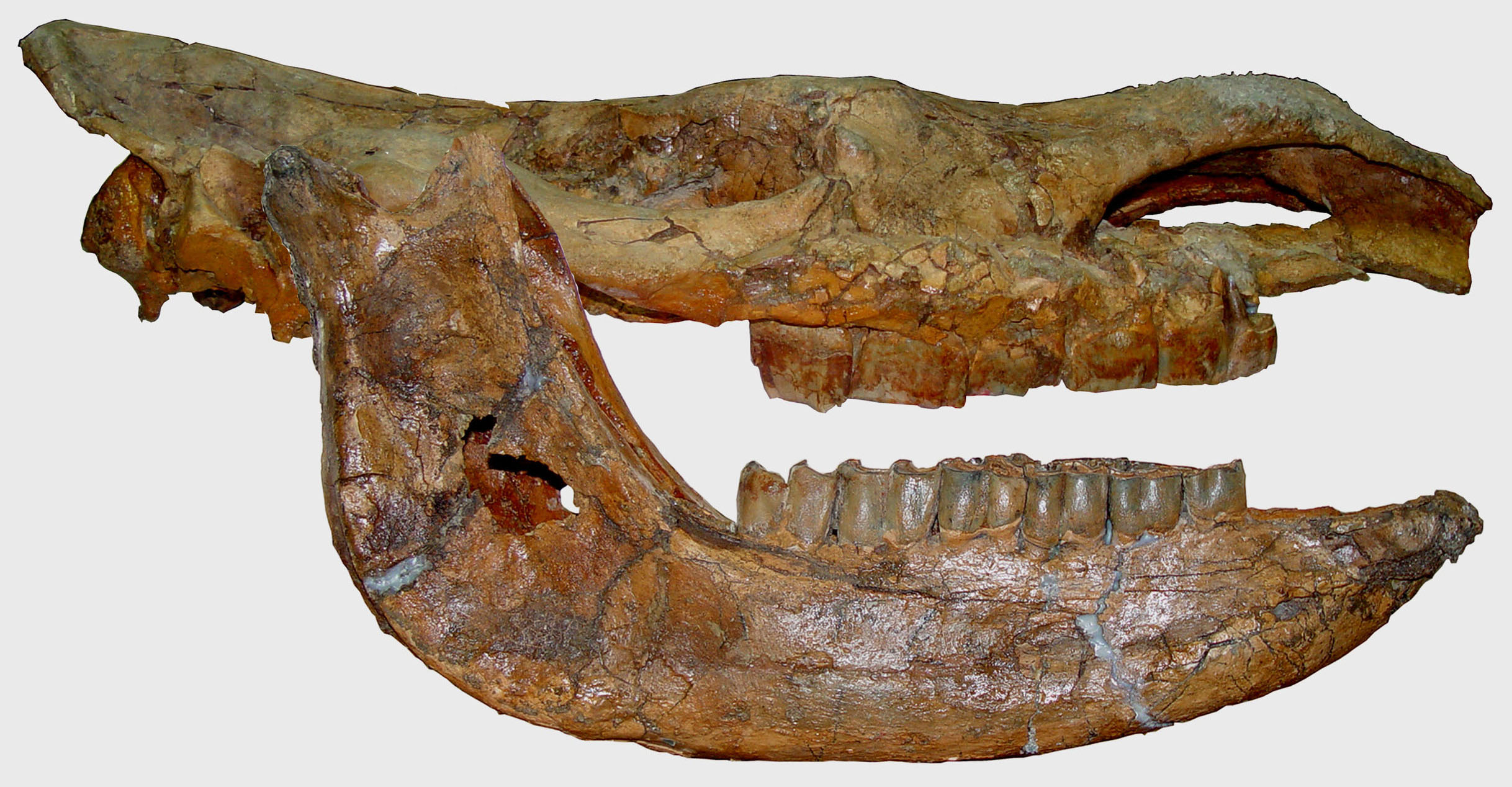
A new oldest woolly rhino fossil in Tibet suggests some giant mammals evolved there before the beginning of the Ice Age, but it leaves a lot of questions about where these giants came from and how they acquired their adaptations for life in a cold environment.

A team of geologists and paleontologists led by Xiaoming Wang from the Natural History Museum of Los Angeles County (NHM) and Qiang Li of Institute of Vertebrate Paleontology and Paleoanthropology, Chinese Academy of Sciences, uncovered a complete skull and lower jaw of a new species of woolly rhino (Coelodonta thibetana) in the foothills of the Himalayas at the southwestern Tibetan Plateau.

