



Twin detectors recently installed in the first of three experimental halls in the Daya Bay Reactor Neutrino Experiment are now recording interactions of elementary antineutrinos produced by powerful reactors at the China Guangdong Nuclear Power Group power plant located about 55 kilometers from Hong Kong.

China and the U.S. lead the Daya Bay Reactor Neutrino Experiment, which also includes participants from Russia, the Czech Republic, Hong Kong, and Taiwan and the event marks the first step in the international effort to measure a puzzling property of neutrinos and antineutrinos that may underlie basic properties of matter and why matter predominates over antimatter in the universe.

Four new studies have found that when a woman's goal is to be romantically desirable, she is less likely to go into majors and activities related to science, technology, engineering and math (STEM).  The studies were undertaken to determine why women, who have achieved parity in education, getting more Ph.D.s than men, and also in the workplace, continue to be underrepresented at the highest levels of STEM fields.

They found converging support for the idea that when romantic goals are activated women (but not men) show less interest in STEM fields and more interest in feminine fields, such as the humanities, education and social sciences.  

Lead author Lora E.

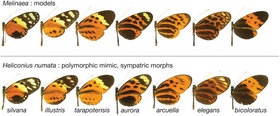
Mimicry can often be observed in nature, and several types can be discerned. One of these types is known as Müllerian mimicry (named after the German zoologist Johann Friedrich Theodor Müller), or when two or more harmful species copy each other’s warning signals. This type of mimicry is well-known among unpalatable butterflies.

The question,  however, is, how do they do this?

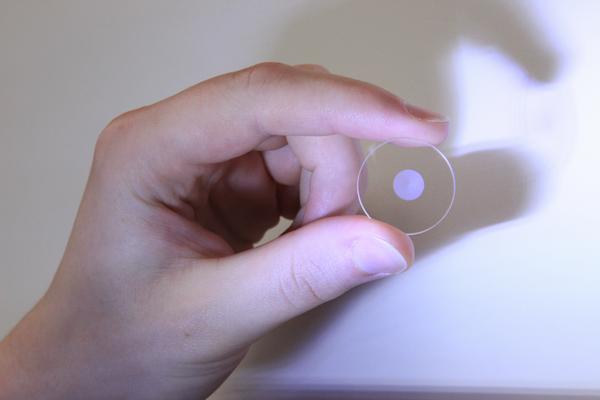
New nano-structured glass optical elements could significantly reduce the cost of medical imaging.

In their Applied Physics Letters paper, the team describes how they have used nano-structures to develop new monolithic glass space-variant polarization converters. These millimeter-sized devices generate ‘whirlpools’ of light enabling precise laser material processing, optical manipulation of atom-sized objects, ultra-high resolution imaging and maybe even table-top particle accelerators. 

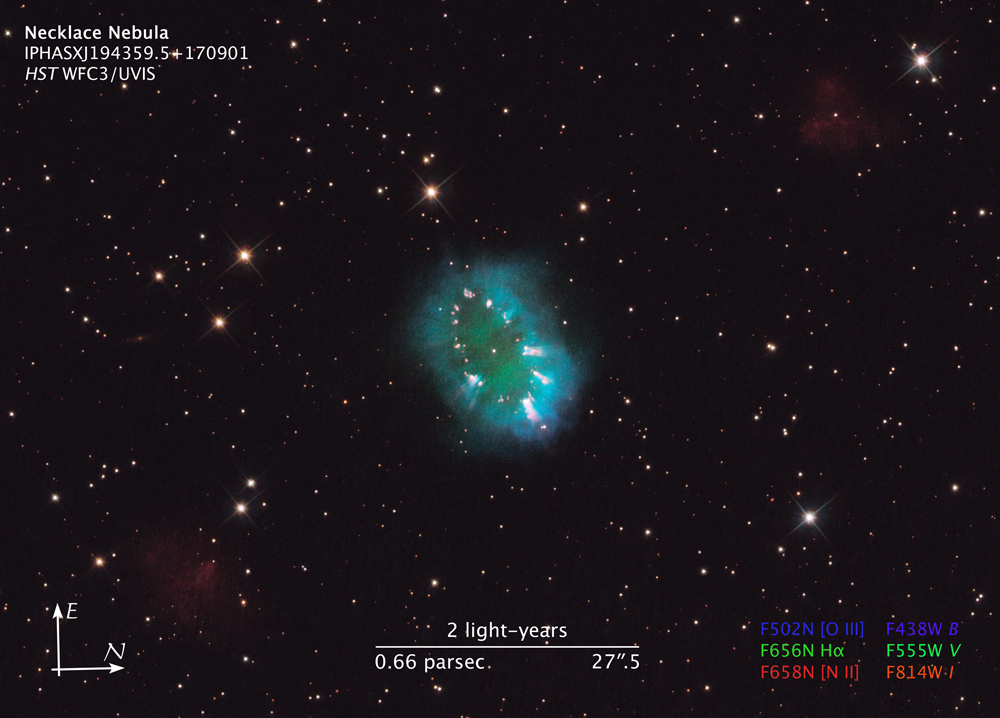
A giant cosmic necklace glows brightly in this NASA Hubble Space Telescope image of an object named (surprise) the Necklace Nebula, a recently discovered planetary nebula which is the glowing remains of an ordinary, Sun-like star. 

The nebula consists of a bright ring, measuring 12 trillion miles across, dotted with dense, bright knots of gas that resemble diamonds in a necklace. The knots glow brightly due to absorption of ultraviolet light from the central stars.

The Necklace Nebula is located 15,000 light-years (4,600 parsecs) away in the constellation Sagitta (the Arrow). In this composite image, taken on July 2, 2011, Hubble's Wide Field Camera 3 captured the glow of hydrogen (blue), oxygen (green), and nitrogen (red).

I recently wrote a piece on various listening therapies for autism that ran at Science 2.0 and at TPGA. The most comments for the piece were at TPGA, and one in particular bears greater scrutiny.

First, though, a quick summary of my conclusions regarding listening therapy based on the literature:
Apologizing with those of you who feel they have had too little particle physics this week, I am reporting today after a longish pause on a new search performed by the CMS experiment, one which has some interesting features, at least to me.
When was the last time you listened to a sporting event on the radio? If given a choice between watching the game on a big screen HD or turning on the AM radio, most of us would probably choose the visual sensation of television.

But, for a moment, think about the active attention you need in order to listen to a radio broadcast and interpret the play-by-play announcer's descriptions. As you hear the words, your "mind's eye" paints the picture of the action so you can imagine the scene and situations. Your knowledge of the game, either from playing it or watching it for years helps you understand the narrative, the terms and the game's "lingo".
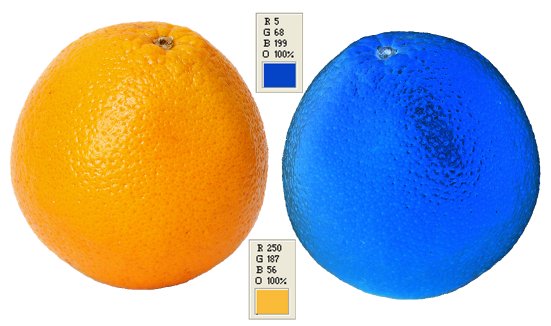
What Color Is An Orange ?


A question like that, here at science20.com, just has to be a trick question.

It is possible, by the application of common sense arguments, to prove to a scientific level of certainty that an orange is absolutely not orange.


How don't we see ?


Between 41% and 67% of participants, depending on the exact way the question was asked, thought that the eye sent out some kind of ray or beam in order for us to see.

That's not the startling bit.
   
Object
: a book      
   
Location: high shelf, exact location unknown
   
Agent: Swarmanoid, robot swarm consisting out of three types of robot.
  
Mission: Impossible?

