



Is it possible to bring up a squid-related topic about which I have nothing to say? So far, the answer seems to be no.

I'm not sure if I should be proud--or find some more hobbies.

Anyhoo, today's blog-babble is tipped off by odori-don, the dancing squid rice bowl. (That linked article includes a video, for the morbidly curious.)
This paper introduces a new model of physics. It is based on logic. It uses the congruence between the logic of quantum physics and a mathematical construct that got its name from David Hilbert. The Hilbert book model extends this construct such that fields and dynamics also fit in the new model.

Introduction

Every time when I read an article about the phenomena, which occur far from us in the universe, I'm surprised about the attention that this Farawayistan gets compared to the phenomena in the world of the smallest. Everything that happens there is dismissed with collective names such as “quantum mechanics” and “field theory”. Rarely or never the treatise goes deeper. In this sub-nano-world spectacular images, such as appear in stories about the cosmos are not available.

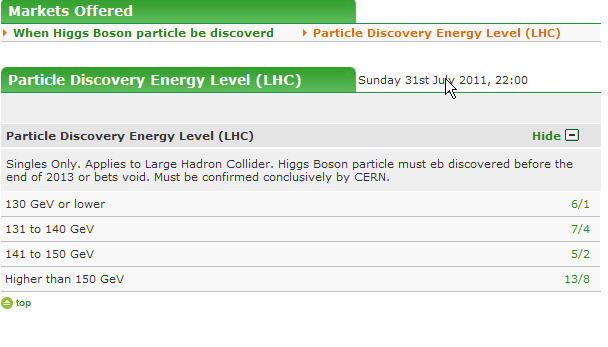
The LHC and its lower-energy counterpart in the US, Tevatron, have reported some important Higgs news this past week - details of six searches for the Standard Model Higgs boson at CERN and another in Chicago coming up.

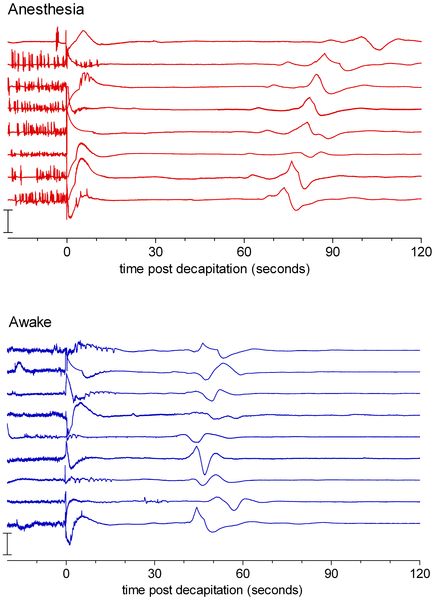
A perhaps somewhat lugubrious study, published in PLoS ONE, set out to investigate whether decapitation is a humane method of euthanasia in small animals, such as rats and birds. To do this, they used 22 rats that were decapitated while an EEG was recorded. Of these rats, 9 were awake and 8 were anesthetized (5 rats lost the electrodes during the experiment).

Not surprisingly, the EEG lost power fast and globally and decreased to about half the initial value in about 4 seconds after the decapitation. Where the EEG markedly differed between both groups before the ‘death sentence’ was carried out, it did not appear different post decapitation.  The authors present two hypotheses to explain this phenomenon:

I confess.


I had cancer.


And stem cells might be to blame!


At the relatively young age of 42, I was diagnosed with what is supposed to be an older man’s disease: prostate cancer.


How could this happen to me?  It could be the fault of stem cells.


No, I don’t mean some rogue stem cells created in my own lab that attacked me, but rather I’m talking about my own perhaps slightly imperfect stem cells that might have gone rogue.


You see scientists are realizing that for many, but not all cancers, a unique type of stem cell called a “cancer stem cell” might be to blame.

In the last few days I described in some detail (here and here) the six searches for the Standard Model Higgs boson just produced by CMS, the experiment at the CERN Large Hadron Collider to which I proudly belong.
You know how you'll be swimming along (metaphorically), going, well geez, things are going pretty well, knock on wood? And then, bamm! You say those words, even invoking superstitious protections, and you're hit with anecdotal evidence that you spoke too soon?

I'm just saying, it seemingly never fails to happen. Of course, that might be more to do with the reality that life is constantly on an up and down roller coaster ride of events and when we're in a high or in a low, it can be hard to see that it's been something else and will be again.
There's a giant ceramic squid in a New York art gallery.
Walking into the gallery, you encounter the 16-foot-long, beached creature, its opalescent, slick-looking flesh seeming to putrefy, lying in a puddle of its own ink. You expect its tentacles to quiver in a final death-throe.
Despite the distraction of seeing the singular form of "throe" for the first time in my life, that's still a pretty striking image.
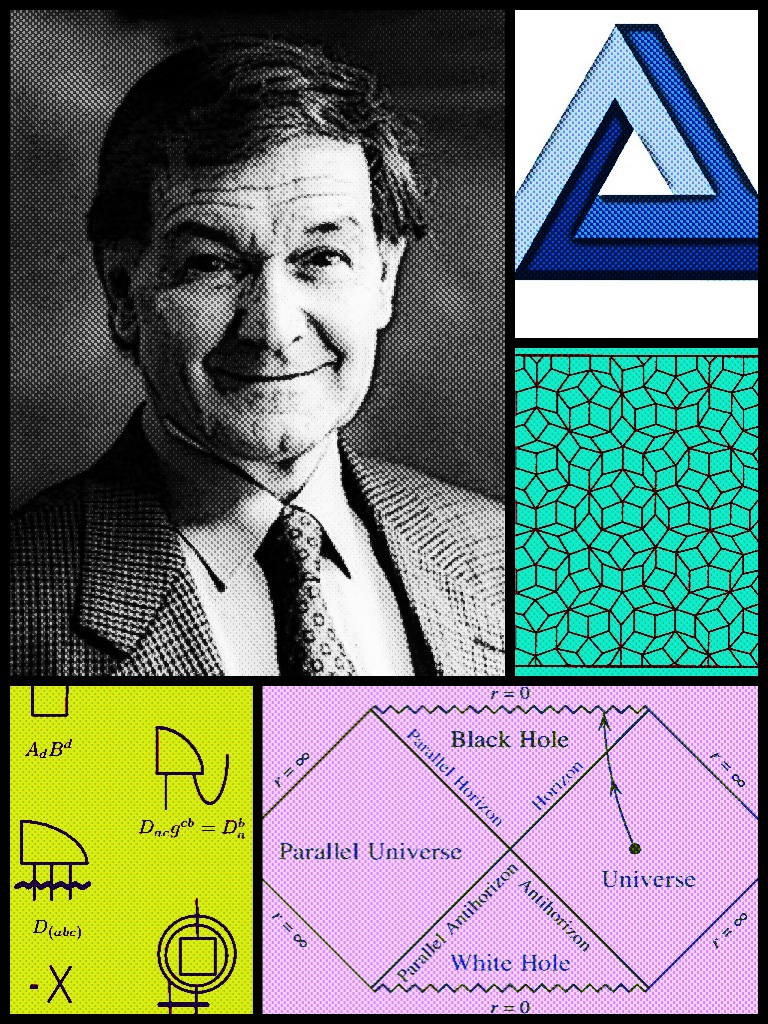
Equations don't sell. Pop science editors tell us that each equation added to a book halves its sales figure. If this is true, Sir Roger Penrose's Cycles of Time, which was recently released in the US, and which I can testify sold at least one copy, would have sold by the billions if only the editor would have scrapped half of the equations.

