

Banner
    Five New Higgs Searches By CMS!
    By Tommaso Dorigo | July 22nd 2011 11:11 AM | 13 comments | Print | E-mail | Track Comments
    About Tommaso

    I am an experimental particle physicist working with the CMS experiment at CERN and the CDF experiment at Fermilab. In my spare time I play chess...

    View Tommaso's Profile
    An orgy of new results has started. Let me just show a few of them concerning Higgs searches in CMS - I am on vacation after all, and I have little time left to comment these interesting new papers and plots after all the sunbathing and restaurants.

    Let us start with the Higgs search in the diphoton decay mode by CMS (paper here). With 1.09 inverse femtobarns of data, CMS has a pretty good reach even to this very rare decay mode of the Higgs boson. Let me remind you that only a handful every thousand Higgs particles decay into two photons, in the most favourable circumstances.
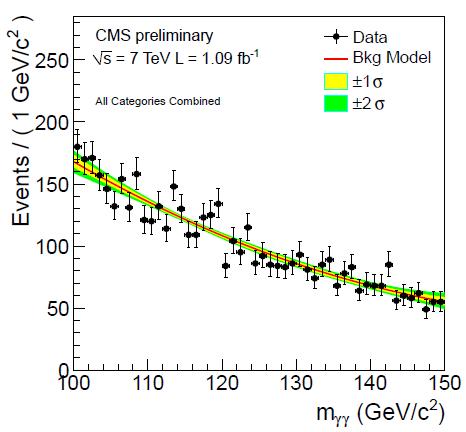
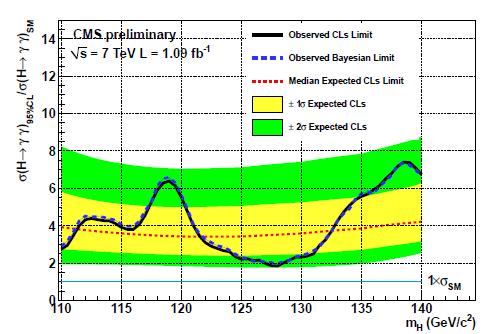
    The diphoton mass spectrum is shown on the right, with a background model overlaid. Nothing sticks out -and nothing should, since one inverse femtobarns is just a bit too little data yet; a Higgs signal with a rate 10 times the SM would however show well here, as a five-bin bump or so evident above the smooth background. The limit on the cross section for Higgs production (computed in units equal to the SM cross section, such that a limit going below 1.0 at some mass point means that the particle cannot have that particular mass value) is tantalizingly close to start eroding our faith that the Higgs boson does exist, somewhere in the sought mass range. You can check this in the figure below.


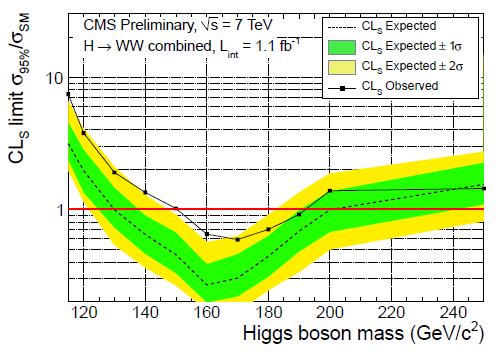
    Now let us go on to the H decay into W boson pairs (paper here). Here, an exclusion of a wide mass range does occur -and yet, funnily enough things do not go as planned; the observed exclusion range is much narrower than expected, as you can check in the relative Brazil band plot below. The observed limit (using the CLs statistics and the multivariate analysis -you must read the paper to understand some detail about these things) extends from 150 to 193 GeV, but the analysis was expected to have a median exclusion power ranging from 130 to above 200 GeV! Does this mean that real Higgs bosons are contaminating the sample at some particular mass point ? We will know soon.

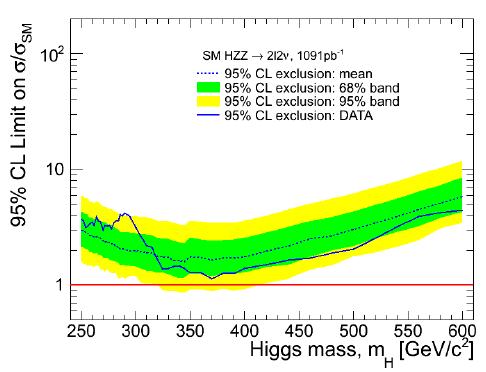
    Further, let me show the results of one Higgs search performed by CMS in the ZZ final state (paper here. In this case CMS looked for two charged leptons (from one Z) plus significant missing transverse energy (from the other Z going into a pair of neutrinos -something which Z bosons do twice as frequently). The branching fraction of Higgs to Z boson pairs in the SM, together with the small branching fraction of Z bosons into leptons, makes this final state less sensitive than the one discussed above, but it is still interesting to go look, for the time being just in the high-mass region where backgrounds are very small and the sensitivity is larger. The results are shown below, again in the form of a 95% confidence-level limit on the signal cross section in unit of the Standard Model prediction. As you see, there is no region where the Higgs boson gets excluded, although the result is close to that goal in the mass range 350-400 GeV.


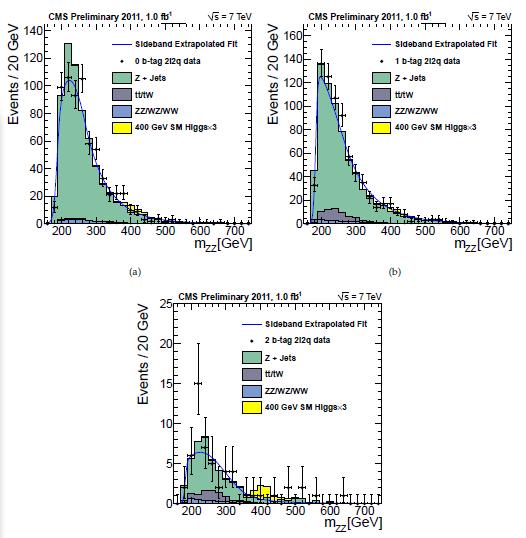
    Now, if you are not too tired yet, let us see what CMS finds in another possible final state of the H->ZZ decay: the one including two charged leptons and two jets (paper here). Here, the two jets coming from a hadronic decay of one of the two Z bosons increase the possible yield significantly, since the probability of a Z decaying hadronically is 70% -over ten times higher than the probability of a decay to electron or muon pairs combined. Further, since in 40% of the cases the two quarks are heavy ones -charm or bottom-, it makes sense to consider the case when the resulting jets contain secondary vertex information; the heavy flavour hadrons produced in the heavy quark fragmentation in fact live long and can give rise to secondary vertices, plus they also decay to soft leptons. All this information can be used to identify them, strongly reducing the background from QCD Z+jets production, where the jets accompanying a leptonically-decaying Z boson are very rarely coming from heavy quarks.

    The figure below shows the invariant mass of the pair of Z boson candidates (one reconstructed from the lepton pair, the other from the jet pair) observed in the data, after dividing the data into events with zero, one, or two b-tags. As you can see, a Higgs signal with three times the rate of the predicted SM Higgs (for a mass of 400 GeV chosen for illustrative purpose only) would produce almost no visible signal in the zero- and one-b-tag categories, while it would give some indication in the two-tag category.


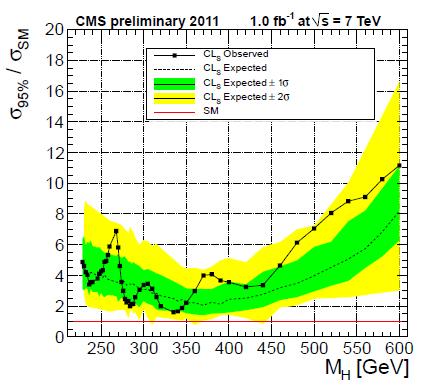
    From the agreement of data and total background prediction, a 95% CL upper limit on the Higgs cross section, again computed in units of the predicted Standard Model rate, is derived as a function of the unknown mass of the Higgs boson -see below. As in the former analysis, here too there is no exclusion yet, but the limit is also close to the line at 1.0 (where an exclusion would result).


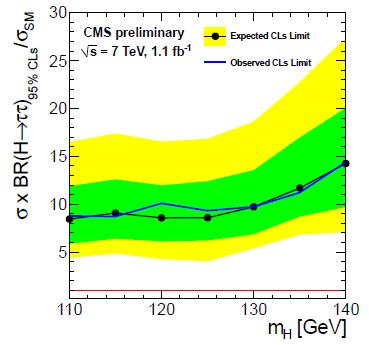
    Finally, I just flash the result obtained by CMS in the search for Higgs boson decays to tau lepton pairs (paper here). Why tau pairs ? Well, because tau leptons are heavy -at 1.77 GeV they are much heavier than electrons and muons. The Higgs boson decays more readily in tau pairs than in other fermion pairs (except bottom quarks), because of its coupling proportional to the mass of the fermion. You should also know that tau leptons are much harder to detect than electrons and muons; however, they can still be seen in the large background (mainly due to fake tau leptons and to the Drell-Yan continuum). Much better than one could ever see the Higgs decay to bottom-quark pairs anyway -the latter is utterly unobservable in the huge QCD background.

    To search for the Higgs in the tau-pair decay mode, CMS makes use of two different production processes: the one called "direct", whereby the Higgs is produced alone, and the one called "vector-boson fusion", whereby the Higgs is produced through the fusion of two W or two Z bosons. In this latter case, there are two forward-going hadronic jets accompanying the Higgs, so the event is better recognizable -at the expense of a smaller total rate.The search obtains a good agreement with backgrounds, and no hint is seen of the presence of signal decays. The resulting upper limit is shown below: in this case there is still the need of more data before the search becomes sensitive to the Standard Model Higgs.


    To conclude, let me say that I am eager to see a combination plot which puts together all the information above, plus other which I have been unable to report on yet. Once these results are further combined with ATLAS ones we will have a much more clear picture of where, if anywhere, the Higgs boson can still hide (hint: the 114-130 GeV region is still rather safe). Stay tuned!


    Comments

    Daniel de França MTd2
    Tommaso,
    Is it possible to informally combine Tevatron and LHC data?
    Figure H->WW has been made by one particular method of event-selection. CMS shows two plots in the paper: cut based and multivariate analysis @ same luminosity, but they are little bit different between 140-160 GeV.

    Perhaps, if we go close to 2 fb^{-1}, is it reasonable to think that both methods will "converge" to same plot (without differences) at higher statistics?

    Thanks,

    Nick

    dorigo
    Hi,

    Daniel, no, it requires the full likelihood. Or rather, it depends on what you mean by "informally". Since both experiments are just claiming exclusions, however, I would be rather uninterested in a combination.

    Nick, true, there are two methods, but they sort of agree. I would only look at the one which claims the best "median exclusion", until things get more interesting. So I do not worry about them being still different.

    Best,
    T.
    Daniel de França MTd2
    Hi Tommaso,
    I meant something like this:

    http://blog.vixra.org/2011/07/23/higgs-combos/

    So you can exclude everything above 130 GeV? How long do we wait for that annoying 114-130 GeV window to close?

    No collision 'on earth' can bring out Higgs. I literally mean 'on earth', because these are not the condition which can take us back to the so-called big bang. Further, Higgs is theory. In practice gravity is due to particles whose spin is of course 0, but the rest is not so definitive as being thought in the SM.

    The Stand-Up Physicist
    Nature.com has a report about the Higgs. They say the best candidate is 130-150 GeV. DailyKos.com is also reporting about the 260 GeV signal. Tommaso's report show the actual data, while these two are summaries. I will put my t-shirts in the attic, and take a photo of the collection, if/when we get to a 5 sigma signal.
    Hi, I only wanted to point out that there are some problems with the low GeV Higgs data. Summing over the entire expected Higgs width in the now most likely 140GeV mass gives better S to N than in the ATLAS/CMS presentations, and so I do that here. There is a an aproximately 3sigma signal for a 140GeV Higgs boson in the ATLAS and CMS WW channel, but its a bit too broad, and theres a 2sigma signal outside the Higgs window as well, indicating this could be a false backgound (which would have to be common to both CMS/ATLAS, so its either a theoretical error in the backgound estimation or LHC is not delivering quite what was expected).

    There is a bigger problem in the gammma/gamma channel, which for the near future is the only significant check on the WW channel. Both CMS and ATLAS show local excesses, but they are in mutually exclusive regions. The CMS shows excess at up to 2sig at greater than 135GeV and less than 120GeV, and a deficit up to 2sig in 122-132 GeV, ATLAS shows an excess up to 2sig in 126-132GeV, and almost 0sig in 132-147GeV. There are 14 Higgs events expected in this channel, with sigma=17 events, so a 1sig signal is expected now, while combining ATLAS and CMS results points to 0sig. In 3 months 2sig will be expected. If the trend in this channel continues, the Higgs is in trouble in this channel. Do you agree?

    dorigo
    Hi Anon,

    I do not agree. I think the fluctuations you highlight are normal, and in fact quite likely if one considers that this search overall invests a 500-GeV range. I also think that once we will get enough data to be really sensitive to the gamma-gamma final state, things will change, in that fluctuations will be less important with respect to the expected signal. As for the possibly mismodeled background, I think it is within uncertainties.

    Time will tell... I think these analyses have been done well. They involved the coordinated effort of about 100 skilled physicists in ATLAS and CMS, and they underwent careful scrutiny. Fluctuations cannot be a source of doubting of the good work these people have done.

    Best,
    T.
    Hi Tommaso,

    Thank you for your response. I think the physicists at CMS (and ATLAS) dis a wonderful job to put together such a complex experiment, to make the results so accessible, and in such a short time. I did not mention it because I took it as granted. It is very diffferent from 20 years back when I was doing my PhD. Back then the Z0 factory (LEP) was about to start up, and I was modelling QCD events for it. One of the major functions of LEP, as we theorists envisaged at the time, was to serve as a precision test of QCD. Now all that has been done, there is almost no doubting QCD anymore (and there was little doubting even then), and the last big test of the standard model is the Higgs boson, a key test of EW. I, and quite a few others, have always considered this to be a much more question than anything else in the SM. This particle has been postulated because this is the only sensible way likely to agree with experiment to make EW theory renormalizabile and unitary. However a global field with a non zero VEV giving a mass to everything seems like a very radical way to achieve it. There have been no better candidates (technicolor suffers from even bigger problems). Without it there is a gaping hole in the theory. If the boson is found its a huge tribute to people like Weinberg, Salam and Higgs. However whether it is found or not has no bearing onis no blemish on the work the people at CMS have done, it will be a service to physics either way.

    In my comment I wanted to point out (and if others are interested engage in a dialogue) that with a favoured mass emerging from the present LHC data, it makes sense to integrate over the Higgs width at the proposed mass to improve the S to N. Then it comes out that the signal that both ATLAS and CMS have seen is 3sig and spot on with a SM Higgs in the WW channel at about 140GeV. Its only problem is that it is too wide,since there is a 2sig 'signal' outside the expected Higgs width of 60GeV. This might go away in 3 months time with more data, in which case it would be a huge boost for the Higgs. If it does not, then there are things to worry about. Predicting the background is a bit of an art, and Kyle of ATLAS has said so publically. It is a wonder that it has been predicted this well for the W+W- channel, which after all is fairly new. Any error in the theoretical background (as opposed to statistical errors) will be systematic, and will add up to a signal, which will exceed any number of sigmas in a matter of time. A signal such as 3sig already in the WW channel is unlikely to go away in 3 months time unless the present cuts are changed, so the main test in the WW channel will be its width. In 3 months it must be not be too wide outside the Higgs window.

    Whatever the size of signal in the WW channel it is not the SM Higgs if there is nothing in the gamma/gamma channel. At the moment ATLAS shows a 1sig deficit in the 135-150 GeV range where CMS has found its excess. This is a problem, since a 1sigma signal is now expected over the Higgs width in that channel, so ATLAS is actually 2sig down on the Higgs at 140GeV. This is a running commentary of course - much like on election night, and things can change - but there is a trend. If in 3 months ATLAS reverses this to a 1sig excess say, and the width in the WW channel improves, I think people will start thinking there is a Higgs there.

    dorigo
    Hi Leonard,

    I have grown wary of 2- and even 3-sigma bumps over time. The problem here is that we do not know where to look, so we are bound to see some excess somewhere. I therefore do not assign much meaning to these fluctuations. Really, the 5-sigma requirement for a particle to be discovered is all about addressing the fact that one often bumps into a bump while searching something else, or searching it somewhere else.

    I think that even when we'll have found the Higgs -if it is there!-, we will be in a situation where for a lot longer we will not be definitely sure about its nature. We will need to produce measurements of the branching fraction to gamma pairs, W pairs, Z pairs, taus and b-quarks, as well as cross section measurements. Only then will we be able to draw meaningful conclusions. For now it is just a game...

    Cheers,
    T.
    Hi Tommaso,

    I would have to disagree with you. The SM tells us where to look for the Higgs, the WW, the gam/gam, the tau/tau channels, they all come from theory. If the SM Higgs is there thats where we have to find it. Else its not the SM Higgs, and Weinberg and company can return back their prizes. A very bad thing to do would be to trim where we look. For instace if in the next release of data, ATLAS and CMS where to impose severe cuts outside 90-150GeV in the WW channel so that we do not see disagreement between the theoretical background and the observation outside the Higgs window. Its precisely the agreement of the theoretical background with observations in the region where there is no Higgs that will give us confidence that where we do see a 'signal', it may be a new particle. As I wrote before, 3sig, 5sig, 10sig, means nothing if you have a systematic error such as a false theoretical background. In that case achieving such a 'signal' will be just a matter of time. That why independent confirmation from a different channel is so important, and the best candidate this year I think is the gam/gam channel. Personally speaking I would be very surprised if there really is a SM Higgs. I just dont think we are as clever as some people think we are. And like Veltman said, we are just going to have to learn how to do strong interaction physics (which EW will become without a Higgs).

    Add a comment

    The content of this field is kept private and will not be shown publicly.
    • Allowed HTML tags: <sup> <sub> <a> <em> <strong> <center> <cite><TH><ul> <ol> <li> <dl> <dt> <dd> <img> <br> <p> <blockquote> <strike> <object> <param> <embed> <del> <pre> <b> <i> <table> <tbody> <div> <tr> <td> <h1> <h2> <h3> <h4> <h5> <h6> <hr> <iframe><u><font>
    • Web page addresses and e-mail addresses turn into links automatically.
    CAPTCHA
    If you register, you will never be bothered to prove you are human again. And you get a real editor toolbar to use instead of this HTML thing that wards off spam bots.
