Too lazy to exercise? In a world full of concern about global warming and estrogen in rivers and anti-vaccine hippies trying to bring back polio, science has some good news for a change; even if you are sedentary, a glass of red wine may offset some of the effects just like exercise would.
A new study in the FASEB Journal suggests that resveratrol in red wine may prevent the negative effects of a sedentary lifestyle, which is good news for couch potatoes and even astronauts. The report describes experiments in rats that simulated the weightlessness of spaceflight, during which the group fed resveratrol did not develop insulin resistance or a loss of bone mineral density, as did those who were not fed resveratrol.
Botany: A Blooming History
And now we return to part one of this series
Our own body is covered with entire (albeit tiny) ecosystems. Incredible numbers of bacterial strains live in and on the human body. And the belly button seems to be a place extraordinarily rich in bacterial passengers. The Belly Button Biodiversity Project took samples from the navels of volunteers and went to work, performing DNA analysis on the bacteria that were found there.
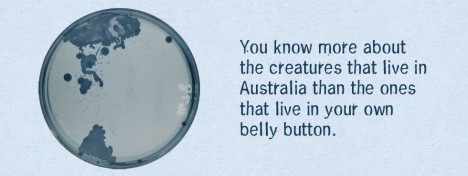
(Source: Belly Button Biodiversity Project)
History Mysteries #1 - Who Shot The Tomatoes?
or
The Astonishment of a Sailor on Finding Buckshot in His Portion of Tomatoes.
Hidden in the details of the Jeannette Expedition one finds a factor in common with the Franklin Expedition: lead poisoning.
The Jeannette Expedition
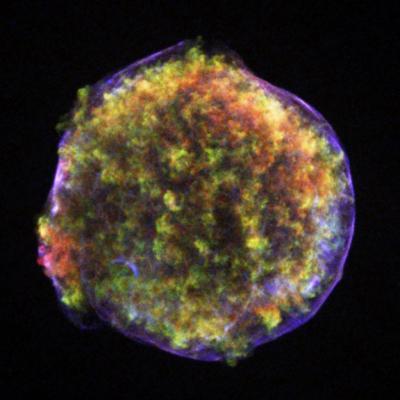
According to an astrophysicist at UC Santa Barbara, 'zombie' stars may be a way to measure dark energy. Type Ia supernovae are stars that have been observed since 1054 A.D., when an exploding star formed the crab nebula, a supernova remnant.
Theoretical dark energy should make up about three-fourths of the universe, says Andy Howell, adjunct professor of physics at UCSB and staff scientist at Las Cumbres Observatory Global Telescope (LCOGT).
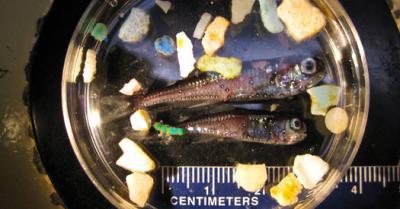
An article in Marine Ecology Progress Series found evidence of plastic waste in more than nine percent of the stomachs of fish collected during a recent voyage by graduate students from Scripps Institution of Oceanography at UC San Diego to the North Pacific Subtropical Gyre - also known as the "Great Pacific Garbage Patch.".
Based on their evidence, authors Peter Davison and Rebecca Asch estimate that fish in the intermediate ocean depths of the North Pacific ingest plastic at a rate of roughly 12,000- to 24,000 tons per year.
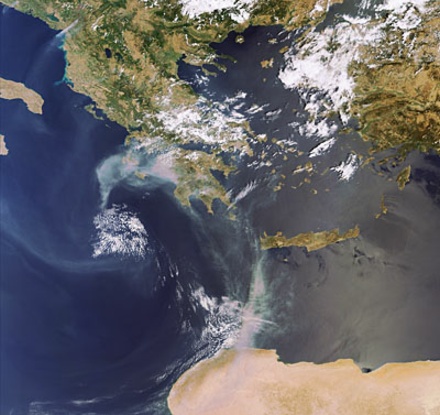
As airplanes fly through clouds, they can punch holes through those with supercooled water, or water that has remained in liquid form below its freezing point and researchers are now saying this phenomenon can lead to increased snowfall around the world's major airports.
The effect is similar to cloud seeding, which has been controversially used past to influence precipitation, but a new study in Science says that private and commercial flights have been drilling holes and canals through clouds all along, influencing the snow and rainfall below them.
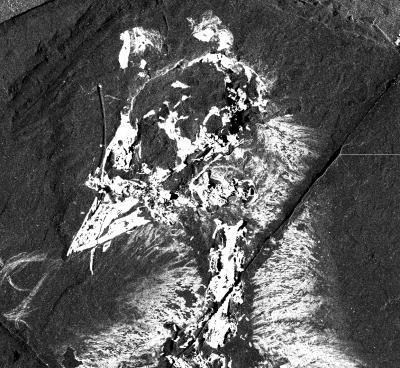
Using the Stanford Synchrotron Radiation Lightsource, researchers have examined two fossilized birds, Gansus yumenensis and
Confuciusornis sanctus. Confuciusornis sanctus , which lived 120 million years ago, was one of many evolutionary links between dinosaurs and birds, sporting the first known bird-like beak. Gansus yumenensis, considered the oldest modern bird, lived more than 100 million years ago and looked a bit like a modern grebe.
How easy is it to falsify memory? Perhaps as easy as a little bit of social pressure, according to research at the Weizmann Institute.
In a forthcoming Science study, they show a unique pattern of brain activity when false memories are formed – one that hints at a surprising connection between our social selves and memory.
The experiment took place in four stages. In the first, volunteers watched a documentary film in small groups. Three days later, they returned to the lab individually to take a memory test, answering questions about the film. They were also asked how confident they were in their answers.