

A new psychology paper evolution and basic survival techniques adapted by early humans influence the decisions gamblers make when placing bets. 

So if current counseling options for problem gamblers don't work, we can blame biology.

The scholars examined how gamblers made decision after they won or lost. They found that  gamblers relied on their past experiences to predict what might happen in the future. But in games of chance where the outcome is completely random, this strategy doesn't work.

Electrically charged lunar dust near shadowed craters can get lifted above the surface and 'jump' over the shadowed region, bouncing back and forth between sunlit areas on opposite sides.

Ancient rises in sea levels and global warming are partially attributable to cyclical activity below the earth's surface, according to a new analysis of geological studies. 

New York University's Michael Rampino and Carleton University's Andreas Prokoph analysis considers long-term fluctuations in global climate, diversity of marine organisms, and sea level changes, aiming to identify a unifying cause for these changes. While much scientific study has centered on phenomena above the earth's crust, less attention has historically been paid to changes deep inside our planet.

Engineers at the University of Sheffield have been doing some science of rugby - measuring the dynamic friction between the material of the ball and the skin on the fingertips and palm, and the mitts that some players choose to wear under different weather conditions to find the best way to limit the risk of a player fumbling the ball.

In a first, a whale skeleton has been found on the ocean floor near Antarctica, almost a mile below the surface in an undersea crater. With it were at least nine new species of deep-sea organisms thriving on the bones. 

A new paper in Molecular Pharmacology describes how 'reverse pharmacology', enabled by Heptares Therapeutics StaR(R) technology, can be applied to and accelerate GPCR-based drug discovery.

The paper utilized the study of isolated GPCRs locked in conformations that correspond to agonist or antagonist pharmacology, and the elucidation of their respective 3D structures. These StaRs and structures can be used to select and design compounds with specific pharmacologies, such as inverse agonist, partial agonist or full agonist, based on their ability to bind differentially to the agonist and antagonist StaRs. For example a full agonist will preferentially bind to the agonist StaR. 

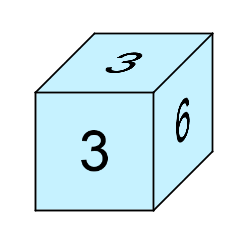
Alice wants to play a game with Bill. She has just bought some new and rather strange dice. The average of each die is 3.5, just like a normal playing die, but the numbers on each face have an unfamiliar distribution.

Die P has the numbers 3, 3, 3, 3, 3, 6.
Die Q has the numbers 2, 2, 2, 5, 5, 5.

The game itself is very simple: whoever rolls the highest total wins a sweet from the candy box. If the box becomes empty, the winner can take one from the other player’s pile.
Since today is a celebration of St. Patrick, the religious figure who 'drove the snakes out of Ireland' (meaning Paganism), a whole lot of people got drunk last night.  

Yeah, Protestants getting drunk the night before before a Catholic religious festival makes as much sense as anything else about St. Patrick's Day. In addition, kids in California get something magical in their shoes, which puzzles me too. I never heard of that when I was a kid but the rural area I grew up in was a delightful mix of people descended from residents of Scotland and Eastern Europe so there weren't a lot of magical pots of gold lying around - if an Irishman came along asking about our shoes the reply was going to be sent at muzzle velocity. 
The title should be: Reformulating the Postmodern Core Insight versus Consistency as Absolute Meta-Truth:  Last Bastion against New Totalitarianism - or some such, however, the software does not support the length.  Anyway, let us start:

Can anything fundamental be described and what is the, potentially undesired, outcome if we should succeed?


The Lazarus Project team says they have been able to recover cell nuclei of the extinct gastric-brooding frog, Rheobatrachus silus,
from tissues collected in the 1970s and kept for 40 years in a conventional deep freezer. 

The genome of
Rheobatrachus silus, extinct since 1983, has been revived and reactivated by a team of scientists using
somatic cell nuclear transfer
to implant a "dead" cell nucleus into a fresh egg from another frog species.
 

Rheobatrachus silus is famous for swallowing its eggs, brooded its young in its stomach and giving birth through its mouth. The "de-extinction" project aims to bring the frog back to life.


