



Thanks to No Child Left Behind, the gender gap in math skills tests disappeared for the first time in history.  But a new paper says the issue might never have been there if the format for math competitions was different - rather than one-shot events, switch to rounds.

Twenty-four local elementary schools in a 
Journal of Economic Behavior&Organization article changed the math format to go across five different rounds. Once the first round was over, girls performed as well or better than boys for the rest of the contest.

International publisher Elsevier has announced the launch of InOrder, a cloud-based order sets solution that enables clinicians to author, review and publish orders in a collaborative environment that quickly translates evidence-based knowledge into better patient care. 

The tool has evidence-based content and the capability to make updates rapidly as regulations and medications change, so Elsevier says InOrder can help hospitals and clinicians increase patient safety and prevent medical errors. 

Because I signed a petition asking for increased open access of studies, I got an email from White House Science Czar Dr. John Holdren today - don't get excited, after all of the mean things I have said about him he is not suddenly writing me personally, it was a mass email - saying they had 'listened' and were making some changes, a letter we all knew was coming.

It reads, in part:   
CMS is one of the two huge detectors built to study the high-energy collisions of protons produced by the Large Hadron Collider at CERN. As all previous collider detectors, CMS is a redundant multi-purpose collection of dozens sub-detector components, which use different physics mechanisms to detect everything that comes out of the collision point, from protons to muons to photons, neutrinos (using the energy imbalance in the calorimeters), neutral hadrons.

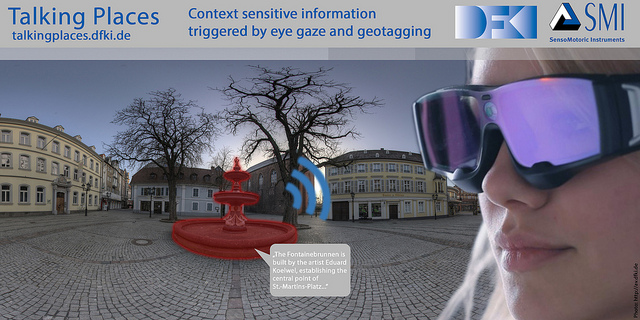
SensoMotoric Instruments (SMI) and the German Research Center for Artificial Intelligence (DFKI) discuss new augmented reality applications which trigger information by eye gaze. Eye tracking technology by SensoMotoric Instruments (SMI) was used by researchers from the German Research Center for Artificial Intelligence (DFKI) to develop a vision of new augmented reality applications in mobile environments.

These applications use eye tracking data from SMI's mobile eye tracking glasses to analyze a user's eye gaze on objects, buildings or persons. A special DFKI information processing technology detects patterns of attention and presents additional information on objects of interest to the person wearing the glasses.  

Researchers analyzed strains of mold fermented in sourdough bread and were able to isolate natural compounds that can help keep bread fresh without changing its flavor, resulting in a tastier loaf.

Michael Ganzle, professor and Canada Research Chair in the University of Alberta Department of Agricultural, Food and Nutritional Science and fellow researchers say the natural compounds can replace preservatives added to store-bought bread which are safe to eat and extend shelf life, but alter the taste.

What are the functions of smiling, specifically, the functions of smiling in relation to laughter? Dr. Markku Haakana [pictured here, not smiling], from the Department of Finnish, Finno-Ugrian and Scandinavian Studies, at the University of Helsinki, Finland, explains:

“(i) Smiling can be used as a pre-laughing device: laughing together can be entered step-wise, and smiling is a common device for paving the way to the laughter. (ii) Smiling can be used as a response to laughter in the previous turn.”


Dear Squid of the World,

Excuse me. What is this? I have been your friend and advocate for years. No, DECADES. (Two, to be specific.) I have championed your cause to family and friends, students and total strangers. I wore the shirts. I read the books. I even got a PEE AITCH DEE in the science of baby squid. I think I've earned a modicum of consideration. A smidgeon of thoughtfulness.

But no. I go on maternity leave to care for my firstborn and what do you do? Everything

Researchers with National Renewable Energy Laboratory (NREL), one of the U.S. Department of Energy's (DOE) labs, say that the United States can double its energy productivity by 2030 — and do so in ways that bolster the nation's economy.

Unveiling their recommendations at the National Press Club in Washington, D.C.,  NREL Director Dan Arvizu and a blue-ribbon panel of 20 energy experts drove that message home, declaring that the United States and other members of the Alliance to Save Energy (ASE) Commission on National Energy Efficiency Policy said that doubling energy productivity could create a million new jobs, while saving the average household $1,000 a year and reducing carbon-dioxide emissions by one-third.

The base pairs that hold together two pieces of RNA, the older cousin of DNA, are some of the most important molecular interactions in living cells. Many scientists believe that these base pairs were part of life from the very beginning and that RNA was one of the first polymers of life. But there is a problem. The RNA bases don't form base pairs in water unless they are connected to a polymer backbone, a trait that has baffled origin-of-life scientists for decades. If the bases don't pair before they are part of polymers, how would the bases have been selected out from the many molecules in the "prebiotic soup" so that RNA polymers could be formed?

