


About ten percent of all cases of malignant melanoma are familial cases. The genome of affected families tells scientists a lot about how the disease develops. Prof. Dr. Rajiv Kumar of the German Cancer Research Center (Deutsches Krebsforschungszentrum, DKFZ) together with Prof. Dr. Dirk Schadendorf from Essen University Hospital studied a family where 14 family members were affected by malignant melanoma.

Decentralization is the greatest challenge facing energy companies in Germany - directing energy efficiently has become more important than how much to produce. 

"Distribution System Operators (DSO) and energy companies are working feverishly on various new models and technologies to ensure the right amounts of energy get to the right places at the right times, as well as attempting to pre-empt looming new questions," said Tobias Rothacher, Senior Manager of Renewable Energies and Resources at Germany Trade&Invest.

Electric cars of the future will present a whole host of new riddles in power availability that will need answering, as will eventual turns to electric forms of heating and/or cooling. 

The “coffee-ring effect” is a commonplace occurrence that happens when drops of liquid with suspended particles dry, leaving a ring-shaped stain at the drop’s edges.

How those particles stack up as they reach the drop’s edge, and how different particles make smoother or rougher deposition profiles at the drop edge depending on their shape, is the subject of a new study from Penn and the growth profiles they found offer tests of deep mathematical ideas about growing interfaces.

A new study details changes in Earth's climate from more than 100,000 years ago and indicates that the last interglacial, the term for the periods between "ice ages", was warmer than previously thought. 

The research findings also indicate that melting of the massive West Antarctic ice sheet may have contributed more to sea-level rise at that time than melting of the Greenland ice sheet.

Can anyone ever truly take credit for a discovery? Every researcher stands 'on the shoulders of giants', as Sir Isaac Newton said. Scientists talk to each other and argue and hone their thoughts based on the criticisms and reactions they get. No one lives in a bubble and great things happen when a lot of smart people know each other and debate as often as possible.

But when the debates are well-known, it's difficult to assign credit and far too easy to take it away. In modern times, tearing down statues of giants and standing on the rubble happens more often than standing on their shoulders and reaching new heights. And everyone wants to stand on the rubble of Albert Einstein.

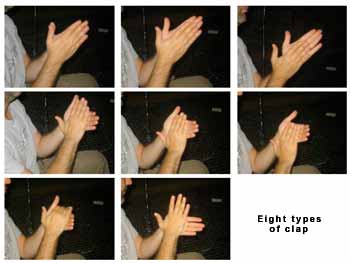
“Hand claps are a relatively primitive conveyor of sonic information, yet they are widely applied for different purposes.”

The DZERO collaboration has released last week the result of their search for the rare decay of B_s mesons into muon pairs, based on the full statistics of proton-antiproton collisions acquired during Run II - a total of 10.4 inverse femtobarns of integrated luminosity.


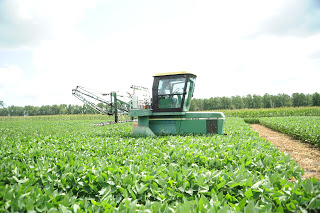
Does the adoption of GM crops lead to more or less pesticide use?  This is a frequent topic of debate, but generally one that misses the point.  Both sides make the same erroneous assumption that all pesticide use is, by definition, a bad thing.  

We love our modern gadgets, so we sometimes forget we still have an energy problem our Founding Fathers faced - and it impacts everything from the usability of solar power to the uptake of electric cars also.

The remains of a calcified ovarian teratoma in the pelvis of the skeleton of a woman from the Roman era confirms the presence in antiquity of this type of tumor - formed by the remains of tissues or organs, which are difficult to locate during the examination of ancient remains.

Inside the small round mass, four teeth and a small piece of bone were found.
