




It's easy to blame weather forecasting when the forecast says one thing and ends up being another, but Brigham Young University mechanical engineering professor Julie Crockett says it may not be the fault of the meteorologists. 

According to Crockett, forecasters make mistakes because the models they use for predicting weather can't accurately track highly influential elements called internal waves.

Atmospheric internal waves are waves that propagate between layers of low-density and high-density air. Although hard to describe, almost everyone has seen or felt these waves. Cloud patterns made up of repeating lines are the result of internal waves, and airplane turbulence happens when internal waves run into each other and break.

Concern that many animals are becoming extinct before scientists even have time to identify them has led to some exaggeration, according to Griffith University researcher Professor Nigel Stork.

A number of misconceptions have fueled these fears, Stork said, and there is no evidence that extinction rates are as high as some have feared.

"Surprisingly, few species have gone extinct, to our knowledge. Of course, there will have been some species which have disappeared without being recorded, but not many we think," Professor Stork said.

Professor Stork said part of the problem is that there is an inflated sense of just how many animals exist and therefore how big the task to record them.

Epigenetics is a nascent, exciting field and due to its broad scope, it is used to rationalize the 'it might be so' potential of the mundane (evolutionary psychology) to the silly (social psychology) but some new research reveals a potential way for how parents' experiences could be passed to their offspring's genes. 

Epigenetics is a system that turns our genes on and off. The process works by chemical tags, known as epigenetic marks, attaching to DNA and telling a cell to either use or ignore a particular gene. The most common epigenetic mark is a methyl group. When these groups fasten to DNA through a process called methylation they block the attachment of proteins which normally turn the genes on. As a result, the gene is turned off.

Northwestern University graduate student Jonathan Barnes and colleagues are the first to permanently interlock two identical tetracationic rings that normally are repelled by each other.

Some experts had said it couldn't be done. 

On the surface, the rings hate each other because each carries four positive charges (making them tetracationic). But they discovered that by introducing radicals (unpaired electrons) onto the scene, the researchers could create a love-hate relationship in which love triumphs.

Unpaired electrons want to pair up and be stable, and it turns out the attraction of one ring's single electrons to the other ring's single electrons is stronger than the repelling forces.

You know how your grandfather could tell a storm was coming by an ache in his knee? University of Cincinnati researchers say lightning may affect the onset of headache and migraines.

Geoffrey Martin, fourth-year medical student, and his father Vincent Martin, MD, professor in the division of general internal medicine, led the study which showed that there was a 31 percent increased risk of headache and 28 percent increased risk of migraine for chronic headache sufferers on days lighting struck within 25 miles of study participant's homes.

In addition, new-onset headache and migraine increased by 24 percent and 23 percent in participants.

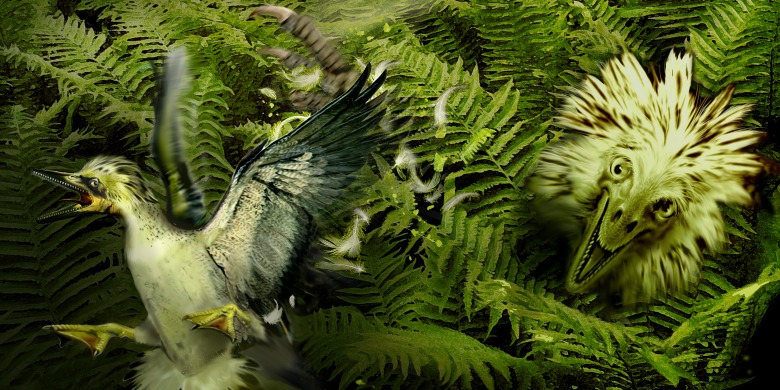
Fossilized teeth have led to identification of at least 23 species of small meat-eating dinosaurs that roamed western Canada and the United States between 85 and 65 million years ago, a large increase from the 7 species of small two-legged meat-eating dinosaurs from the North American west that had previously been identified.

The researchers examined a massive dataset of fossil teeth that included samples from members of the families to which Velociraptor and Troodon (possibly the brainiest dinosaur) belong.

While many people believe they can multitask, a new paper indicates yet again that people who multitask the most, including supposedly easy things like talking on a cell phone while driving, are least capable of doing so.

Since this is a psychology study, it involved putting 310 undergraduate psychology students who wanted extra credit through a series of tests and questionnaires to try and measure actual multitasking ability, perceived multitasking ability, cell phone use while driving, use of a wide array of electronic media, and personality traits such as impulsivity and sensation-seeking. The key findings:

Antidepressant prescriptions in the UK increased by 9.6% in 2011, to 46 million prescriptions. Since that is for a total of only 63 million people in the last census, a lot of whom are children, the antidepressant prescription total is quite high.

But does that reflect over-medication or appropriate treatment for better diagnoses? 

An international team of researchers sequenced nuclear and mitochondrial DNA that had been extracted from the leg of an early modern human from Tianyuan Cave near Beijing, China and found that the human from 40,000 years in China is related to many people on multiple continents.

Analyses of this individual's DNA showed that the Tianyuan human shared a common origin with the ancestors of many present-day Asians and Native Americans. In addition, the researchers found that the proportion of Neanderthal and Denisovan-DNA in this early modern human is not higher than in people living in this region nowadays.

Some people believe in magic. In Science Left Behind, in the process of debunking claims that one American political party is overwhelmingly pro-science and one is anti-science,  we put a handy chart on page 213 itemizing the various anti-science positions of registered voters.  Sure, evolution and climate change was higher on one side but the list of anti-science beliefs by the other side was as long as your arm - astrology, psychics, ghosts, UFOs, homeopathy, you name it and that global-warming-accepting party is more anti-science - they just have better public relations.
