






In America, the government banned incandescent light bulbs, convinced that if they banned them, the free market would replace it with something affordable, effective and efficient. In reality, since there was no good alternative, people just horded light bulbs. The automobile did not supplant the horse and buggy because horses were banned and banning regular light bulbs was not going to make compact fluorescent bulbs or light emitting diodes popular. 


Going round the exhibition of the Association for Science Education always leaves me with a few small challenges, such as “how much can I really take in of what an exhibitor is telling me?” and “how much school science do I really understand?”  For example, on the same table as the Toilet Roll Fungus, part of the NBCE exhibit, I came upon two fuel cells.  I’ve had to think quite hard before writing this one up
Can owning a dog or cat be classed as a dangerous activity?

Judy A. Stevens PhD. and colleagues at The Division of Unintentional Injury Prevention, of the US National Center for Injury Prevention and Control have completed their report – Dogs and cats as environmental fall hazards – which is published in the Journal of Safety Research,Volume 41, issue 1, February 2010, Pages 69-73.
In a comment on You, Andromeda, And The Largest Structure In The Universe, Mike Crow posted a picture of Andromeda, made from 40 hours of his exposure, 5 minutes at time, in his driveway.
The new PDG - a full-size copy of the glorious "Review of Particle Properties"- is on my desk since its arrival a few weeks ago, but only today did I get some time to browse it.

It is always awesome to observe how much information is contained in it. It is 1526 pages long, and I wonder how many typos and mistakes are contained in the data-thick pages... Probably much fewer than an ordinary book. Some of the review articles are of exceptionally good quality, because they have been passed from hand to hand in the last few dozen years, and constantly improved. If you want an example, for instance, go to the "Statistics" section - you will find a lot of new material which, along with the old one, still meets the highest standards.

While every study ever done shows that people who consume fewer calories than they burn will lose weight, it is as well known that some people cannot or will not eat less or exercise. For those people, laparoscopic adjustable gastric banding – lap banding – is a safe and effective long-term strategy for managing their obesity, according to the findings of 15-year follow-up study of patients treated in Australia. 

The follow-up study found a significant number of lap band patients maintained an average weight loss of 26 kilograms for more than a decade after their procedure.

In 2005, a decade and a half of environmental lobbying convinced President George W. Bush and the U.S. Congress that corn ethanol was a promising fossil fuel substitute which would reduce both American dependence on foreign oil and greenhouse gas emissions. The 2005 energy bill mandated that 4 billion gallons of renewable fuel be added to the gasoline supply in 2006. That rose to 4.7 billion gallons in 2007 and 7.5 billion in 2012, to the delight of corn farmers, activists and almost no one else.

Pregnant women who were vaccinated against pandemic influenza in 2009 were not at increased risk of experiencing fetal death, though pregnant women who contracted influenza had an increased risk of fetal death. 

During the swine influenza pandemic of that year, there were anecdotal reports of miscarriages and stillbirths occurring shortly after vaccination, so the Norwegian Institute of Public Health initiated a study to investigate if there was an association between pandemic influenza vaccination and the fetal deaths. 

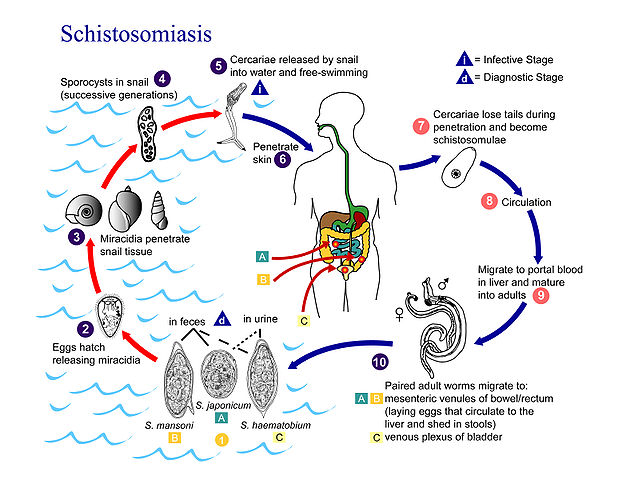
About 200 million people across 75 of the poorest countries in the world are now infected by the blood parasite Schistosoma haematobium (S. haematobium). The infection causes severe urogenital disease, but also causes bladder cancer in a number of patients and why this occurs is not clear.

While the developed world gets all of the attention for obesity, the developing world is only different in one sense; they retain more severely undernourished people even while obese and overweight people in those countries are gaining weight.

Unless people get obese equally, that growing divide may force governments in the developing world to simultaneously care for starving people while treating health problems associated with obesity, including diabetes and heart disease.
