






BASEL, Switzerland, September 12 /PRNewswire/ --

- Avastin Shows Unprecedented Patient Benefits Regardless of K-Ras Status, Age and Chemotherapy Choice

Avastin's (bevacizumab) essential role in the treatment of patients with metastatic colorectal cancer (mCRC), the world's second most common cancer, was strengthened at the 33rd European Society of Medical Oncology (ESMO) meeting with a compelling data set including:

- the final overall survival analysis of a 2,000 patient community-based study - further analyses of the Avastin and cetuximab combination study highlighting K-Ras findings - strong and consistent outcome for elderly patients on Avastin-based therapy

Long-term overall survival reported from First BEAT (1)

AMSTERDAM, Netherlands, September 12 /PRNewswire/ --

- Demonstrations Illustrate Advanced Functionality Beyond Mobile TV and Highlight the Immersive, Personalized Nature of Interactive Mobile Broadcast Services -

In hospitals and clinics, magnetic resonance imaging is quite common today. Clinicians like it because it shows much better images of soft tissues than computed tomography (CT) and uses no ionizing radiation. What it does use is a powerful magnetic field.

Magnetic resonance tomography has been around for just over 30 years so it is much younger than something like X-ray technology(>110 years) but ordinary MRI technology uses magnetic flux densities of 1.5 and 3 tesla.

A new MRI device delivered to Physikalisch-Technische Bundesanstalt (PTB) and the Experimental and Clinical Research Center (ECRC) of the Max Delbrück Center (MDC) for Molecular Medicine in Berlin-Buch uses a whopping 7 tesla and, they say, it will provide the clearest images ever taken of our insides.

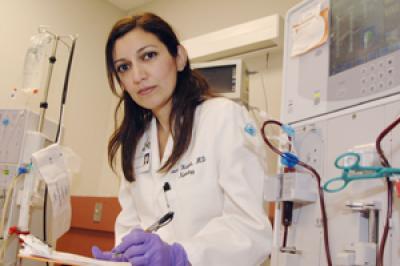
Dialysis patients diagnosed with depression are nearly twice as likely to be hospitalized or die within a year than those who are not depressed, a UT Southwestern Medical Center researcher has found.

In the study, available online and in the Sept. 15 issue of Kidney International, researchers monitored 98 dialysis patients for up to 14 months. More than a quarter of dialysis patients received a psychiatric diagnosis of some form of depression based on a Diagnostic and Statistical Manual of Mental Disorders 4th edition (DSM IV).

This is the first reported link between adverse clinical outcomes in dialysis patients and depression made through a formal psychiatric interview based on the DSM-IV standards. More than 80 percent of the depressed patients died or were hospitalized, compared with 43 percent of non-depressed patients. Cardiovascular events, which previously have been linked to depression, led to 20 percent of the hospitalizations.

Dr. Susan Hedayati

Chronic obstructive pulmonary disease (COPD)is the fourth-leading cause of death in the U.S. and affects more than 16 million Americans.

Broccoli is everywhere and enjoyed by almost no one - but your mom was right; broccoli is good for you. Now it turns out that broccoli can also help those with COPD, and that's reason enough to give broccoli some new respect.

According to recent research from Johns Hopkins Medical School, a decrease in lung concentrations of NRF2-dependent antioxidants, key components of the lung's defense system against inflammatory injury, is linked to the severity of chronic obstructive pulmonary disease (COPD) in smokers. Broccoli is known to contain a compound that prevents the degradation of NFRP.

A new type of drug could alleviate pain in a similar way to cannabis(marijuana) without affecting the brain, according to a new study published in the journal Pain on Monday 15 September.

The research demonstrates for the first time that cannabinoid receptors called CB2, which can be activated by cannabis use, are present in human sensory nerves in the peripheral nervous system, but are not present in a normal human brain.

Drugs which activate the CB2 receptors are able to block pain by stopping pain signals being transmitted in human sensory nerves, according to the study, led by researchers from Imperial College London.

EDMONTON, Canada, September 12 /PRNewswire/ -- MatrikonOPC(TM), the world's leading OPC connectivity provider, will be hosting the only European OPC User Group on October 22, 2008 in Barcelona Spain. The MatrikonOPC User Group will teach attendees how to optimize, implement and integrate OPC Solutions that will automate their process control systems and instantly improve productivity and communications for their company. Not only will attendees learn about how OPC can optimize and secure their current system infrastructure, but they will also have the unique opportunity to explore the future of OPC technology in the new OPC Unified Architecture specification presented by an industry expert from the OPC Foundation.

Adults like to watch Chris Angel or David Blaine because we know the stunts are controlled, but there is always the chance they might off themselves. We get some fun out of figuring out the impossible and it's more challenging than figuring out how to cheat at Wii Fit.

Impossible tricks have a different effect on kids: a new experiment announced today at the BA Festival of Science in Liverpool says learning magical feats can boost children’s confidence and social skills.

The study, conducted by Rebecca Godfrey, Dr Sarah Woods, and Professor Richard Wiseman from the University of Hertfordshire, involved assessing the effect of teaching secondary school children some seemingly impossible illusions, including how to magically restore a rope that has been cut in half, and read another person’s mind.

Here's something you probably know. When asked, people say they would choose “good” snack rather than a “bad” one, and they probably mean it, but when the goodies arrive, they may just go ahead and get the bad one.

In an article in the September/October 2008 issue of the Journal of Nutrition Education and Behavior, Dutch researchers found that there is a substantial inconsistency between healthful snack choice intentions and actual behavior.

Witness the Waffles of Doom.

When an electrical current passes through a wire it emanates heat – that's where we get toasters and the light bulbs Al Gore hates - but some materials violate this rule at low temperatures and carry current without any heat loss.

That's where we get superconductor research.

Andrea Bianchi, a professor in the Department of Physics at the Université de Montréal, and his colleagues say that, contrary to previous belief, superconductivity can induce magnetism, which has raised a new quantum conundrum.

