
From the Shangri-La Diet forums:

This is week 5 for me, and I have lost 7 pounds so far.

You may have read about the strange double asteroids dancing in space but putting together the pictures is a perfect example of science collaboration.

Prior to 2000, Antiope was just another asteroid. Then the 10-meter Keck II telescope in Hawaii discovered it was a doublet but not much else was known.

Two years ago, improved images from the European Southern Observatory's 8-meter Very Large Telescope (VLT) in Chile and Keck II determined an approximate orbit of the asteroids - but information was still sparse.

Enter crowdsourcing.

Attending the Tuesday lecture series of the ACS CINF division was a very educational  experience, that provided me with some key insights into the present state of scientific collaboration. I observed that almost all people who presented were focused on different techniques that improved the way scientists could get information they need from sources that were not human, i.e., publications, databases, etc.
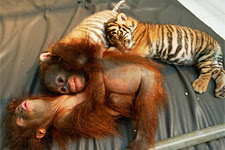

Sumatran tiger cubs and orangutan babies at Taman Safari Indonesia Animal HospitalRecently week pictures were released by Taman Safari Indonesia Animal Hospital & Zoo of two Sumatran tiger cubs and a pair of orangutan babies who have been sharing a home over the last month. All four were orphaned, rescued and are now being housed together at the animal hospital.

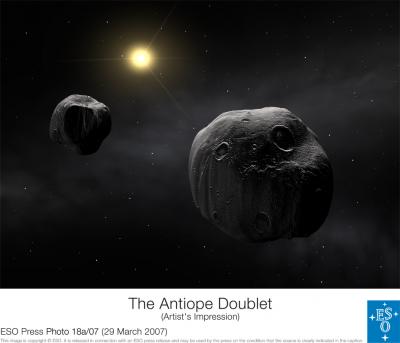
Combining precise observations obtained by ESO's Very Large Telescope with those gathered by a network of smaller telescopes, astronomers have described in unprecedented detail the double asteroid Antiope, which is shown to be a pair of rubble-pile chunks of material, of about the same size, whirling around one another in a perpetual pas de deux. The two components are egg-shaped despite their very small sizes.

The asteroid (90) Antiope was discovered in 1866 by Robert Luther from Dusseldorf, Germany. The 90th asteroid ever discovered, its name comes from Greek mythology.

Scientists at MIT have created an ocean model so realistic that the virtual forests of diverse microscopic plants they "sowed" have grown in population patterns that precisely mimic their real-world counterparts.

This model of the ocean is the first to reflect the vast diversity of the invisible forests living in our oceans-tiny, single-celled green plants that dominate the ocean and produce half the oxygen we breathe on Earth. And it does so in a way that is consistent with the way real-world ecosystems evolve according to the principles of natural selection.

What would large women think if a dress sold for lower cost to women of smaller sizes?

Common sense says this would turn them off.

But swimmers react well to items claimed to improve speed if they know the product is given away free to Olympic swimmers.

If you perceive the person getting the good deal as being smarter than you, you are okay with it. You are even more likely to pay full price.

Astronomers at the Naval Research Laboratory (NRL) have produced the first images of the sky from a prototype of the Long Wavelength Array (LWA), a revolutionary new radio telescope to be constructed in southwestern New Mexico. The images show emissions from the center of our Galaxy, a supermassive black hole, and the remnant of a star that exploded in a supernova over 300 years ago. Not only a milestone in the development of the LWA, the images are also a first glimpse through a new window on the cosmos. "First light" is an astronomical term for the first image produced with a telescope. It is a key milestone for any telescope because it indicates that all of the individual components are working in unison as planned.

Scientists have identified three different signals that indicate damage to chloroplasts— the photosynthetic factories of plant cells that give plants their green color —but little is known about how the signal gets passed on to the nucleus. Scientists at the Salk Institute for Biological Studies made a big step towards explaining how chloroplasts let a cell's nucleus know when things start to go wrong at the periphery so nuclear gene expression can be adjusted accordingly.

Multiple distress signals converge on a single pathway and channel the information to a nuclear master switch, the scientists report in the March 29 issue of Science Express. In response, hundreds of genes involved in photosynthesis are simultaneously shut off to ease the chloroplast crisis.

The city of London, with funding from the European Space Agency, has launched AirTEXT, which delivers air pollution alerts and health advice via SMS text messages.

AirTEXT is a free service aimed at those who have been diagnosed with asthma, emphysema, bronchitis, heart disease or angina as well as for those who live or work in London. The service has operated in the Borough of Croydon, the largest borough by population, since July 2005 and has received a positive response with 80 percent of users saying it has helped them manage their symptoms better and reduce their exposure to air pollution.