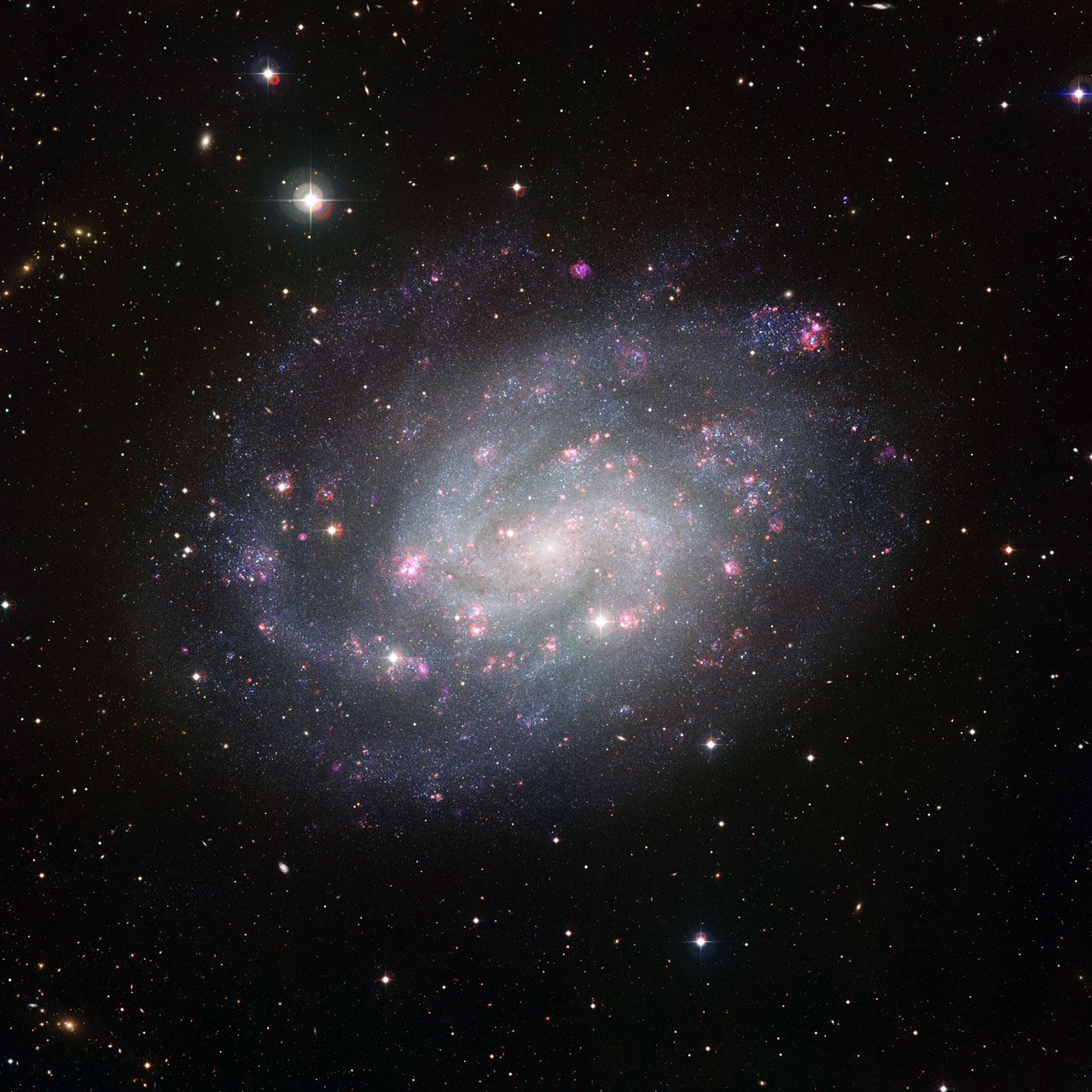
NGC 300 is one of the closest and most prominent spiral galaxies in the southern skies, about six million light-years away and bright enough it can be seen with binoculars. NGC 300 lies in the constellation of Sculptor with only a few bright stars, but is home to a collection of nearby galaxies that form the Sculptor Group, though recent distance measurements show that NGC 300 lies significantly closer to us than many of the other galaxies in the group and may be only loosely associated with them.
Compared to other galaxies, NGC 300 is remarkably normal, making it an ideal specimen for astronomers studying the structure and content of spiral galaxies such as our own.
Current battery design and implementation is not optimal, but it's cheap. A new effort seeks to make conventional battery systems more standardized and increase interoperability of battery and charger parts, which creates energy waste, extra costs and operational inefficiencies. But it's not for the casual user.
It's called the Intelligent Battery system and it also isn't cheap - the charger is about 20 percent more expensive than alternatives but the developers say the extra initial investment is recuperated in the medium and long term through prolonged battery life and better performance and the system provides real time information on the health and charge level of their batteries.
An important enzyme that acts in the nervous system may lead to new treatments for conditions such as Alzheimer's and Parkinson's disease.
Our cells contain a network of tubes known as microtubules that are made of protein and serve as tracks for the shuttling of materials from one part of the cell to another. Microtubules in parts of neurons in the brain that send signals, for example, are loaded with chemical additions called acetylation marks. Microtubules in parts of neurons that receive signals, on the other hand, have few.
Gossiping has benefits, according to research conducted by Dr. Jennifer Cole and Hannah Scrivener from Staffordshire University, who presented preliminary results at the British Psychological Society Social Psychology Section annual conference at the University of Winchester.
And praising someone in gossip may even lead to a short-term boost in gossipers' self-esteem.
Science can make you a better dancer - or at least improve your chances of not looking stupid to the opposite sex, say a group of evolutionary psychologists who used 3D motion-capture technology to create uniform avatar figures and identified the key movement areas of the male dancer’s body that influence female perceptions of whether their dance skills are “good” or “bad”.
Apparently it all comes down to neck, trunk, left shoulder and wrist, the variability of movement size of the neck, trunk and left wrist, and the speed of movement of the right knee.
Sounds simple, right? Read on.
We want to know some things in science are absolute yet we accept that a lot is relative. The speed of light is absolute and so the same with respect to any observer in empty space but sound is relative, like when a train whistle goes from high to low as it passes the observer. A longstanding quest in physics has been to determine whether chaos, in which tiny events lead to very large changes in the time evolution of a system, such as the universe, is absolute or relative in systems governed by general relativity, where the time itself is relative.
Like right after the Big Bang.
No, it is not a typo. I do mean "quirks": these are hidden-valley brothers of quarks predicted to exist in some fancy new physics scenarios. These particles have been sought by the DZERO experiment in a large dataset of proton-antiproton collisions, making use of a neat technique which I thought could be interesting to briefly explain today.
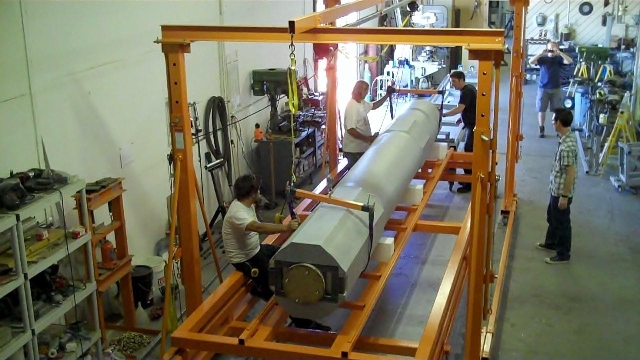
I like rocket photos and was getting a little jealous looking at all the Copenhagen folk's
photos. Where were
my rocket's photos? I'm launching the Project Calliope
music satellite with
Interorbital Systems (IOS) and even I don't know what my rocket looks like!
With all the fuss surrounding whether the l'Aquila earthquake should have been predicted, the point is often missed that it didn't need to be. As the recent Christchurch earthquake has shown, a city can survive relatively unscathed without an accurate prediction. All it takes is proper preparation.