If church attendance is any indication, Americans are as religious as they were 30 years ago. But the makeup of the nation's congregations has undergone significant changes during that same stretch, according to a study published in Sociology of Religion.
The findings challenge the popular notion that church attendance has decreased. Aside from a moderate decline in the 1990s, the study shows that Americans' churchgoing routines have been fairly constant over the decades, at around 23 to 28 services a year.
"There is a small decline in church attendance over time, but not nearly as large as suggested in popular culture, or even by some social scientists," said University of Nebraska-Lincoln sociologist Philip Schwadel.
Chemical analysis of a stalagmite found in the mountainous Buckeye Creek basin of West Virginia suggests that native Americans contributed a significant level of greenhouse gases to the atmosphere through land use practices, such as burning trees to actively manage the forests and yield the nuts and fruit that were a large part of their diets.
The finding, published in The Holocene, provide more evidence that humans impacted global climate long before the modern industrial era.
A study published in Environmental Research Letters suggests a link between low solar activity and jet streams could explain why regions North East of the Atlantic Ocean might experience more frequent cold winters in years to come.
Scientists say the UK and Europe could experience temperatures not seen since the end of the seventeenth century as a result of the changes in solar activity.
"This year's winter in the UK has been the 14th coldest in the last 160 years and yet the global average temperature for the same period has been the 5th highest," said Lead author Mike Lockwood of the University of Reading. "We have discovered that this kind of anomaly is significantly more common when solar activity is low."
The 84 members of the Donner Party, trapped by a Sierra Nevada snowstorm on their way to California, did not resort to cannibalism, according to a new analysis of bones found at their Alder Creek campsite.
Instead of each other, anthropologists say the Donner Party probably ate cattle, deer, horse and dog and did their best to maintain a civilized lifestyle in an otherwise harsh setting.
Details of the analysis will appear in the July issue of American Antiquity.
The Donner Party has long been infamous for reportedly resorting to cannibalism after becoming trapped in the Sierra Nevada Mountains of California for months during the winter of 1846-1847.
Personalized genetics is hot in the news right now, but in fact we're generally terrible at using genotypes to predict who is going to get a disease. One villain here is the phenomenon known as epistasis, which essentially means that the physiological effect of one genetic variant depends on what other genetic variants (in other genes) are hanging around in the same genome.
Recent comments on a certain
article (hey, what does that green button do?) about the future of neural interface technologies have brought up some valid ethical arguments. Because I didn't want to go Jurassic Park and revel in the possibilities while ignoring the consequences, I thought it a good idea to break down the issues.
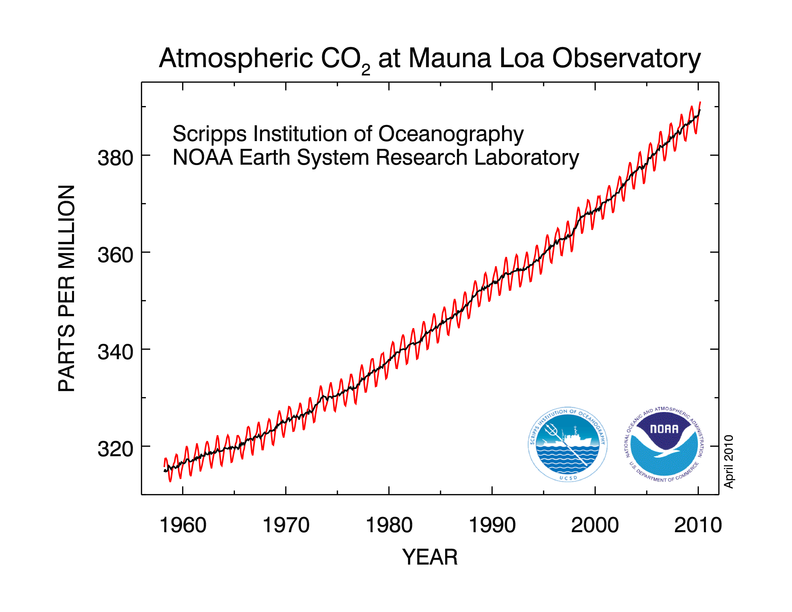
CO2 As A Greenhouse Gas
A greenhouse keeps an air volume warm mainly by enclosing it as fixed volume of air. From that perspective, the term 'greenhouse gas' is a somewhat unfortunate choice of term. But we seem to be stuck with it.
Obsolete books and web site pages continue to describe the atmosphere in terms of 'well-mixed gases'. That is counterfactual. Gases entering the atmosphere from whatever source can take a very long time indeed to become well distributed even even within a single hemisphere. Or even within a single atmospheric layer.