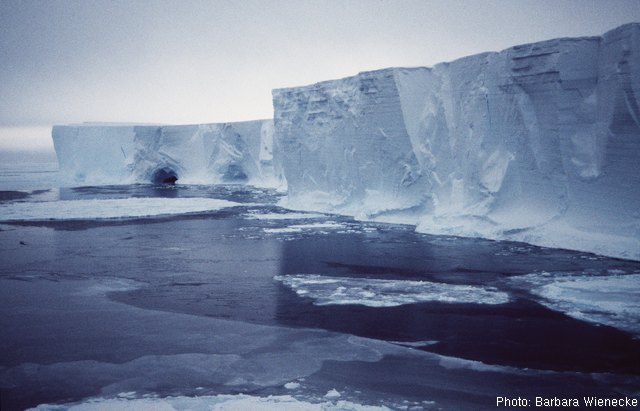
CRACICE Team's Cracked Ice Study Goes Crack!

A team of scientists has been studying two cracks in an ice tongue to see if they would meet.  During that study the tongue was rammed by a giant iceberg. 

The team studying the development of two major cracks in the Mertz Glacier Tongue has captured a sequence of satellite images showing how a giant iceberg, B-9B, rammed the tongue they were studying and broke it off.
Pitfalls Of Science Journalism

How do we fix it so that journalists can again be the 'trusted guides' they used to be?

If you are going to write about science and want the public to trust what you are saying to them then you need to understand three simple facts.  


fact #1 Many scientists lack basic language skills

A possible new solution to a 163-year-old biology puzzle - why animals grow bigger in cold climates - may have been found, according to researchers who say ecological factors can now be added to physiological ones.

The results were published in The American Naturalist and they say it offers new insight into 'Bergmann’s rule', an ecogeographic notion that correlates latitude with body mass in animals - animals grow larger at high, cold latitudes than their counterparts closer to

Most people believe the individual is the best judge of his or her own personality. But a Washington University Psychologist says that we are not the know-it-alls that we think we are.

Simine Vazire, Ph.D., Washington University assistant professor of psychology, says that the individual is more accurate in assessing one's own internal, or neurotic traits, such as anxiety, while friends are better barometers of intellect-related traits, such as intelligence and creativity, and even strangers are equally adept as our friends and ourselves at spotting the extrovert in us all.
While much attention has been given to the potential global impact of climate change, less has been paid to how a warmer planet would affect regional climates. The Intergovernmental Panel on Climate Change (IPCC) projects that the global average temperature will rise about 1°C by the middle of the century, but the global average does not tell us anything about what will happen to regional climates, for example rainfall in the western United States or Hawaiian Islands.

Analyzing warming projections in models used by the IPCC, a team of scientists claim that ocean temperature patterns in the tropics and subtropics will change in ways that will lead to significant changes in rainfall patterns. The study will be published in the Journal of Climate this month.
Researchers at UT Southwestern Medical Center say that increasing the normally occurring process of making nerve cells might prevent addiction. The conclusion is based on a rodent study demonstrating that blocking new growth of specific brain nerve cells increases vulnerability for cocaine addiction and relapse.

Published in Journal of Neuroscience, the study's findings are the first to directly link addiction with the process, called neurogenesis, in the region of the brain called the hippocampus.

While the research specifically focused on what happens when neurogenesis is blocked, the scientists said the results suggest that increasing adult neurogenesis might be a potential way to combat drug addiction and relapse.