


According to a new report in the Archives of General Psychiatry, individuals at extremely high risk of developing psychosis appear less likely to develop psychotic disorders following a 12-week course of fish oil capsules containing long-chain omega-3 polyunsaturated fatty acids.

Researchers conducted a randomized, double-blind, placebo-controlled clinical trial of their effect on the risk of progression to psychosis in 81 individuals at ultra–high risk. These individuals either had mild psychotic symptoms, transient psychosis or a family history of psychotic disorders plus a decrease in functioning. These criteria identify individuals whose risk of becoming psychotic may be as high as 40 percent in a 12-month period.
Last Friday I was in Pisa, at the Scuola Normale Superiore (see picture), where italian members of the CMS Collaboration gathered for two days to discuss the status of their studies, exchange ideas, and try to coalesce common analysis efforts.

     I have been following with interest the columns and blogs related to climate change, most recently from Patrick Lockerby, who agrees with the evidence for human-caused global warming, and Karen Barnes, who comments on Jesse Ventura’s conspiracy theory.  Perhaps thoughttul readers of Scientific Blogging will be interested in seeing the actual data that supports global warming. Here is a NOAA website that succinctly summarizes the main lines of evidence.

Self-Aggrandising Pseudoscience Castigated - Wakefield Struck Off By GMC


Following the longest medical misconduct inquiry ever held in the U.K., Andrew Wakefield has been struck off by the GMC, the General Medical Council.  The GMC, an independant charitable organisation, is responsible in the UK for the registration of medical doctors and for the supervision of their conduct.  The GMC enjoys a global high reputation for its ethics and integrity.

Brian Deer has exposed much wrongdoing by Wakefield and has been the subject of a (withdrawn) libel suit by him.  He reports in the UK's Sunday Times, 31st Jan 2010:
W bosons are amazingly interesting objects. Almost thirty years after their discovery -by Carlo Rubbia and his collaborators of the UA1 experiment at CERN- they continue to provide critical information on the theory of electroweak interactions. The front of particle physics has moved quite a bit further from 1983, and yet the weapons we use todat to try and conquer unexplored land have not changed much. Today I wish to summarize one particular search that has been done by the CDF experiment at the Tevatron proton-antiproton collider, one which tries to catch W bosons as they decay in a very uncommon way.
King Coal And The Heat Values Of Fuels


A Potted History Of The Human Use Of Coal


The term 'coal' covers many different materials with a common property: they are materials high in carbon which were formed from plant residues under pressure and over geologically long periods.

BCE 13,000 - black amber, or jet, is known to have been used1 for ornamental purposes in Britain.
BCE 2 - 3,000 - natural outcrop coal used for fuel in Britain.
CE 200 - 400 - exploitation of surface coal fields on, by modern standards, a small scale.
CE 1200 - 1300 - trade has developed in coal; mining is in development.
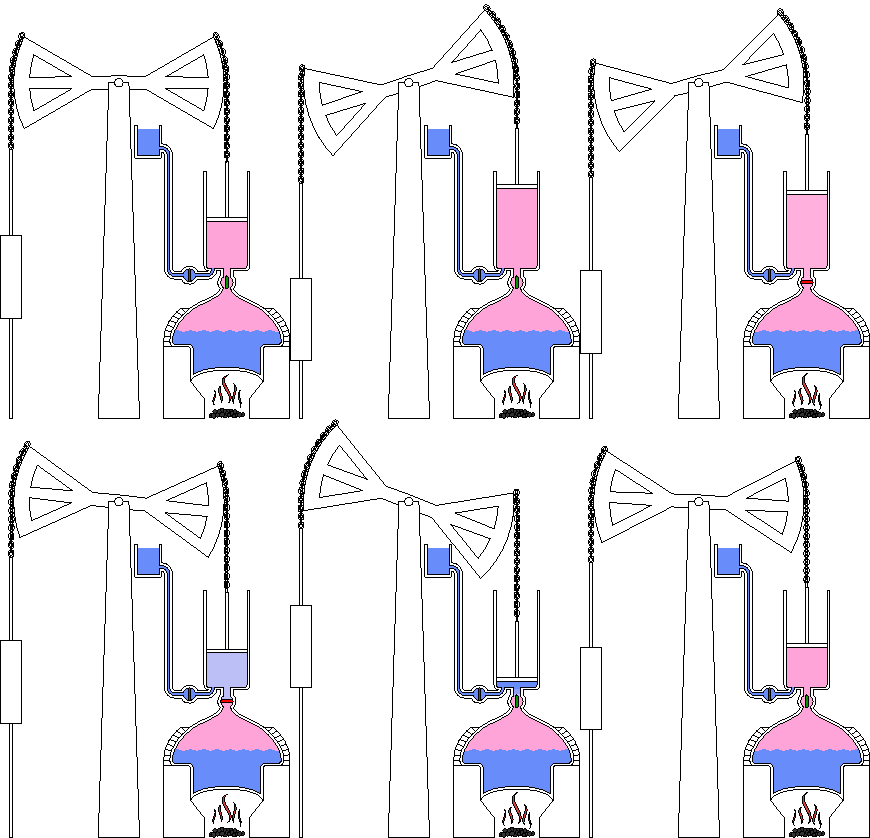
CE 1600 - 1700 - experiments with steam engines, leading to
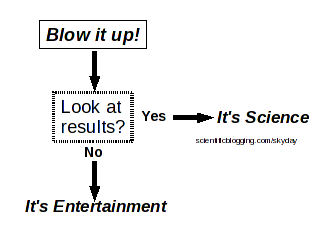
We scientists have a desperate need to make our science interesting to everyone-- including ourselves. Our terminology reflects this. In astronomy, we have the Big Bang. In comp sci, computers Crash. In engienering, "Test to Destruction".

But at some point, usually when I'm in a classroom, my science audience wants me to do something extreme. Mix chemicals until they explode. Shatter a rose in liquid nitrogen. Fire off a rocket. Something 'kinetic', in the sense of lots of fragments of something once whole being rent a'sunder.

As usual, parody best covers the dilemma, as with this week's "The Onion" science headline: Science Channel Refuses To Dumb Down Science Any Further.

