

In New York City, you can easily date a different person within a mile of your home for the rest of your life and never come close to duplicating - and that may be why people in New York City have trouble finding relationships, according to a study in Psychological Science.

When people have a large number of potential dating partners to select from, say psychologist Alison Lenton of the University of Edinburgh and economist Marco Francesconi of the University of Essex, they respond by paying attention to different types of characteristics – discarding social attributes such as education, smoking status, and occupation in favor of physical characteristics such as height and weight. 
I just became aware of a letter that is being sent to a couple of US Senators by a large and illustrious collection of scientists, and I decided to put my signature below it. The letter is clear and I will not comment it here - suffices to just paste it here.

By the way, I do not think that more signatures are necessary to it, but if you agree with the contents and wish to participate your support, please do so by adding your name below, in the comments thread. It will just take you thirty seconds of your valuable time, but it might have an impact here too.

-----------

Senator Dianne Feinstein
Chairman
Energy& Water Appropriations Subcommittee
 
SenatorLamar Alexander

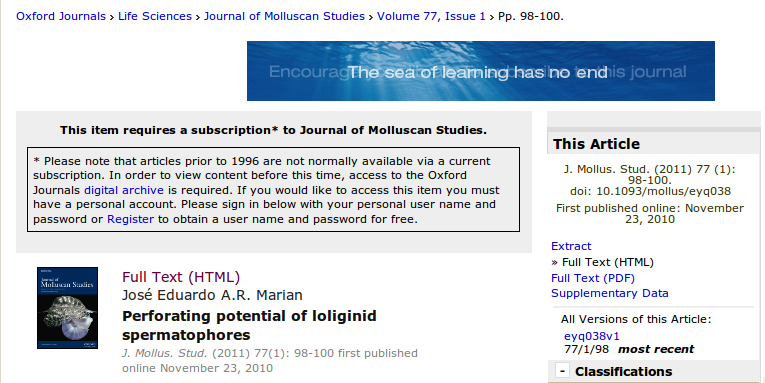
Squid sex is both discreet and discrete.

Discreet, because usually the sexual organs remain hidden. The only visible activity looks more like a handshake than like intercourse, as the male uses one arm to pass sperm to the female.

Discrete, because the sperm comes in neat, quantized packages rather than free-flowing semen. These packages are called spermatophores, and they're quite complex. In addition to a mass of sperm, they have a variety of tools for attaching themselves to the female's body.
If we're being honest in retrospect, the first decade of the 2000s was bad for science journalism.    Too many journalists decided they wanted to be cheerleaders for science or, worse, had scientist envy and wanted to be included in cool discussions about the mysteries of the universe.  

Basically, journalists stopped asking the awkward questions of scientists that journalists in other fields know makes their careers (see: Dan Rather and Richard Nixon).  Result: While the science audience is up and science knowledge has tripled since 1988, jobs in science journalism are down.  Few people read them.


