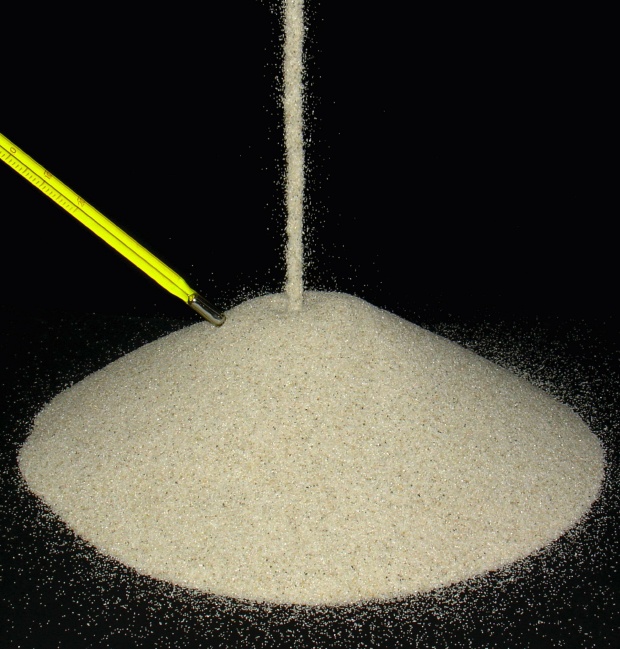
A word is vague if it has borderline cases. Yul Brynner (the lead in "The King and I") is definitely bald, I am (at the time of this writing) definitely not, and there are many people who seem to be neither. These people are in the “borderline region” of ‘bald’, and this phenomenon is central to vagueness.
Nearly every word in natural language is vague, from ‘person’and ‘coercion’ in ethics, ‘object’ and ‘red’ in physical science, ‘dog’ and ‘male’ in biology, to ‘chair’ and ‘plaid’ in interior decorating.
Vagueness is the rule, not the exception. Pick any natural language word you like, and you will almost surely be able to concoct a case -- perhaps an imaginary case -- where it is unclear to you whether or not the word applies.
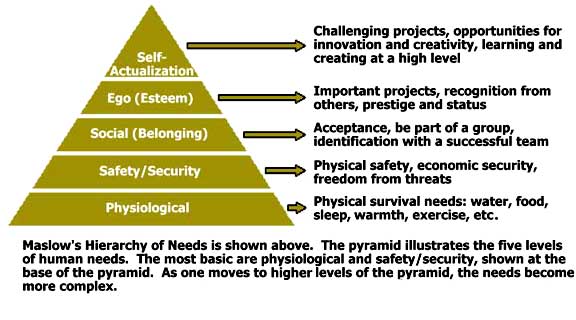
Despite being one of psychology's most memorable concepts and a genuinely good idea, Abraham Maslow's hierarchy of needs, immortalized in his 1943 paper "A Theory of Human Motivation" and later Motivation and Personality, needs a makeover, say some researchers.
Maslow's hierarchy says humans will fulfill basic needs before moving on to higher level ones. If you're unemployed and losing your house because fuzzy 'jobs saved or created' statistics have no real value to you, for example, global warming will not be your biggest concern.
A long time ago (≈1975) I was involved in establishing a world standard for the measurement of the Optical Transfer Function (OTF). It is better known as its modulus, the Modulation Transfer Function (MTF). The OTF combines the MTF with the Phase Transfer Function (PTF). The OTF is a two dimensional Fourier transform of the Point Spread Function (PTF). Thus, it is a two dimensional frequency characteristic used for qualifying imaging devices and chains of imaging devices.
Since the image of a point contains very little energy, the OTF is measured by analyzing the Line Spread Function (LSF).