Young people with Attention-deficit hyperactivity disorder (ADHD) are not only at increased risk of starting to smoke cigarettes, they also tend to become more seriously addicted to tobacco and more vulnerable to environmental factors such as having friends or parents who smoke, according to a study from Massachusetts General Hospital reseachers. The report in the Journal of Pediatrics also found that individuals with more ADHD-related symptoms, even those who don't have the full syndrome, are at greater risk of becoming dependent on nicotine than those with fewer symptoms.
Climate change will have different effects on lakes in warmer and colder regions of the globe, according to Japanese and German researchers following studies of very deep caldera lakes in Japan.
Scientists from Hokkaido University, the Hokkaido Institute of Environmental Sciences, Kagoshima University and the Helmholtz Centre for Environmental Research (UFZ) compared current measurements with measurements taken 70 years ago. This confirmed a rise in temperatures in the deep water layers of lakes in the south of Japan, while the deep water temperatures of lakes in the north remained the same.
A rise in carbon emissions is not the only threat to the planet. Changes to the nitrogen cycle, caused in large part by the widespread use of fertilizers, are also damaging both water quality and aquatic life. These concerns are highlighted by Professor Grace Brush, from Johns Hopkins University in Baltimore, USA, in her historical review (1) of landscape changes around Chesapeake Bay, a large estuary on the Atlantic coast of the USA. Her findings are published online this week in Springer's journal Estuaries and Coasts.
New studies conducted by April Benasich, professor of neuroscience at Rutgers University in Newark, and her colleagues reveal that gamma wave activity in the brains of children provide a window into their cognitive development, and could open the way for more effective intervention for those likely to experience language problems.
"Research into the adult brain has shown that gamma activity is the 'glue' that binds together perceptions, thoughts and memories," notes Benasich. "Little research, however, has been conducted into the development of gamma activity in the infant brain and its possible connection to cognitive and language skills."
A bit of serendipity has given astronomers a surprise view of a never-before-observed event in the birth of a galaxy.
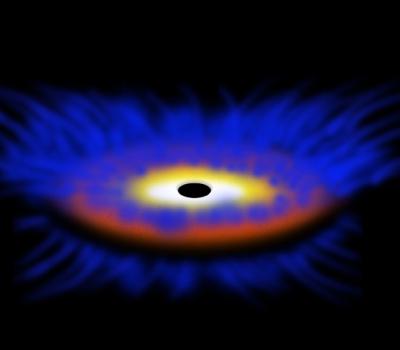
University of Florida and University of California-Santa Cruz astronomers are the first to discover the onset of a huge flow of gas from a quasar, or the super-bright core of an extremely remote young galaxy still being formed. The gas was expelled from the quasar and its enormous black hole sometime in the space of four years around 10 billion years ago – an extremely brief and ancient blip noticed only by a sharp-eyed undergraduate and the unlikely convergence of two separate observational efforts.
New research on the manner in which people reveal their most intimate secrets on national TV talk shows will be presented at the University of Leicester on Wednesday October 22.
Professor Ian Hutchby, Professor of Sociology at the University of Leicester, will present his paper: Revealing revelations: 'Performed retellings' of significant announcements on a TV talk show.
In his talk, Professor Hutchby will discuss his findings on the way the revelation of personal information is managed by the protagonist.
He said: "There is now an established tradition of television talk shows in which secrets, affairs and other private things are 'revealed' for the watching audience. Sometimes, such things are also revealed for co-guests in the studio.
If bioethanol is going to make a major contribution to our fuel supplies, we will require using biomatter a lot more efficiently than we do now - but we may be able to get some assistance from tiny insect helpers, says Michael Scharf, an assistant professor of entomology at the University of Florida, Gainesville.
In Biofuels, Bioproducts&Biorefining, Scharf and his colleague Aurélien Tartar describe how the enzymes produced by both termites and the micro-organisms that inhabit their gut – known as symbionts – could help to produce ethanol from non-edible plant material such as straw and wood.
Contrary to popular belief, polar dinosaurs may not have traveled nearly as far as originally thought when making their bi-annual migration.
University of Alberta researchers Phil Bell and Eric Snively have suggested that while some dinosaurs may have migrated during the winter season, their range was significantly less than previously thought, which means their treks were shorter. Bell and Snively's findings were recently published in Alcheringa: An Australasian Journal of Paleontology.
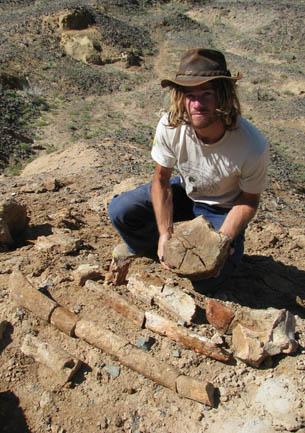 Phil Bell holding a vertebra of a 70-million-year-old Saurolophus.
We believe we know a lot about the universe but there's a lot left to be explained, especially about its origins. A team of cosmologists from the University of the Basque Country are searching for a model that best explains how the universe evolved - mathematically.
One of the phenomena that standard models of physics have not yet been able to explain is that of the accelerated expansion of the universe. Although Einstein proposed a static model to describe the Cosmos, phenomena like supernovas tell us the universe is expanding.
Yale researchers have described how dueling brain systems may explain why you forget to drop off the dry cleaning and may point to ways that substance abusers and people with obsessive compulsive disorder can overcome bad habits.
In Proceedings of the National Academy of Sciences, Christopher J. Pittenger, M.D., and colleagues describe a sort of competition between areas of the brain involved in learning that results in what Pittenger calls the “dry cleaning effect.”
One area of the brain called the striatum helps record cues or landmarks that lead to a familiar destination. It is the area of the commuter’s brain that goes on autopilot and allows people to get to work, often with little memory of the trip.