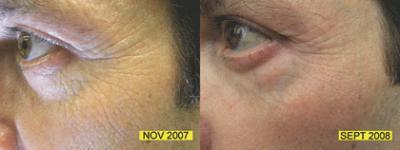
Researchers in Germany are describing a potential alternative to Botox and cosmetic surgery for easing facial wrinkles. Their study, scheduled for the November 5 issue of ACS' Crystal Growth&Design, reports that high intensity visible light from light emitting diodes (LEDs) applied daily for several weeks resulted in "rejuvenated skin, reduced wrinkle levels, juvenile complexion and lasting resilience."
LEDs, if you're not a regular reader here (though you should be) are the miniature lights used in an array of products, from TV remote controls to traffic lights.
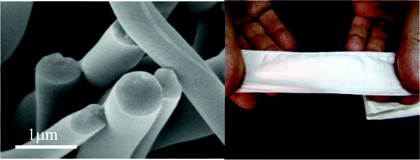
Scientists in Israel are reporting the first successful spinning of a key natural protein into strong nano-sized fibers about 1/50,000th the width of a human hair. The advance could lead to a new generation of stronger, longer-lasting biocompatible sutures and bandages to treat wounds. The study is scheduled for the November 10 issue of Biomacromolecules.
Using more coal won't solve greenhouse gas issues but it buys time for clean energy to become cost- and energy-effective. Our coal supply, unlike oil, will last for hundreds of years .
Scientists in Italy are reporting that a new process could eliminate key obstacles to the expanded use of coal gasification to transform that abundant domestic energy resource into synthetic liquid fuels for cars and trucks. The study is scheduled for the November 19 issue of Energy&Fuels.
With larger populations and greater demand for food, pesticide usage has increased over the last few decades. Luckily, a new study has found that concentrations in ground water have not matched the increase.
Samples taken from over 300 wells across the US show they have not retained a high concentration of pesticide contamination, according to results of a decade-long study to assess the extent of the impact of contaminants on the nation's water supply.
Over the past 30 years, the U.S. population has reduced its fat intake and increased its consumption of carbohydrates. During the same time period, obesity has been rising along with the prevalence of metabolic liver disease in which fatty deposits in the liver can lead to inflammation, fibrosis and cirrhosis. Some studies have suggested that a high carbohydrate diet leads to fat formation in the liver, although confirming the association has been difficult.
When carbohydrates are restricted, the liver relies more on substances like lactate and amino acids to form glucose, instead of glycerol. These findings are in the November issue of Hepatology.
Do we want people to have water or cleaner energy? As the search for new fuels intensifies, researchers in Texas report that switching to certain alternative fuels to power cars, trucks, and SUVs may require the use of much more water than conventional petroleum-based gasoline and diesel.
The findings suggest that producing alternative fuels could strain already limited water supplies in some regions of the country. Their study is scheduled for the October 15 issue of Environmental Science&Technology.
In the human world , some humans try to bank money to obtain financial security and occasionally form groups to reduce risks and increase gains.
Regardless of well-known financial wisdom, some people still end up in 'poverty traps', where because of fewer resources and an increasingly high cost of living they find themselves unable to increase their quality of life.
Canada continues to export asbestos to developing countries, despite limiting its use in Canada, write Dr. Amir Attaran, David Boyd and Dr. Matthew Stanbrook in the Canadian Medical Association Journal. And it's both hypocritical and dangerous to importing countries, they write.
Canada is opposed to placing
chrysotile, the main asbestos fiber used today, under the Rotterdam Convention's notification and consent process, despite chrysotile being deemed a human carcinogen by the World Health Organization (WHO).
Researchers at Wake Forest University School of Medicine may be one step closer to understanding why past oral contraceptive use dramatically lowers the risk of ovarian and uterine cancers later in life.
While studying the effect of post-menopausal dietary soy consumption on estrogen metabolism in cynomolgus monkeys, Latanya M. Scott, Ph.D., discovered that monkeys who had been given birth control earlier in life had a reduced amount of estrogen excreted in their urine. The research was done in collaboration with Xia Xu, Ph.D., and Timothy Veenstra, Ph.D. at Science Applications International Corporation-Frederick, Inc., in Frederick, Md., who have developed novel methods for analysis of urinary estrogens.
The often-criticized components of the Western diet, like fried foods, salty snacks and meat, accounts for 30 percent of heart attack risk across the world, according to a study of dietary patterns in 52 countries reported in Circulation: Journal of the American Heart Association.
That's right, apparently Americans make the whole world eat bad.
Researchers identified three dietary patterns in the world:
- Oriental: higher intake of tofu, soy and other sauces;
- Prudent: higher intake of fruits and vegetables; and
- Western: higher intake of fried foods, salty snacks, eggs and meat.
The Prudent diet was associated with a lower heart attack risk than the Oriental, researchers said.