


The Obama administration has terminated the Microbiological Data Program created under President George W. Bush and his 2001 Food Safety Initiative.

During its run, MDP conducted 80 percent of all federal produce testing for pathogens like Salmonella and Listeria. They conducted tests on thousands of samples of fruits and 
vegetables each year, gathered from 11 distribution centers.

The group was officially shut down on December 31st but had been winding down since November. The Obama administration had asked Congress to eliminate funding for it and the Republican Congress, stunned there was something they could stop funding, dutifully complied.  

The Earth's core formed under more oxidizing condition's than previously believed, researchers have discovered through of series of laser-heated diamond anvil cell experiments at high pressure - 350,000 to 700,000 atmospheres of pressure - and temperatures - 5,120 to 7,460 degrees Fahrenheit.

That black holes radiate Hawking radiation (which should actually be called Unruh radiation) is almost established knowledge although it has not been experimentally confirmed.  The radiation, as of now, is founded on the consistency of the thermodynamics of, for example, black holes.  The radiation being also found around string theory black holes for example adds confidence.

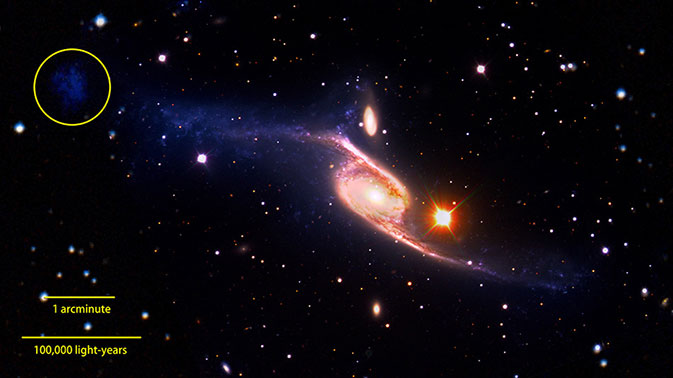
The barred spiral galaxy NGC 6872 has been considered a candidate for the biggest stellar system for decades and now a team of astronomers has officially crowned it the largest - so far.

A new study indicates that  thousands of individuals have had kidneys removed unnecessarily because doctors misdiagnosed their disease.

20% of individuals with kidney tumors common in patients with tuberous sclerosis complex (TSC), a genetic disorder, has had a kidney removed. 40% had some kind of surgical procedure performed. Better diagnosis could have led to treatment that would have made surgery or kidney removal unnecessary, according to John Bissler, MD, a nephrologist at Cincinnati Children's Hospital Medical Center and lead author of the study. 

While corn ethanol was always a bad idea, biofuels themselves have a potential.

Perennial biofuel crops miscanthus, switchgrass, and mixed prairie species have shown high yields in producing ethanol, and a 4-year University of Illinois study has found another beneficial characteristic – the ability to reduce the escape of nitrogen in the environment.

The study compared miscanthus, switchgrass, and mixed prairie species to typical corn-corn-soybean rotations and each of the perennial crops were highly efficient at reducing nitrogen losses, with miscanthus having the greatest yield. 

Harvested biomass and nitrogen, nitrous oxide emissions, and nitrate leaching in the mid-soil profile and through tile drainage lines were all measured.

There's a mystery in them there clouds - but astronomers at Caltech are on the case.

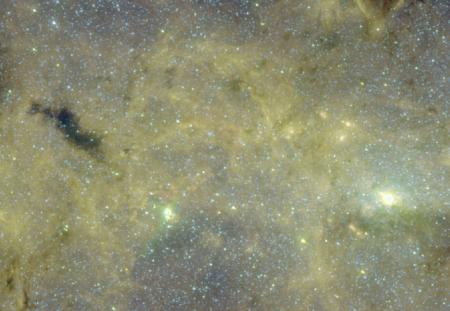
Near the crowded galactic center, billowing clouds of gas and dust hide a supermassive black hole 3,000,000X as massive as our sun, Its gravity is strong enough to grip stars that are whipping around it at thousands of kilometers per second. One particular cloud named G0.253+0.016
has delighted astronomers. Because scientists love a mystery. 

G0.253+0.016 defies the rules of star formation. But apparently those are more guidelines than rules.

Students everywhere, put down those highlighters and pick up some flashcards! Some of the most popular study strategies, like highlighting and even re-reading, don't show much promise for improving student learning, according to a new paper.

In the article, psychologist John Dunlosky of Kent State University and colleagues review ten learning techniques commonly used by students.

Based on the available evidence, they provide recommendations about the applicability and usefulness of each technique.

People view brown-eyed faces as more trustworthy than those with blue eyes- unless the blue eyes belong to a man with a broad face, according to a new paper in PLOS ONE

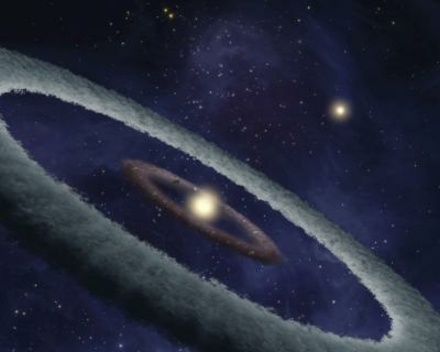
Vega is the second brightest star in northern night skies and astronomers using the Infrared Space Telescopes have discovered an asteroid belt much like that of our sun. 

Results showing an asteroid belt around Vega makes it more similar to its twin, the star called Fomalhaut. Both stars now are known to have inner, warm asteroid belts and outer, comet-filled belts, similar in architecture to the asteroid and Kuiper belts in our own solar system.

