A journalist I am following on twitter just posted the question in the title of this post. I felt bound to try and give an answer with as simple concepts as I found meaningful. So, what makes a unstable particle unstable ?
One answer is this: a particle is unstable if there is a way, not forbidden by any physical law, to convert its rest-mass into other forms of energy. One may understand this by thinking of entropy: any system left free to evolve will do so in the direction of maximum entropy. So since a single particle state is a very low-entropy system, while the decay products of its disintegration have a multitude of possible configurations and a higher entropy, the system will naturally evolve in that direction.
“ ‘Chills’ (frisson manifested as goose bumps or shivers) have been used in an increasing number of studies as indicators of emotions in response to music …”
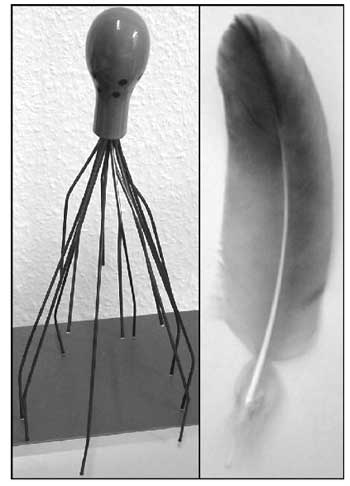 But in a new research project, investigators from Hanover University of Music and Drama (hmtmh) in Germany focused their attention not just on chills which are exclusively musically-induced, but also on those initiated by aural, visual, tactile, and taste stimulation.
A comprehensive set of experiments were devised to investigate.
Here is an interesting statistic: if we multiply the (approximate) number of computers currently present on planet Earth by the (approximate) number of transistors contained in those computers we get 10^18, which is three orders of magnitude larger than the number of synapses in a typical human brain. Which naturally prompted Slate magazine’s
Dan Falk to ask whether the Internet is about to “wake up,” i.e., achieve something similar to human consciousness.
In its third century, psychological science will come of age but a mature discipline carries with it responsibilities, chief among them the responsibility to maximize confidence in findings through good data practices and replication.
In the recent issue of
Perspectives on Psychological Science (free to read), writers reflect on the discipline's ongoing commitment to examine methodological issues that affect all areas of science — such as failures to replicate previous findings and problems of bias and error — with the goal of strengthening the discipline and contributing to the discussion that is taking place throughout science.
Energy companies in New Jersey and Pennsylvania are required to buy some solar power each year.
They are required to overpay for that solar power.
In return for overpaying, they get Solar Renewable Energy Certificates (SRECs) which let them pass the extra cost onto local families and taxpayers.
Most people can't read lips. If you turn down the sound on your television, you can see why it is difficule. Unless trained, if you see someone speak a sentence without the accompanying sounds, you are unlikely to recognize many words but it turns out people can lip-read themselves better than they can lip-read others, and that shows an interesting link between speech perception and speech production.
Should child care providers be tasked with childhood obesity too?
The National Health and Nutrition Examination Surveys found that over 21% of children ages 2 to 5 were considered overweight or even obese. That has led some advocates to posit that child care settings can tackle teaching children about nutrition, since nearly 50% of children in the United States under age 5 go to some kind of child care.
When I was a young guy living in Florida, on one station we used to get reruns of a television show called "The Saint". I liked the stick figure cartoon and the halo that would appear above his head in the beginning. Roger Moore was cool.
He became the third actor to play Ian Fleming's British super spy James Bond (and the longest-running) and was the perfect choice. Yet most people remember the 'cartoon-y' James Bond films that came on his watch. He is unfairly derided as the worst James Bond now, and that is saying something in a roster that includes George Lazenby and Timothy Dalton. "The Spy Who Loved Me " holds up pretty well, the recurring actors all have at least one good movie.
OptiNose US Inc. has announced that its Norwegian affiliate was awarded $2.1 million by the Research Council of Norway to study its nasal drug delivery technology in the treatment of autism spectrum disorders (ASDs).
OptiNose will use this research grant to investigate "nose-to-brain" transport of oxytocin via the patented OptiNose Bi-Directional delivery technology for the treatment of ASDs. Partners who have agreed to collaborate with OptiNose in the project include the Department of Psychiatry at Oslo University Hospital, SINTEF and Smerud Medical Research and Norwegian academic insitutions.
New data from the RELY-ABLE study have provided additional support to the safety profile and efficacy of Pradaxa(R) (dabigatran etexilate) for stroke prevention in patients with nonvalvular atrial fibrillation (AF) over a period in excess of 2 years.[*][1]
The new long-term results presented at the American Heart Association's (AHA) Scientific Sessions, are consistent with the findings from the RE-LY trial[*]. The rates of stroke and haemorrhage observed during an additional 2.3 years of blinded follow-up in RELY-ABLE correspond to the initial RE-LY results, with the benefit of both doses of dabigatran etexilate sustained throughout the study's duration.[1]-[3]