




A skull fragment unearthed in Tanzania verifies that our ancient ancestors were eating meat at least 1,500,000 years ago and that can tell us something about the evolution of human physiology and brain development and why we wouldn't be where we are if there was a Prehistoric PETA.

The two-inch skull fragment was found at the famed Olduvai Gorge in northern Tanzania, a site that for decades has yielded numerous clues into the evolution of modern humans and is sometimes called `the cradle of mankind.'
In my previous article, the fundamental equivalence of foods was discussed recognizing that there is a difference in assessing problems with the food, versus problems with food handling.  Moreover, much of the focus has been on the safety of these foods regarding human/animal consumption, however I would argue that there are much more serious problems that need to be addressed.

Leaves store carbon. In the spring, leaves soak up carbon dioxide from the atmosphere, converting the gas into organic carbon compounds, and then in the autumn, trees shed those leaves, which decompose in the soil as they are eaten by microbes. Over time, decaying leaves release carbon back into the atmosphere as carbon dioxide.

A couple of weeks ago ago, a debate about the existence of scavenging cephalopods broke out on the cephalopod mailing list. A few days later, such a creature appeared in the news as if conjured!

A grad student had e-mailed the ceph-list because he’d found a website that claimed “most cephalopods are active hunters while some are scavengers.” He couldn’t think of any scavenging cephalopods, and wanted to know if anyone else could.
The Greenland ice sheet has a tale to tell about ancient greenhouse gas emissions too. Researchers have determined how much methane originates from natural sources and how much is due to human activity, from Roman times to the present.

Methane is an underestimated greenhouse gas, 23X the impact of CO2 but not as long-lived, and like CO2 it has natural sources and also originates from human activities. The emissions from natural sources varies due to \climate variations; as an example, bacteria in wetlands release methane and less is emitted in dry cycles when wetlands shrink. 

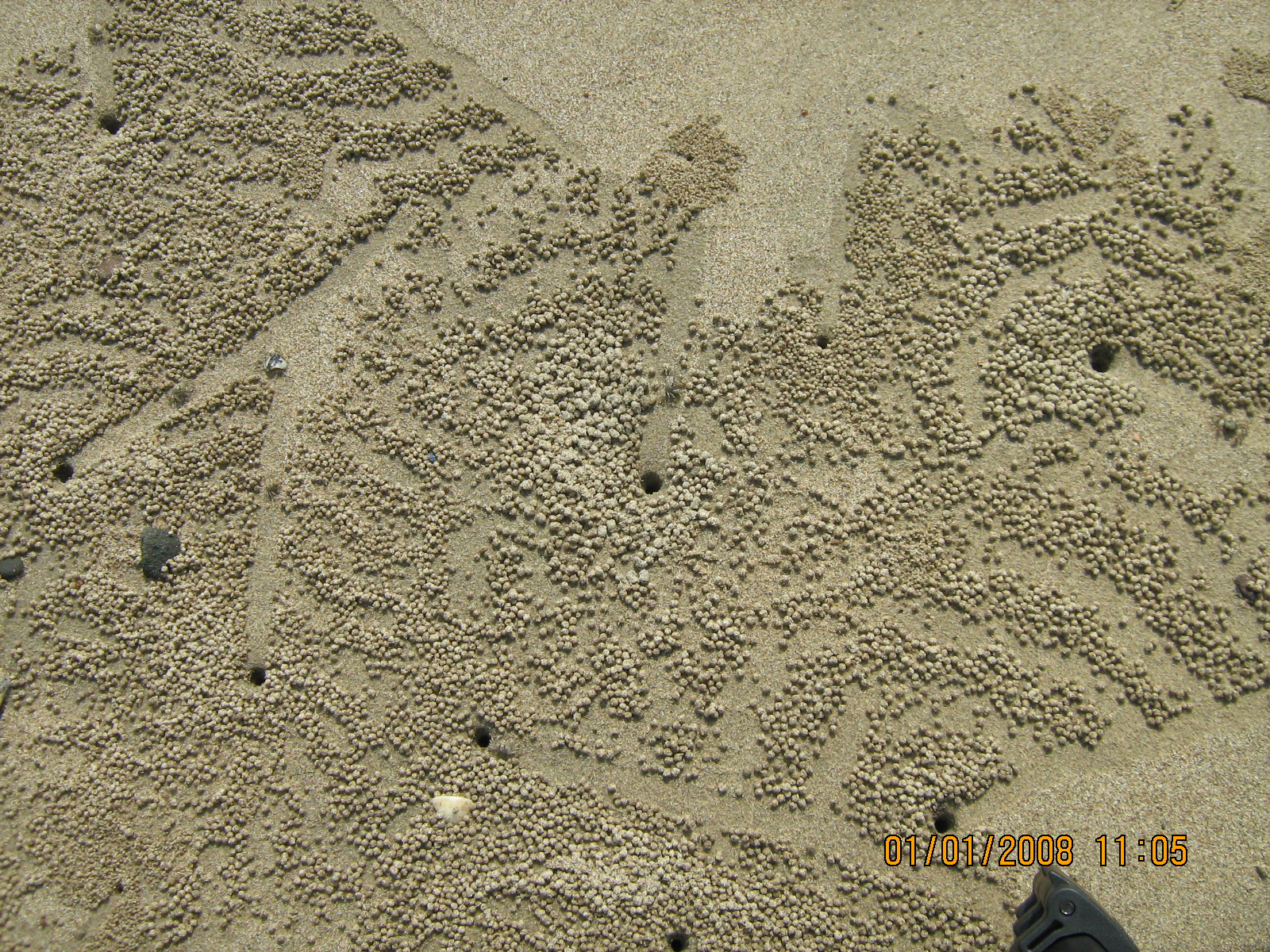
Thinking of some amazing organisms in a sandy beach, the sand bubbler crab always comes in mind. Dotilla clepsydrodactylus, the sand bubbler crab, is the one crab which makes the beaches more beautiful by displaying its marvelous art. 

While walking on beaches in Andaman Islands, India, during low tide we can savor the beautiful designs done by these crabs. So, why and how these crabs design like this? The answer is: food!! These crabs have no idea that they are making beautiful designs for us. They are so ignorant that they design pretty well!
. 
45-year meta-analysis of 240 science studies found that 'organic' processed food is the same in pesticides, the same in nutrition and a whole lot more expensive.

"...there isn’t much difference between organic and conventional foods, if you’re an adult and making a decision based solely on your health,” said Dena Bravata, senior author of the paper and a physician at Stanford’s Center for Health Policy.
The Affordable Care Act controversy rages on. In this week's BMJ, journalist Jeanne Lenzer says the basic assumption that US people don't have enough health care is misleading and in reality, Americans have too much - and that unnecessary care costs an estimated $800 billion per year. 

The article arrives as an international conference named 'Preventing Overdiagnosis' was announced for September, 2013 in the United States, hosted by The Dartmouth Institute for Health Policy and Clinical Practice, in partnership with the BMJ, Consumer Reports and Bond University of Australia.

Researchers have found a way to 'toggle' the intestinal enzymes responsible for processing starchy foods on and off, which could lead to better control of those processes in people with Type 2 diabetes.

This "toggling" was discovered in the lab of  Simon Fraser University chemist Mario Pinto, who has designed inhibitors capable of regulating each of the four starch-digesting enzymes known as alpha-glucosidases. Three of those enzymes are responsible for generating glucose from starch, each in different ways. A fourth enzyme breaks down sucrose, also giving glucose. Occasionally one or more of the enzymes is missing, which also affects how glucose is created, Pinto explains.

While rabid Democrats charge Republicans with racism and rabid Republicans do the same to Democrats, the least partisan people and therefore most independent are really the most likely to use race as a criterion, according to a new survey.  While a Republican candidate outraged the opposition by stating 47% were going to vote Democrat no matter what, voting history shows that is largely true on both sides.  That 6% of swing voters might be a problem for President Obama, if the survey results are accurate.


