Robots don't understand subtlety - what is effortless to a human, like pouring juice into a cup, is a challenge for a machine. While one hand holds the glass bottle firmly, the other one must gently grasp the cup.
Researchers at Saarland University together with associates in Bologna and Naples have developed a robotic hand that can accomplish both tasks and the actuator is barely larger than a human arm. They use a novel string actuator, making use of small electric motors to twist strings, making the new robotic hand suitable as a helper around the house or in catastrophic scenarios.
The robotic hand was recently presented during a meeting at the Forschungszentrum Informatik in Karlsruhe.
What the public and even experts suspected is now supported by representative data collected by researchers at Ruhr-Universität Bochum (RUB) and University of Basel: ADHD, attention deficit hyperactivity disorder, has been over-diagnosed. New studies show that child and adolescent psychotherapists and psychiatrists have tended to give a diagnosis based on heuristics and unclear rules of thumb rather than adhering to recognized diagnostic criteria. Boys in particular are substantially more often misdiagnosed compared to girls.
Will review reports published with articles enhance peer review quality?
Atheists like to think they are more rational people but, as death approaches, they secretly play the irrational odds, according to new work which suggests that when even non-religious people think about their own death and consciously still seem to be more skeptical about religion, they unconsciously grow more receptive to religious belief. Or at least less likely to deny it.
The work from the Department of Psychology at the University of Otago in New Zealand, predictably also found that when religious people think about death, their religious beliefs appear to strengthen at both conscious and unconscious levels. They believe these findings help explain why religion remains a durable feature of human society.
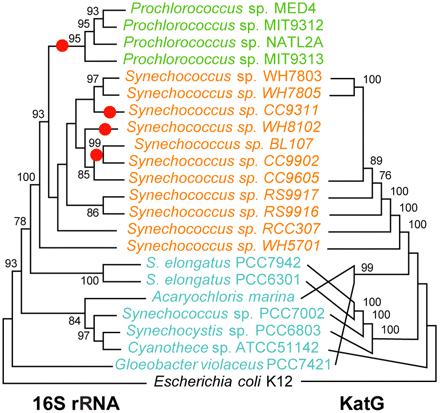
Some microorganisms lose the ability to perform a function that appears to be necessary for their survival, and yet they still somehow manage to endure and multiply. How can that be?
One hypothesis says microbes that shed necessary functions are getting others to 'do that work' for them, an adaptation that can encourage microorganisms to live in cooperative communities. Yes, genetic inter-organism cooperation and adaptive gene loss.
Approaching the 100th anniversary of the maiden voyage and subsequent nearly immediate sinking of the ship marketed as 'unsinkable' - the RMS Titanic, also known as the world's largest metaphor - it has become synonymous with bold claims that ironically come back to haunt the claimants.
In science, Lord Kelvin is a popular example of that, believed to have said "There is nothing new to be discovered in physics now, All that remains is more and more precise measurement" shortly before Albert Einstein took the lid off of physics and shook the whole concept around.
Scientists think they have found a way to prevent and possibly reverse the most debilitating symptoms of the rare, progressive childhood degenerative disease called ataxia-telangiectasia, or A-T disease, that leaves children with slurred speech, unable to walk, and in a wheelchair before they reach adolescence.
Most breast cancers are categorized as estrogen-receptor positive, which means they are hormone sensitive and may need estrogen to grow. Patients with this type of cancer often respond favorably to aromatase inhibitors, like tamoxifen, which cause cell death by preventing estrogen from reaching the cancerous cells. Over time, the disease often becomes resistant to estrogen deprivation from the drugs, making treatment options more limited.
New findings from the AACR Annual Meeting identified a pair of proteins that could play a crucial role in restoring treatment sensitivity to these resistant cancerous cells—possibly leading to more treatment options in the future.
People don't always see it , especially if social change does not move fast enough for their special interest, but the military has always been on the forefront of social issues.
A famous American general, John J. "Black Jack" Pershing, got that nickname because he proudly commanded the Buffalo Soldiers of the 10th Cavalry -
the "Negro Cavalry" as Native Americans of the 19th century called them - and Pershing didn't want it any other way. He wanted to win and that meant the best people.
We are fortune here at Science20 to have come across an early work by Gaston Leroux. This manuscript was dated to 1899, suggesting it was an early, discarded draft of the work that later came to be known as "The Phantom of the Opera". Current speculation is Gaston changed the setting at the beheast of his editor. Here, then, is the unabridged transcript of that early draft. It is set in the historic 1899 Paris Academie des Sciences, and begins with the arrival of two new managers to this prosperous yet troubled place.
[Secretary] "Welcome, new Branch Heads, to our Paris Laboratory! We owe our success to Professor Carlotta, though we do have a new post-doc named Christine Daei. Good luck with the upcoming grant season!"