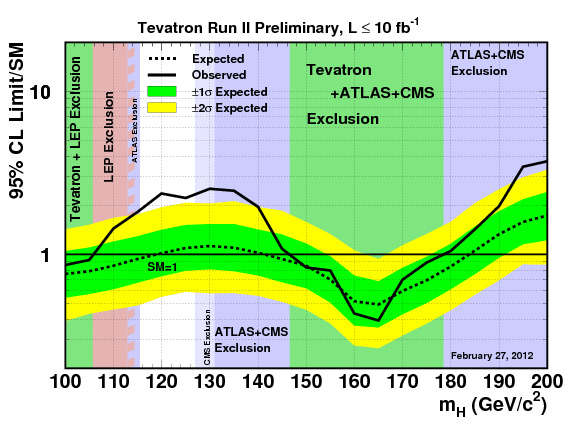
2.2 standard deviations. That is what the combination of CDF and DZERO searches for the Higgs boson yield, according to a release of the interactions news wire.
The talks on Higgs searches are scheduled for this morning at the Moriond Electroweak conference in La Thuile, a nice ski resort in the Italian alps.
The money plot is the one below, which shows the upper limit on the Higgs boson production rate, in units of the Standard Model expectation (y=1 on the vertical axis corresponds to the SM Higgs production rate, for the particular mass identified by the abscissa in the graph).
Utopia is a perfect world where we can eat to our heart's content without without getting heart disease or diabetes or even cancer. In mice, Utopia may be coming closer. Mice with an extra dose of a known anti-cancer gene called Pten lose weight even as their appetites grow. They also live longer - but not just because they aren't getting cancer.
One of the animals' youthful secrets is hyperactive brown fat, which burns energy instead of storing it. The findings add to evidence that tumor suppressors aren't designed only to protect us against cancer, the researchers say. They also point to new treatment strategies aimed to boost brown fat and fight aging.
One of our popular topics last year was earthquakes. That makes sense, with the earthquake in Japan. It's not like there was some greater instance of earthquakes but if you are a Doomsday fearmonger, any event is a good event; that means anti-science activists determined to send us back to the 13th century looked for ways to make earthquakes result from fracking.
If you dispute that, you get meaningless gibberish responses like 'you can't prove the earthquakes did not come from fracking', which is true, in the same way you can't prove I am not the disembodied brain of Adolf Hitler writing this piece from my Antarctic Fortress where I am plotting the Fourth Reich - but it's sort of silly to live your life believing it.
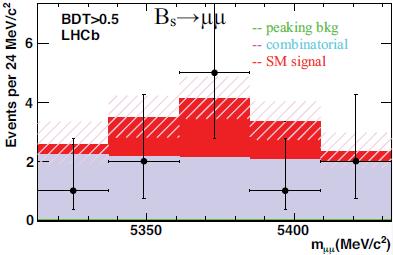
The Moriond EWK conference is in full swing and results are being shown of the recent new searches for rare decays of the Bs meson. The Bs is a hadron made up by a bottom quark and a (anti)strange one. The peculiar composition of this particle and its zero electric charge make it a very interesting probe of new physics in its decays: new physics processes might give a sizable contribution to the rate of decays yielding pairs of muons, which are both very rare in the standard model, and very easy to identify in the detector.
In 1957, when the USSR launched Sputnik, it began a new era in the Cold War. The Race to Space. Senator Lyndon Johnson worried the commies could rain nuclear bombs down on us from the high ground, making him the perfect guy to run NASA and because it was a military concern it got funded. Only later it became a human exploration issue and much later became a science one.
If you want to know basic things about animals, like who eats whom, you might guess that your days would consist of watching real-life nature documentaries. You might expect to go out into the savannah or into the depths of the sea to observe predators hunting and devouring their prey.
Actually, it takes a lot of sitting still and watching to see even a single predation event. It turns out you can get a lot more data a lot more quickly by looking at predator vomit and feces. Oh, the glamour of science!
When it comes to squid, the remmants they leave in their predators' guts or scat are usually beaks. These hard, chitinous structures last a lot longer than the muscle that makes up the rest of the squid.
“Exaggerated celebrations after making a goal, such as sliding, piling up, and tackling a team-mate when racing away, can result in serious injury.”
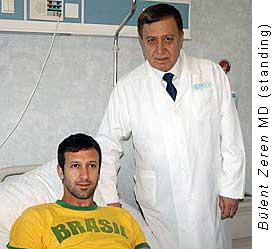 Bülent Zeren, MD from the Center for Orthopaedics and Sports Traumatology, Karsiyaka, Izmir, Turkey, and Haluk H. Öztekin, MD at the Clinic of Orthopaedics and Traumatology, Atatürk Research and Training Hospital, Izmir, Turkey, have undertaken one of the very few formal scientific studies into ‘Score-Celebration Injuries’ (SCIs)
A mini-medical machine could mean a new power scheme for cardiac pacemakers. Rather than use batteries, engineering researchers at the University of Michigan say they can use vibrations from heartbeats themselves.
Their new device is designed to harvest energy from the reverberation of heartbeats through the chest and convert those to electricity to run a pacemaker or an implanted defibrillator. By taking the place of the batteries that power them today, the new energy harvester could save patients from repeated surgeries - the only way today to replace the batteries, which last five to 10 years.
A research team has announced discovery of molecular oxygen ions (O2+) in the upper atmosphere of Dione, one of the 62 known moons orbiting Saturn.
“
Why is there something rather than nothing?” studies have become a field provided with copious Templeton funding. Yale recently had the 2011
WITA (Why is there Anything?) conference (see their
blog), which was funded by the Templeton and Yale Divinity School. Rutgers sports the
Rutgers Templeton Project in Philosophy of Cosmology, and they now have a
blog where they ask a list of questions ending in a grand finale with lucky number 13 being the ‘
WITA question ’ in its better known version: