



If you're a fan of "Big Trouble In Little China" (and if you are not, either go rent it and then come back or go read "People" like you should be doing instead of visiting Science 2.0)(1) next to "Chinese people got a lotta Hells"(2) this famous exchange likely sticks in your mind.  As they descend into a metaphorical netherworld on their quest (see: anything by Joseph Campbell or Bulfinch's Mythology, if you are more conservative in your reading) the following exchange takes place:

Jack Burton: That is not water.
Egg Shen: Black blood of the earth.
Jack Burton: Do you mean oil?
Egg Shen: I mean black blood of the earth.
The metabolic profiles of blood serum have revealed significant differences in metabolites between men and women, say scientists at the Helmholtz Zentrum München who have concluded that there is a need for gender-specific therapies. 

If you look at the most politicized aspects of science, it is areas where scientists and science journalists became advocates and stopped being trusted guides for the public. Result: the collapse of science journalism and increased distrust of scientists in those fields.

Paul Ehrlich, the Bing Professor of Population Studies at Stanford, says scientists need to be more political and not less. He summed it up this way: "You often hear people say scientists should not be advocates. I think that is bull."

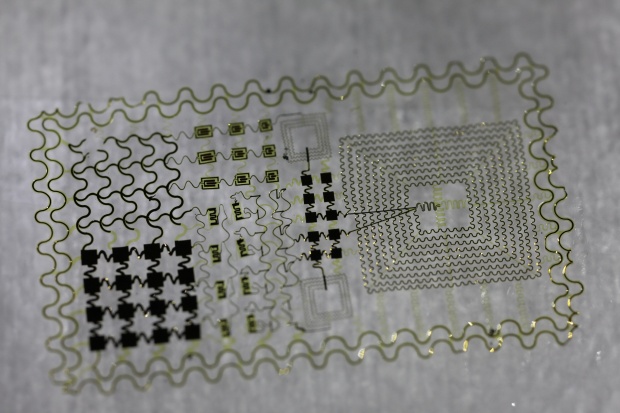
Micro-manufacturing even the "Sons of Anarchy could love - a new type of ultra-thin, self-adhesive electronic 'tattoo' that can effectively measure data about the human heart, brain waves and muscle activity.  No bulky equipment, conductive fluids or glues needed.

The researchers have created what looks like a cool tattoo, but in reality it is an epidermal electronic system (EES). They have incorporated miniature sensors, light-emitting diodes, tiny transmitters and receivers and networks of carefully crafted wire filaments into their initial designs.

Thousands of tons of toxic mercury are released into the environment each year and much of it ends up in sediment where it is converted into toxic methyl mercury, - and then enters the food chain, including in the fish we eat.

 New research in BMC Biotechnology details genetically engineered bacteria which can withstand high levels of mercury and go one step beyond - they can mop up mercury from their surroundings.

Researchers from the University of Valladolid (Spain) have answered one of science's most pressing questions - which beer is better, dark or pale?

They analyzed 40 brands of beer and found that dark beer has more free iron than pale and non-alcoholic beers. Iron is essential to the human diet but also helps oxidize the organic compounds that give beer, also essential to the human diet - at least among scientists - stability and flavor.  The work in the Journal of the Science of Food and Agriculture indicates that higher iron content in dark beer could be explained by the malt and hop extracts used to produce it.  

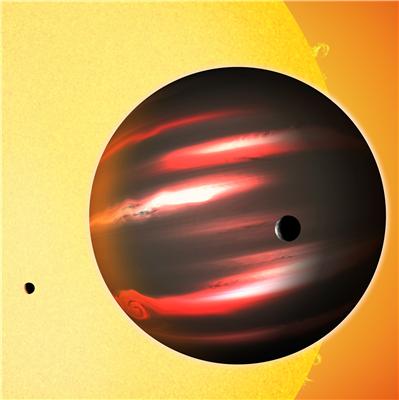
Astronomers writing in Monthly Notices of the Royal Astronomical Society say they have discovered the darkest known exoplanet, a Jupiter-sized gas giant called TrES-2b. Their measurements show that TrES-2b reflects less than one percent of the sunlight falling on it, making it blacker than coal or any planet or moon in our solar system.

Components of DNA have been found in several meteorites ever since the 1960’s, but the question that continually lingered was whether these components were actually made in space, or rather the result of terrestrial contamination. Now, NASA-funded researchers present three lines of evidence that should support the notion that these DNA building blocks were made in space (see figure 1).


Figure 1: DNA blocks made in space?

(Source: NASA)


So, can the building blocks of life be made inside meteorites?

It's about squid and it's about sperm, and apparently the combination is sexy enough to get this research onto the BBCMSNBCDiscover, and more. (Not to malign io9--that's actually where I first read about it.)

Usually, the Einstein-Podolsky-Rosen paradox is presented as if it potentially conflicts with the theory of relativity. This is because the correlation between Alice’s and Bob’s measurements seems to travel with superluminal speeds in one real world. The solution [1] of the EPR paradox shows that this view is upside-down, which is the reason it took so long to solve it satisfactorily.


Scientists and philosophers where trying to understand the quantum mechanics involved without bothering with relativity, because the problematic seems to conflict with relativity. However, in that way, the actual solution looks suspect:


