






Citizen Science – Past, Present & Future, to be held at Vaughan College, the University’s Institute of Lifelong Learning, will showcase longstanding research from the University’s Departments of Biology and Lifelong Learning, as well as from the Rutland Water Nature Reserve, the British Trust for Ornithology, Game and Wildlife Conservation Trust (GWCT) and the Earthwatch Institute, all linked with the University.

Its emphasis will be on how ordinary citizens have helped scientific research over the years of the University’s existence. In making this connection, the conference goes back to the very beginnings of Adult Education in Leicester, when Canon Vaughan made academic knowledge – including knowledge of the natural world – available to ordinary working class men and women of Leicester in the 19th Century. The university is proud to continue these traditions throughout the world.

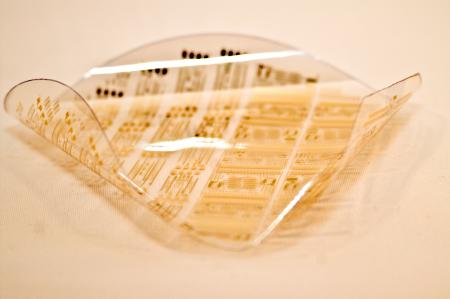
At yesterday’s International Solid State Circuit Conference, Holst Centre - founded by the Belgian nanoelectronics research center IMEC and the Dutch research center TNO - presented a plastic 64-bit inductively-coupled passive RFID tag operating at 13.56MHz.

With a record 780bit/s data readout of 64 bits over 10cm, the device approaches item-level tagging requirements. The tag generates a 5-fold higher bit rate compared to state-of-the-art plastic RFID systems. The achievement paves the way for low-cost high-volume RFID tags to replace barcodes.

The RFID system consists of a low-cost inductive antenna, capacitor, plastic rectifier and plastic circuit, all on foil. The LC antenna resonates at 13.56MHz and powers up the organic rectifier with an AC voltage at this frequency.

Computers are increasingly being used by those seeking sexual thrills and this use is helping inspire new and innovative technologies, according to a cybersex expert from University of Portsmouth.

Dr. Trudy Barber is delivering a lecture on the subject at a Royal Society of Medicine ‘Sexual Pleasures’ conference this week in which she will explain how fetishism and deviation in sexuality are helping change the way people use new technology and can even influence the invention of new technology. She doesn't say what those are but it's worth consideration.

Barber is a Senior Lecturer in the School of Creative Arts and Media (SCAFM) at the University of Portsmouth.

Antioxidants are believed to help ward off illness and boost the body’s immune system by acting as free radical scavengers, helping to mop up cell damage caused by free radicals. But you don't have to pay a lot; the humble white button mushroom (Agaricus bisporus) has as much, and in some cases, more antioxidant properties than more expensive varieties.

Although the button mushroom is the foremost cultivated edible mushroom in the world with thousands of tons being eaten every year, it is often thought of as a poor relation to its more exotic and expensive cousins and to have lesser value nutritionally.

But according to new research in the Journal of the Science of Food and Agriculture, the white button mushroom has as much antioxidant properties as its more expensive rivals, the maitake and the matsutake mushrooms - both of which are highly prized in Japanese cuisine for their reputed health properties including lowering blood pressure and their alleged ability to fight cancer.

Scientists at Carnegie Mellon University’s Molecular Biosensor and Imaging Center have developed new “fluorogen activating proteins” (FAPs) that will become a key component of novel molecular biosensor technology being created at Carnegie Mellon. The FAPs, which can be used to monitor biological activities of individual proteins and other biomolecules within living cells in real time, are described in the February issue of Nature Biotechnology.

Carnegie Mellon scientists designed the FAPs to emit fluorescent light only when bound to a fluorogen, an otherwise non-fluorescent dye added by the scientists. This feature will allow biologists to track proteins on the cell surface and within living cells in very simple and direct ways, eliminating cumbersome experimental steps.

A predisposition for obesity might be wired into the brain from the start, suggests a new study of rats in Cell Metabolism.

Rats selectively bred to be prone to obesity show abnormalities in a part of the brain critical for appetite control, the researchers found. Specifically, the researchers show that the obese rats harbor defects in neurons of the arcuate nucleus (ARH) of the hypothalamus, which leaves their brains less responsive to the hunger-suppressing hormone leptin.

Paleontologists, who use estimates based on the fossil record, and scientists who use "molecular clock" methods to study evolutionary history, have never agreed on when modern birds came into existence, because they have had conflicting results.

A new analysis by researchers at the University of Michigan, the University of Chicago, the Centre for Biodiversity Conservation Mexico and Central America, and Boston University offers the strongest molecular evidence yet for an ancient origin of modern birds, suggesting that they arose more than 100 million years ago, not 60 million years ago, as fossils suggest.

Squeeze a crystal of manganese oxide hard enough, and it changes from an electrical insulator to a conductive metal. In a Nature Materials report, researchers use computational modeling to show why this happens.

The results represent an advance in computer modeling of these materials and could shed light on the behavior of similar minerals deep in the Earth, said Warren Pickett, professor of physics at UC Davis and an author on the study.

Manganese oxide is magnetic but does not conduct electricity under normal conditions because of strong interactions between the electrons surrounding atoms in the crystal, Pickett said. But under pressures of about a million atmospheres (one megabar), manganese oxide transitions to a metallic state.

Manic depression, also known as bipolar disorder, is a psychiatric condition characterized by alternating mania and depression, affecting about one in every hundred people worldwide. Although it is known that the condition can be treated relatively effectively using the mood-stabilising drugs lithium and valproic acid, the reasons why these treatments work are poorly understood.

People with manic depression have a distinct chemical signature in their brains, according to a new study. The research may also indicate how the mood stabilisers used to treat the disorder counteract the changes in the brain that it appears to cause.

Ethylene, the world's most commonly produced organic compound, is used many types of industries. Farmers and horticulturalists use it as a plant hormone to promote flowering and ripening, especially in bananas while doctors and surgeons have long used ethylene as an anesthetic and ethylene-based polymers are found in everything from freezer bags to fiberglass.

Its current production methods result in a number of greenhouse gases. A new environmentally friendly technology created by scientists at Argonne National Laboratory may revolutionize creation of this compound by use of a high-temperature membrane that can produce ethylene from an ethane stream by removing pure hydrogen. Says senior ceramist Balu Balachandran, “This is a clean, energy-efficient way of producing a chemical that before required methods that were expensive and wasteful and also emitted a great deal of pollution.”


