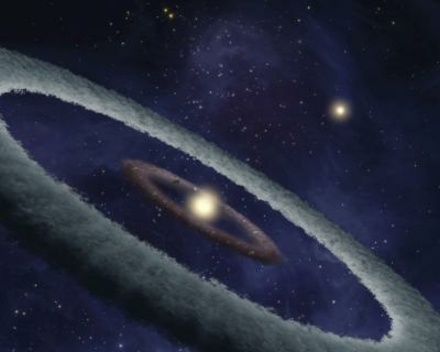






A new groups of exoplanets announced today comprises no less than 32 new discoveries. Including these new results, data from HARPS have led to the discovery of more than 75 exoplanets in 30 different planetary systems.
In 1999, ESO launched a call for opportunities to build the High Accuracy Radial Velocity Planet Searcher, better known as HARPS, a high resolution, extremely precise spectrograph for the ESO 3.6-meter telescope at La Silla, Chile.
Brain activity considered to be spontaneous 'white noise' changes after a person learns a new task, according to researchers, and the degree of change reflects how well subjects have learned to perform the task.
The suggestion is that this learning-induced change in the brain's spontaneous activity may reflect a 'memory trace' for the new skill, which makes it easier to use those parts of the brain together again when the same challenge is presented.
In addition to helping anatomical connections between different brain regions, the changes in spontaneous brain activity may maintain a record of prior experience that constrains the way the same circuitries are recruited at the time of a task.
The conventional family has changed over the last few decade but regardless of parent genders or family structure, adolescents' perception of proper family functioning has changed little, says a new study.
Previous studies have pointed to families without a regular structure, such as headed by a lone parent or including the children of other partners, etc. as leading to a greater risk of teenagers living in such families turning to drugs or being violent, having mental health problems or even exhibiting criminal behavior.
Ah, to be a lizard - lay around in the sun, star in Japanese movies and, if your tail is pulled off, you grow it right back.
Humans are not so lucky about the regeneration part but Tel Aviv University research says we may come close.
Prof. Meital Zilberman of TAU's Department of Biomedical Engineering has developed a new biologically active "scaffold" made from soluble fibers, which may help humans replace lost or missing bone. With more research, she says, it could also serve as the basic technology for regenerating other types of human tissues, including muscle, arteries, and skin.
While the body mass index (BMI) has been a popular yardstick for deciding who is at risk of obesity-related diseases because of their weight, since it is essentially a measure of density, identifying 'under-' and 'over-weight' risk groups, a more sophisticated approach than BMI is needed, says a new study.
Brookhaven National Laboratory scientists say your wine bottle may hold a secret to a new biofuel.
Inside cork is an enzyme responsible for the formation of suberin, the woody, waxy, cell-wall substance found in cork. It helps keep wine inside your bottle but in plants suberin controls water and nutrient transportation and keeps pathogens out.
Adjusting the permeability of plant tissues by genetically manipulating the expression of this enzyme could lead to easier agricultural production of crops used for biofuels.
It is estimated that biomass covers currently up to 15% of the world energy demand, almost 1/3 of all energy consumption in the Less-Developed Countries. This rate was over the last years rather constant, with increasing overall demand bioenergy consumption increased in absolute terms.
Table 1 : World Energy Consumption pattern 1997 (ref 1)
Biomass Share
Total World 9.6 Bio TOE 1-1.5 Bio TOE 11-15%
Asia 2.3 Bio TOE 0.6-0.8 Bio TOE >30%
Africa 0.4 Bio TOE 0.2-0.27 Bio TOE >50%
Lat. America 0.4 Bio TOE
Now that we're all convinced the Humboldt squid
isn't going to eat you, let's turn the question around: can you eat the Humboldt squid?
First, from the public health angle:
Does it have mercury, everyone wants to know about any seafood, quickly followed by,
I don't want nasty parasites.
From Oct. 9-30, the University of Guelph and
Ed Video are hosting a special art exhibit entitled "
This View of Life: Evolutionary Art for the Year of Darwin". It was organized by professors in four departments: Integrative Biology, Philosophy, History, and English and Theatre Studies, and was curated by Scott McGovern of Ed Video. The exhibit features art by 10 artists, all inspired by the themes of evolution, Darwin, and biodiversity.
The
Gregory Lab contributed some installations as well, which are shown in this brief clip from just before the opening reception on Oct. 16 (about 200 people attended the event).
As Hank
explains in a recent article, when he visits a Casino he plays the Roulette. His simple strategy consists in betting on a single colour, doubling the bet every time he loses; when he wins, he starts back with the minimum bet.

