A study led by Loyola Medicine researchers found that female triathletes are at higher risk for pelvic floor disorders, among other health issues.

The study, published in Female Pelvic Medicine and Reconstructive Surgery, found that female triathletes suffered from a high rate of stress urinary and anal incontinence.

"We expected the high rates of urinary incontinence, but did not expect to find such high rates of anal incontinence," said senior author, Colleen Fitzgerald, MD, MS. Dr. Fitzgerald is the medical director of the Chronic Pelvic Pain program and an associate professor in the department of obstetrics and gynecology at Loyola University Chicago Stritch School of Medicine.

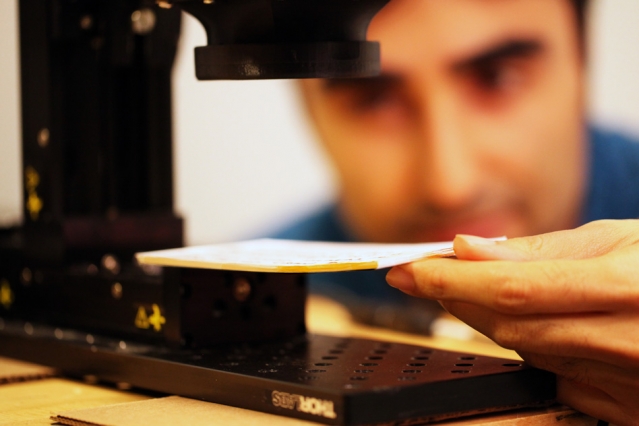
You soon won't have to judge a book by its cover, you'll be able to judge through it. Researchers writing in Nature Communications describe a prototype of an imaging system that can read closed books. They tested on a stack of papers, each with one letter printed on it. The system was able to correctly identify the letters on the top nine sheets.

Three out of four (75 percent) people in the UK are unaware of the link between obesity and cancer, according to a new Cancer Research UK report. The nationwide survey found that people from lower socioeconomic backgrounds are less likely to know about the link. And men are less likely than women to be aware of the increased risk of cancer caused by obesity.

Researchers of Aalto University have made a breakthrough in controlling the motion of multiple objects on a vibrating plate with a single acoustic source. By playing carefully constructed melodies, the scientists can simultaneously and independently move multiple objects on the plate towards desired targets. This has enabled scientists, for instance, writing words consisting of separate letters with loose metal pieces on the plate by playing a melody.

By 1992, environmental activist Jeremy Rifkin claimed, we would achieve Peak Oil. Fossil fuels would begin to decline. Rifkin was just going by an environmental press release but Peak Oil had a long history; almost as long as oil itself.

In 1919, the chief geologist of the United States Geological Survey, said Peak Oil would happen within 3 years, while King Hubbert of Shell Oil predicted in 1956 that Peak Oil would happen by 1971. So by 1992 those claims were only working with a new generation of people who didn't understand science. In reality, math models containing all those variables are unlikely to be right. 

A research team including Professor William Laurance from James Cook University has discovered there has been a catastrophic decline in global wilderness areas during the past 20 years.

The team showed that since the 1990s, one-tenth of all global wilderness has vanished--an area twice the size of Alaska. The Amazon and Central Africa have been hardest hit.

The findings underscore an urgent need for international policies to recognise the value of wilderness and to address unprecedented threats to it, the researchers said.

"Environmental policies are failing the world's vanishing wildernesses," said Professor Laurance.

A new study puts some old folk wisdom to "feed a cold and starve a fever" to the test. In mouse models of disease, Yale researchers looked at the effects of providing nutrients during infection and found opposing effects depending on whether the infections were bacterial or viral. Mice with bacterial infections that were fed died, while those with viral infections who were fed lived. The paper appears September 8 in Cell.

Today's industrial yeast strains are used to make beer, wine, bread, biofuels, and more, but their evolutionary history is not well studied. In a Cell paper publishing September 8, researchers describe a family tree of these microbes with an emphasis on beer yeast. The resulting genetic relationships reveal clues as to when yeast was first domesticated, who the earliest beer brewers were, and how humans have shaped this organism's development.

"The flavor of the beer we drink largely depends on yeast," explains Kevin Verstrepen, a yeast geneticist at the University of Leuven and VIB in Belgium. "We're drinking the best beers now because ancient brewers were smart enough to start breeding yeast before they knew what they were doing. It was really an art."

Up until now, scientists had only recognized a single species of giraffe made up of several subspecies. But, according to the most inclusive genetic analysis of giraffe relationships to date, giraffes actually aren't one species, but four. For comparison, the genetic differences among giraffe species are at least as great as those between polar and brown bears.

The unexpected findings reported in the Cell Press journal Current Biology on September 8 highlight the urgent need for further study of the four genetically isolated species and for greater conservation efforts for the world's tallest mammal, the researchers say.

Ants visually track the motion of objects as they move through their environment in order to determine the distance they have traveled, a new study reports. Such tracking, called optic flow, has been observed in a number of insects but was thought to be used only minimally by ants. Now, results by Sarah Elisabeth Pfeffer and Matthias Wittlinger suggest that certain ants can rely solely on optic flow to find their way back to their nest when lost. Here, they studied Cataglyphis bicolor desert ants, which exhibit unique behaviors; namely, experienced forager ants carry interior nest workers, who are much less familiar with the outdoor environment, between different nest sites.


