A doctoral thesis carried out at the University of Granada has proved that patients with serious anxiety disorders (panic disorder with and without agoraphobia, social anxiety disorder or generalized anxiety disorder) think they suffer more physiological (palpitations, sweating, irregular breathing, shaking of the hands and muscular tension …) than they really have. In other words, although many patients with anxiety disorders have orally reported very intense physiological symptoms in surveys and questionaires, they are hyporeactive when real measures of such symptoms are taken through physiological tests.
A new study by sociologists at the University of Maryland concludes that unhappy people watch more TV, while people who describe themselves as very happy spend more time reading and socializing. The study appears in the December issue of the journal “Social Indicators Research.”

Analyzing 30-years worth of national data from time-use studies and a continuing series of social attitude surveys, the Maryland researchers report that spending time watching television may contribute to viewers’ happiness in the moment, with less positive effects in the long run.
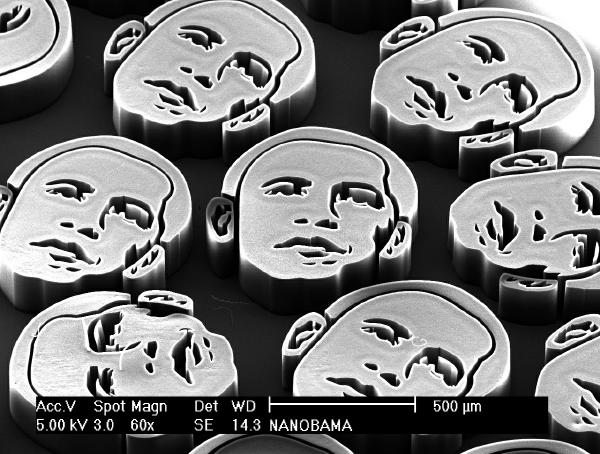
A University of Michigan professor has created 3-D portraits of the president-elect that are smaller than a grain of salt. He calls them "nanobamas."

John Hart, an assistant professor in the Department of Mechanical Engineering, made the mini-Barack Obama 'Nanobama' likenesses with his colleagues to raise awareness of nanotechnology and science.   Plus, Obama flowed much nicer with 'nano' than  McCain would have.   And Hart voted for Obama, not that you didn't think so already.

Each one contains about 150 million carbon nanotubes stacked vertically like trees in a forest. A carbon nanotube is an extraordinarily strong hollow cylinder about 1/50,000th the width of a human hair. 
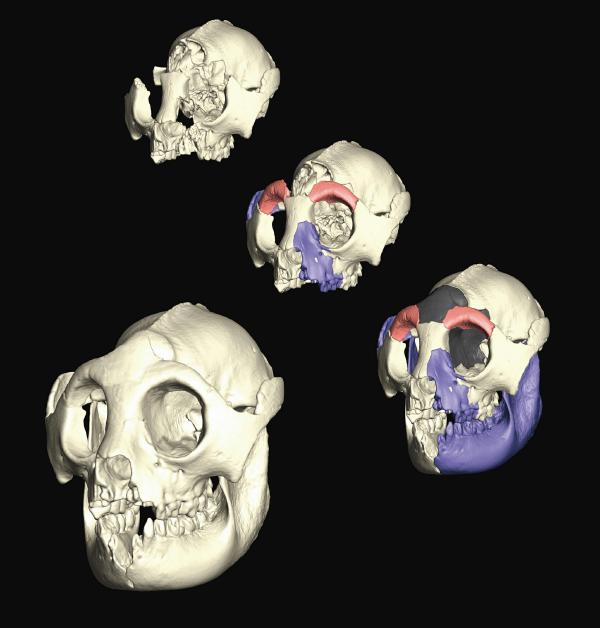
Scientists in Madagascar, at the American Museum of Natural History in New York and the Vienna Natural History Museum and at the University of Massachusetts Amherst now have a nearly complete skeleton of a rare species of extinct lemur to study thanks to a century-long discovery and reconstruction effort. Laurie R. Godfrey, professor of anthropology at UMass Amherst and lemur expert, played a key role in the process in which contemporary researchers were able to match newly found bones with those discovered in a cave in Madagascar in 1899 to construct much of the skeleton of a rare species of extinct lemur.

“It’s remarkable that we were able to reunite bits of the original skeleton,” Godfrey says. “This is a very big gift to science from many people.”

NAPA, California, November 14 /PRNewswire/ --

- Senetek is Debt-Free with Cash on Hand of US$16.7 million at September 30

- Annual General Meeting and Concurrent Broadcast Scheduled for December 16

Senetek PLC (OTC Bulletin Board: SNKTY), a Life Sciences company engaged in the development of technologies that target the science of healthy aging, today announced financial results for the quarter ended September 30, 2008.

Revenue for the quarter ended September 30, 2008 was US$483,000, compared with US$469,000 reported in the third quarter of 2007.

Net loss for the quarter ended September 30, 2008 totaled US$1,050,000, or US$0.14 per share compared to a net loss of US$998,000 or US$0.13 per share in the third quarter of 2007.

AMSTERDAM, Netherlands and NEW YORK, November 14 /PRNewswire/ --

- Playlogic Q3 2008 Results Lower Than Expected Due To A Shift In Product Release Dates From Q3/Q4 2008 To Q1 In 2009

Playlogic Entertainment, Inc. (OTC Bulletin Board: PLGC) announced today its results for the first nine months 2008, ended September 30.

Net revenues

For the first nine months, ended September 30, net revenues increased to US$9.4 million, compared with US$8.3 million in 2007, an increase of 13%. For the 3rd quarter of 2008 net revenues decreased to US$1.1 million compared with US$3.7 million in the 3rd quarter of 2007.

Gross profit

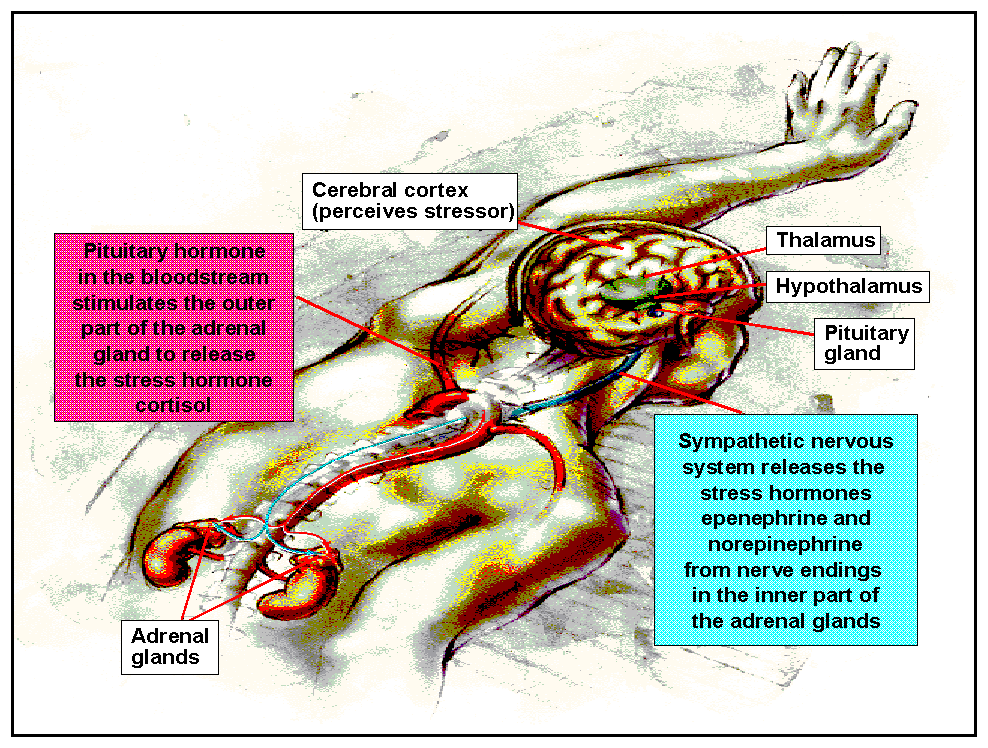
There are a few things that are a given when it comes to understanding the human body. Long periods of stress are bad. We all know this. Stress from relationships, work or other causes are bad for us. We get less sleep, eat worse and we get sick more often. We also know that exercise is good for us. This is also a given.

Molecular biologists have long operated on the principle that knowing the structure of a biological entity is critical for understanding how it works. Most famously, this was the premise behind one of biology's most iconic discoveries, Watson and Crick's model of the structure of DNA. Structure-function studies have been the foundation of much of molecular biology ever since.

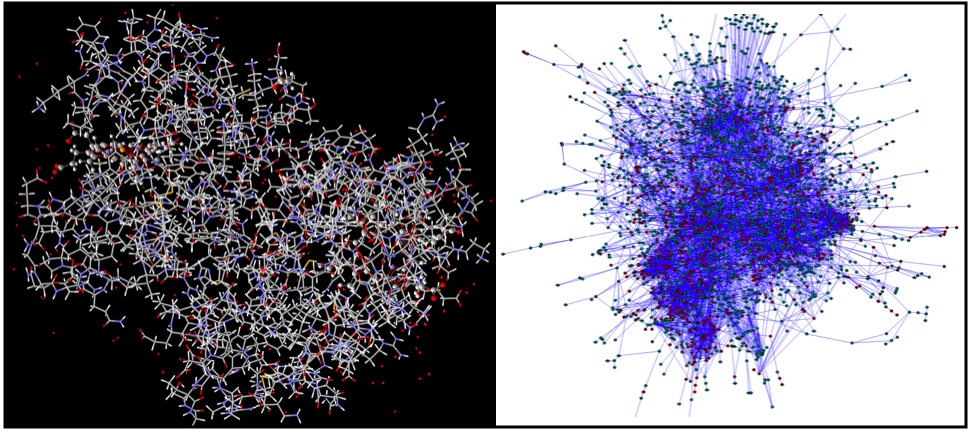
Although the structure of DNA yielded almost immediate insight into an important biological problem, solving structures hasn't always resulted in a eureka moment. The same year Watson and Crick received their Nobel Prize, two other scientists, John Kendrew and Max Perutz, were also awarded the Nobel for determining the structure of a biological molecule. Unfortunatly for Kendrew and Perutz, instead of a flash of insight the result was incomprehension. They had determined the structure of two related proteins, myoglobin and hemoglobin, and these structures at first glance looked like just an irregular mass of thousands of atoms.

Happily, the befuddlement didn't last long. Scientists quickly learned how protein structures explain their function, and today we have amazing structural snapshots of proteins in action. These studies of structure have helped biologists understand the gritty details of key biological processes, such as how membrane-embedded ion pumps enable our nerves to conduct electrical signals. Using a protein's structure to understand its function has now become routine.

But today biologists are facing another moment of incomprehension. We're staring at structures of a different type of biological entity: a network, not an irregular mass of atoms, but one of connections. We know that biological networks give cells their ability to make sense of the world, to process information, to sense the environment or the cells' own internal state, and to take appropriate action. Scientists have been mapping these networks in great detail for years now, but the result is frequently just a giant, molecular hairball (or 'ridiculogram', as a friend calls it).

In other words, scientists are facing yet another giant structure-function problem. How do the strucures of biological networks result in something functional?


WASHINGTON, November 14 /PRNewswire/ --

- Neuroscience Research Goes Digital with Online, 3D Mapping For Faster, More Accurate Research

A revolutionary product that will change the face of brain research was announced today by Elsevier in partnership with the Allen Institute for Brain Science. BrainNavigator (http://www.elsevierlabsuite.com/brainnavigator), a 3D research tool, will replace bulky desk atlases and move brain research online, saving scientists time while improving the quality of day-to-day research.

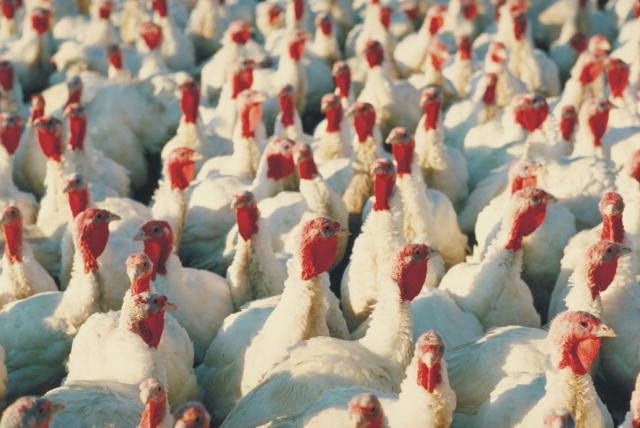
'Tis the season for the local supermarkets to feature delicately balanced displays of gravy, stuffing mix, and cranberry sauce. Thanksgiving is almost upon us, and the centerpiece of the upcoming meal for 95% of families will be the traditional roast turkey.

Americans gobble up a lot of turkey: 267 million­ turkeys are sold in the United States each year. Considering all those turkeys, it may surprise you to hear that there's one that dominates the competition at the supermarket: the broad-breasted white turkey. Most of us have never eaten anything else.