Hydrogen is an ideal solution for cars of the future. The problem remains storage. People have a range they want to go (300 miles) before an automobile enhancement can become commercially acceptable. With hydrogen, that means carrying a tank the size of the car itself or compressing the hydrogen, which has unacceptable safety risks.
Dutch-sponsored researcher Robin Gremaud has shown that an alloy of the metals magnesium, titanium and nickel is excellent at absorbing hydrogen. A hydrogen 'tank' using this alloy would have a relative weight that is sixty percent less than a battery pack. In order to find the best alloy Gremaud developed a method which enabled simultaneous testing of thousands of samples of different metals for their capacity to absorb hydrogen.
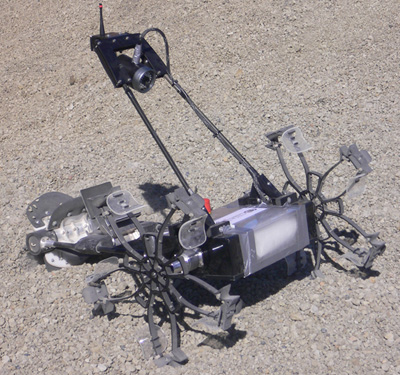
A robot rover designed by a Bremen university team has won an ESA contest to retrieve soil samples from a lunar-style terrestrial crater. Eight student teams fielded rovers during the event, their progress monitored by an advanced 3-D viewer already flight-tested in space and planned for eventual deployment on the Moon.
Craters surrounding the Moon's poles are a top 21st Century science target. Lunar researchers believe these craters may be 'cold traps', preserving ancient water ice deposits. Such ice would not only be an invaluable time capsule, it would also support manned lunar settlements. But the only way to verify the ice is there is to go fetch it, which is where rovers come in.
Researchers at the University of Virginia Health System report that a daily single oral dose of an investigational drug, MK-677, increased muscle mass in the arms and legs of healthy older adults without serious side effects, suggesting that it may prove safe and effective in reducing age-related frailty.
Published in the November 4, 2008 issue of Annals of Internal Medicine, the study showed that levels of growth hormone (GH) and of insulin-like growth factor I (IGF- I) in seniors who took MK-677 increased to those found in healthy young adults. The drug restored 20 percent of muscle mass loss associated with normal aging.
A Harvard-based study led by Drs. Gottfried Schlaug and Ellen Winner and published in PLoS ONE has found that children who study a musical instrument for at least three years outperform children with no instrumental training on tests measuring verbal ability and visual pattern completion, skills not normally associated with music, along with tests of auditory discrimination and finger dexterity, which are traditionally skills honed by the study of a musical instrument.
A team led by a Montana State University professor has found a fungus that produces a new type of diesel fuel, which they say holds great promise. Calling the fungus' output "myco-diesel," Gary Strobel and his collaborators describe their initial observations in the November issue of Microbiology.
The discovery may offer an alternative to fossil fuels, said Strobel, MSU professor of plant sciences and plant pathology. The find is even bigger, he said, than his 1993 discovery of fungus that contained the anticancer drug taxol.
According to the international space agencies, 'space weather' like radiation from the sun and cosmic rays in a solar storm, is the single greatest obstacle to deep space travel. New research out today in Plasma Physics and Controlled Fusion shows how knowledge gained from the pursuit of nuclear fusion research may reduce the threat to acceptable levels, making man's first mission to Mars a much greater possibility.
The solar energetic particles, although just part of the 'cosmic rays' spectrum, are of greatest concern because they are the most likely to cause deadly radiation damage to the astronauts.
TOKYO, November 3 /PRNewswire/ --
- Local Language Interface Accelerates Business Decisions and Improves User Experience
The Scientific business of Thomson Reuters, the world's leading source of intelligent information for businesses and professionals, announced today the launch of a Thomson Innovation(SM) user interface in Japanese ( www.thomsoninnovation.com) to enhance productivity and decision making for Japanese intellectual property (IP) professionals. Japan remains the worldwide leader in published patents according to an analysis of data in Derwent World Patent Index(R), the world's most comprehensive database of enhanced patent documents.
PARIS, November 3 /PRNewswire/ --
Nanosec GmbH introduces the IDForce the world's smallest and fastest table-top laser personalization machine at the 2008 Cartes IDentification Exhibition in Paris, France this week. The new machine is ideally suited for de-centralized, secure laser engraving of cards, like bank cards and National IDs. This secure card personalization solution uses an advanced fiber optic laser engraving technology with the unrivaled capability of deep penetration and long term stability by laser light induced photo chemical reaction resulting in cards with high resolution photo images up to 1600 dpi, text, bar codes, signatures, tactile characters and additional graphics or security elements.
DUBAI, United Arab Emirates, November 3 /PRNewswire/ --
- Service Offers Real Time Measurement and Verification of Carbon Footprint for Homes, Buildings and Infrastructure Globally Using Cloud Computing
At RealTech Middle East 2008, Pacific Controls announced that they have established a state of the art Energy Services Global Command Control Centre at their headquarters building in Techno Park, Dubai, UAE.
(Photo: http://www.newscom.com/cgi-bin/prnh/20081103/327184 )
This Energy Services Global Command Control Centre will offer their Customers, Business Partner's Government and International Agencies real time measurement and verification of carbon footprint for homes, buildings and infrastructure globally.
Does your office lighting make you feel weary and dreary?
The cure may be at hand!
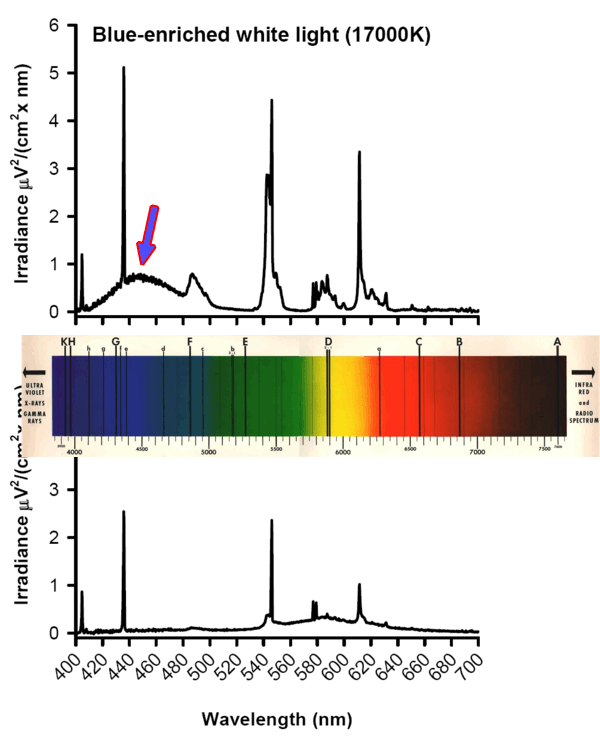
Recently, Professor Derk-Jan Dijk of the Surrey Sleep Centre has led a team testing out new bulbs with a colour temperature of 17,000 Kelvin and found that they increase alertness as compared with more traditional types of lighting. But this sounds rather alarming.
17,000 Kelvin would be the temperature of a star close to B3 in the main sequence, somewhere between
Alkaid and
Regulus in properties.
The luminance of these stars is largely in the ultravio