In New York City, you can easily date a different person within a mile of your home for the rest of your life and never come close to duplicating - and that may be why people in New York City have trouble finding relationships, according to a study in Psychological Science.
When people have a large number of potential dating partners to select from, say psychologist Alison Lenton of the University of Edinburgh and economist Marco Francesconi of the University of Essex, they respond by paying attention to different types of characteristics – discarding social attributes such as education, smoking status, and occupation in favor of physical characteristics such as height and weight.
I just became aware of a letter that is being sent to a couple of US Senators by a large and illustrious collection of scientists, and I decided to put my signature below it. The letter is clear and I will not comment it here - suffices to just paste it here.
By the way, I do not think that more signatures are necessary to it, but if you agree with the contents and wish to participate your support, please do so by adding your name below, in the comments thread. It will just take you thirty seconds of your valuable time, but it might have an impact here too.
-----------
Senator Dianne Feinstein
Chairman
Energy& Water Appropriations Subcommittee
SenatorLamar Alexander
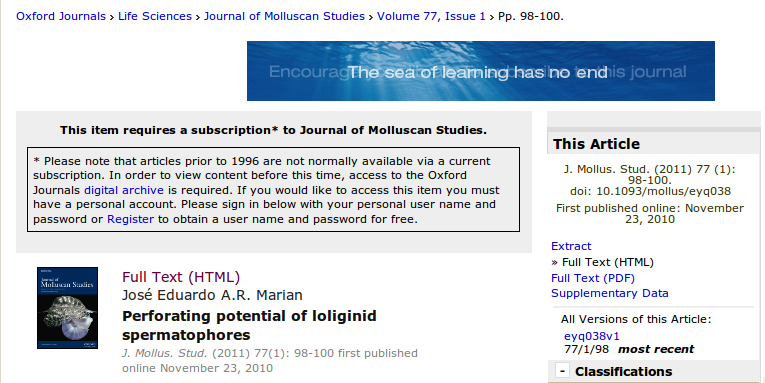
Squid sex is both discreet and discrete.
Discreet, because usually the sexual organs remain hidden. The only visible activity looks more like a handshake than like intercourse, as the male uses one arm to pass sperm to the female.
Discrete, because the sperm comes in neat, quantized packages rather than free-flowing semen. These packages are called spermatophores, and they're quite complex. In addition to a mass of sperm, they have a variety of tools for attaching themselves to the female's body.
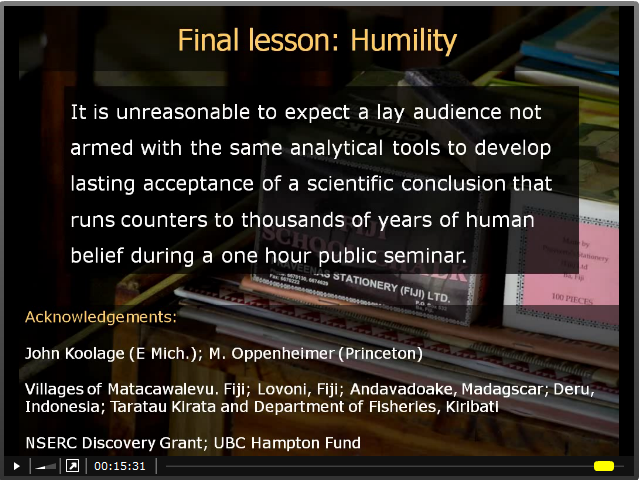
If we're being honest in retrospect, the first decade of the 2000s was bad for science journalism. Too many journalists decided they wanted to be cheerleaders for science or, worse, had scientist envy and wanted to be included in cool discussions about the mysteries of the universe.
Basically, journalists stopped asking the awkward questions of scientists that journalists in other fields know makes their careers (see: Dan Rather and Richard Nixon). Result: While the science audience is up and science knowledge has tripled since 1988, jobs in science journalism are down. Few people read them.
Henry VIII, King of England and founder of the Anglican Church, was basically the Brad Pitt of his day when he was younger. Charming, attractive and even kind, for a member of the Royal family. Yet he is most remembered for being gluttonous, impaired and executing wives.
What happened?
Thousands of artifacts made from chert, a flint-like rock used to make projectile points and other stone tools, are in some cases so delicate that their only practical use would have been on the water, says Jon Erlandson, professor of anthropology and director of the Museum of Natural and Cultural History at the University of Oregon, who has been conducting research on California's Channel Islands for more than 30 years.
The smartest, and yet most disingenuous thing, the homeopathy industry did was conscript 'natural medicine' as part of its umbrella. Homeopathy is clearly snake oil whereas natural remedies have worked since man discovered plants.
Scientists understand the distinction, even if proponents of homeopathy do not - or pretend they don't, if it will bilk unsuspecting people out of money. And because scientists understand the value of natural medicine the goal has always been to understand why things work and, when possible, to synthesize them and make them affordable.
If you saw the film version of "Mamma Mia!" you may have wondered why some of the actors could act, sing and dance and some, clearly, could not.
A new study in Current Biology says that people who are fast to learn a simple sequence of finger motions, like a piano piece, or quick to pick up dance numbers, are also those whose brains show large changes in a particular chemical messenger, gamma-aminobutyric acid(GABA), following electrical stimulation. GABA is important for the plasticity of the motor cortex, a brain region involved in planning, control, and execution of voluntary movements.
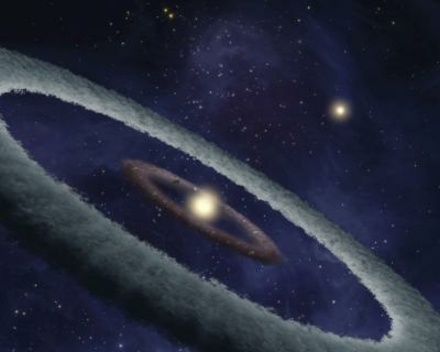
Sunspots are dark spots on the sun, at least as we see them, caused by magnetic activity in the plasma on the surface of Sol.
For 200 years scientists have known that they occasional disappear but no one was sure exactly why. A trio writing in Nature say they have solved the mystery and now can even predict the next time. Piet Martens, Dibyendu Nandi and Andres Munoz-Jaramillo say they have discovered why sunspots were missing from 2008 to 2010, which coincided with an extra-long "solar minimum" and unusually weak magnetic fields at the sun's poles. The fields are ordinarily much stronger when solar activity is minimal.
My husband has an enormous head. Sometimes this concerns me, when I consider the degree to which skull size may have a genetic basis and the fact that we'll probably reproduce at some point. That has to fit through there? OW.
But maybe I should be grateful. I'll certainly have an easier time of it than female Atlantic bobtail squid (Sepiola atlantica). These mamas, according to a recent study on their spawning behavior, can lay up to one and a half times their own body weight in eggs. That would be like me, at 125 pounds, producing 187.5 pounds of baby. WOW.