





Located at the University of Utah, the High Resolution Fly's Eye (HiRes) is an experiment to study the highest energy cosmic rays to determine the energy, direction, and chemical composition of the incident particle.

Final results show that the most energetic particles in the universe rarely reach Earth at full strength because they come from great distances, so most of them collide with radiation left over from the birth of the universe.

The findings are based on nine years of observations at the now-shuttered observatory on the U.S. Army’s Dugway Proving Ground. They confirm a 42-year-old prediction – known as the Greisen-Zatsepin-Kuzmin (GZK) “cutoff,” “limit” or “suppression” – about the behavior of ultrahigh-energy cosmic rays, which carry more energy than any other known particle.

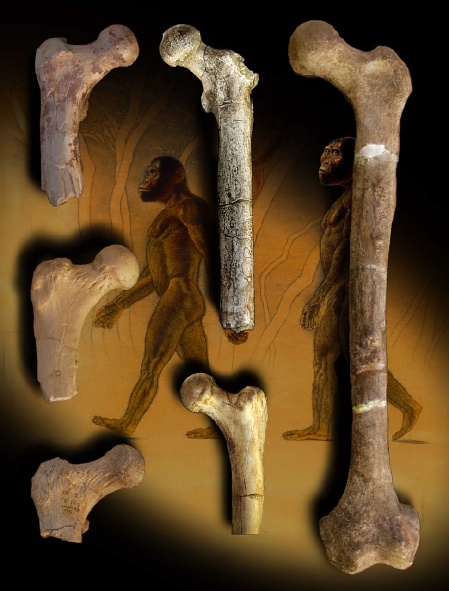
A shape comparison of the most complete fossil femur (thigh bone) of one of the earliest known pre-humans, or hominins, with the femora of living apes, modern humans and other fossils, indicates the earliest form of bipedalism occurred at least six million years ago and persisted for at least four million years.

William Jungers, Ph.D., of Stony Brook University, and Brian Richmond, Ph.D., of George Washington University, say their finding indicates that the fossil belongs to very early human ancestors, and that upright walking is one of the first human characteristics to appear in our lineage, right after the split between human and chimpanzee lineages.


Early human upright walking. A 6 million-yea- old thighbone, or femur (center), represents an upright walker of one of the earliest human ancestors (Orrorin), and resembles 2-3 million year old thighbones of australopiths (left, bottom). Thighbones of Homo (right) mark a transition toward a more modern gait about 2 million years ago. Credit: artwork and composite byJohn Gurche, photograph by Brian Richmond.

A cheap alternative to silicon solar cells can be found in dye-sensitized solar cells. This type of cell imitates the natural conversion of sunlight into energy by plants and light-sensitive bacteria. Annemarie Huijser has succeeded in substantially improving a process in this type of solar cell, which is similar to Grätzel cells.

The use of solar cells is increasing very slowly. One of the reasons is that the most commonly used type, made from silicon, is quite expensive to manufacture. That is why there has been a great deal of research into alternative solar cells over the past few years.

MANCHESTER, England, March 20 /PRNewswire/ --

- ATTN: Northern Region Editors

Two leading skincare experts will be alerting adults in and around Manchester to the signs and symptoms of rosacea and how to regain control of their skin as part of an evening event called 'Beyond the Red Face - Positive ways of living with rosacea' at the Manchester Conference Centre.

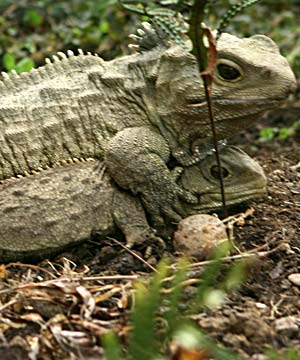
The tuatara, Sphendon punctatus, is found only in New Zealand and is the only surviving member of a distinct reptilian order Sphehodontia that lived alongside early dinosaurs and separated from other reptiles 200 million years ago in the Upper Triassic period.

In a study of New Zealand’s “living dinosaur”, evolutionary biologist David Lambert and his team recovered DNA sequences from the bones of ancient tuatara, which are up to 8000 years old. They found that, although tuatara have remained largely physically unchanged over very long periods of evolution, they are evolving - at a DNA level - faster than any other animal yet examined.


My 200 million years here proves that this is the oldest pasttime.

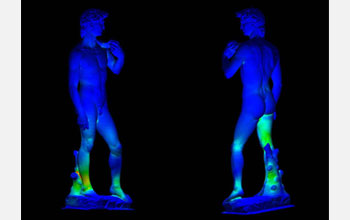
For statues, hidden stress and fractures result from standing in place for hundreds of years. Researchers have now developed a way to predict such fracturing, applying the procedure to Michelangelo's David in an analysis that proved simpler, faster and more accurate than previous methods.

In applying the technique to other objects -- including human bones -- the researchers are also gaining new perspective on how these structures are likely to fail.

On March 18, 2008, Vadim Shapiro of the University of Wisconsin-Madison, Igor Tsukanov of Florida International University and their colleagues will present their latest results from their Scan and Solve technique at the International Conference on Computational and Experimental Engineering and Sciences in Honolulu, Hawaii.


A front and back view of Michelangelo's David through the eyes of the Scan and Solve software. The red and yellow regions indicate the areas most likely to show signs of stress, and in fact, that is where small cracks have already erupted on the statue. Credit: Members of the Spatial Automation Laboratory, University of Wisconsin-Madison

A silent, ultra-thin, low-power and low maintenance cooling system for laptop computers and other electronic devices has been developed based on silent air purifier techniques.

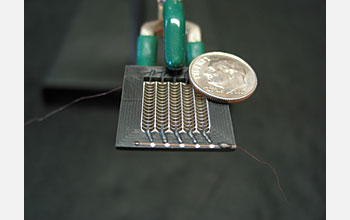
The compact, solid-state fan is the most powerful and energy efficient fan of its size. It produces three times the flow rate of a typical small mechanical fan and is one-fourth the size.

Dan Schlitz and Vishal Singhal of Thorrn Micro Technologies, Inc., of Marietta, Ga. will present their RSD5 solid-state fan at the 24th Annual Semiconductor Thermal Measurement, Modeling and Management Symposium (Semi-Therm) in San Jose, Calif., on March 17, 2008. The device is the culmination of six years of research that began while the researchers were NSF-supported graduate students at Purdue University.


Researchers have developed a new micro-fan only slightly larger than a dime. The new fan can generate winds on the same scale as a laptop computer fan, but uses far less energy and should require far less maintenance. Credit: Dan Schlitz and Vishal Singhal, Thorrn Micro Technologies

When viruses enter cells they manufacture proteins to assist in growth and replication but the body’s immune system recognizes and attacks these non-native proteins. Human Papillomavirus (HPV)(1), which causes several types of cancer but is particularly associated with cervical cancer, has developed sneaky ways of hiding in the body, but researchers at the University of Leeds have found that its ability to trick the body’s first line of defence leaves it vulnerable to counter-espionage from a second defence system.

Professor Eric Blair(2) of the University’s Faculty of Biological Sciences and Dr Graham Cook(3) from the Leeds Institute for Molecular Medicine have been specifically looking at one of the proteins produced by HPV, called E7, and have discovered that it suppresses markers on the cell surface, making infected cells much less visible to T cells, one of the body’s key defense systems.

AMSTERDAM, Netherlands, March 20 /PRNewswire/ --

Playlogic Entertainment, Inc. (OTC Bulletin Board: PLGC) an independent publisher of entertainment software for PCs, consoles, handhelds, mobile devices, and other digital media; announced that it has successfully closed US$3 million in equity (US$1.00 per share) and US$4 million in loan through a Private Placement. This loan of US$4 million is bearing a yearly interest of 7% and a term of 2.5 years.

(Logo: http://www.newscom.com/cgi-bin/prnh/20071119/PLAYLOGICLOGO )

The total amount of US$7 million is placed at existing and new shareholders, all accredited investors. After closing of this private placement, the company has 41.5 million common shares outstanding as per March 31st 2008.

LONDON, March 20 /PRNewswire/ -- NHS Choices (http://www.nhs.uk), the digital 'front door' to the NHS, launches a new Live well bundle aimed to help people improve their fitness levels.

Based on NHS accredited information, the Fitness section (http://www.nhs.uk/Livewell/fitness/Pages/fitnesshome.aspx) enables users to get the low down on the health benefits of exercise in seconds and provides them with clinically approved guidance to help them improve their activity levels in order to lead a healthy lifestyle. This Fitness section is the latest addition to the NHS Choices' extensive Live well section.
