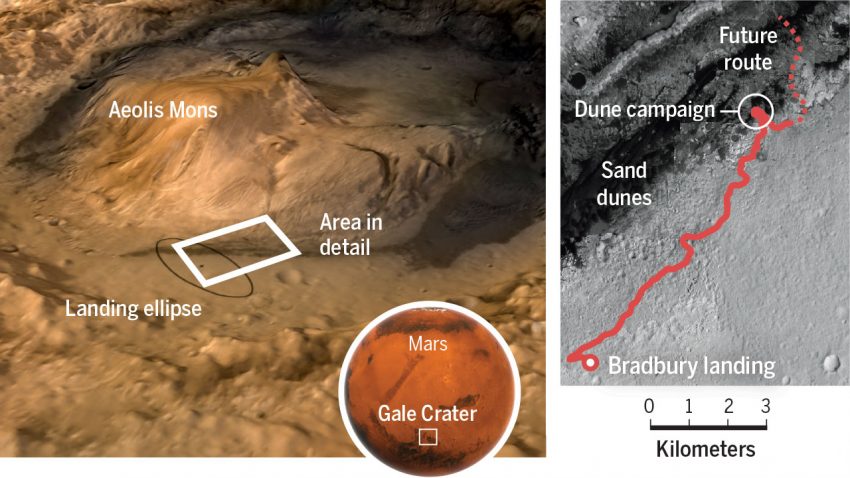
Researchers have discovered a type of dune on Mars intermediate in size between tiny ripples and wavier dunes, and unlike anything seen on Earth.

Because dunes can be preserved in rock over time, these mysterious sedimentary deposits may represent a way to gain insights into the evolution of Mars' atmosphere from a more hospitable realm to the harsh, dry climate observed there today. On Earth, wind and water passing over sand causes the formation of either large dunes or small ripples, collectively called bedforms.

New research shows similarities in the social organisation of bees and mammals, and provides insight into the genetics of social behavior for other animals. These findings, published in PLOS Computational Biology, use sociogenomics - a field that explores the relationship between social behaviour and the genome - to show strong similarities in socially genetic circuits common in honey bees and mammals.

A new study of the University of Cambridge anatomy collection suggests that the bodies of foetuses and babies were a "prized source of knowledge" by British scientists of the 18th and 19th centuries, and were dissected more commonly than previously thought and quite differently to adult cadavers.

Historical research combined with the archaeological assessment of collection specimens shows that foetus and infant cadavers were valued for the study of growth and development, and were often kept in anatomical museums.

Researchers say that socio-cultural factors and changes in the law, as well as the spread of infectious disease during the industrial revolution, dictated the availability of these small bodies for dissection.

The artificial pancreas -- a device which monitors blood glucose in patients with type 1 diabetes and then automatically adjusts levels of insulin entering the body -- is likely to be available by 2018, conclude authors of a paper in Diabetologia (the journal of the European Association for the Study of Diabetes). Issues such as speed of action of the forms of insulin used, reliability, convenience and accuracy of glucose monitors plus cybersecurity to protect devices from hacking, are among the issues that are being addressed.

Bottom Line: Improved cancer detection and treatment efforts, combined with demographic trends, are creating larger numbers of older cancer survivors who are likely to have other health conditions that impact care and well-being.

Journal in Which the Study was Published: Cancer Epidemiology, Biomarkers & Prevention, a journal of the American Association for Cancer Research.

Author: Shirley M. Bluethmann, PhD, MPH, a cancer prevention fellow at the National Cancer Institute in Bethesda, Maryland.

MADISON, Wis. -- Researchers at the University of Wisconsin-Madison have confirmed that a benign bacterium called Wolbachia pipientis can completely block transmission of Zika virus in Aedes aegypti, the mosquito species responsible for passing the virus to humans.

Matthew Aliota, a scientist at the UW-Madison School of Veterinary Medicine (SVM) and first author of the paper -- published today (July 1, 2016) in the journal Scientific Reports -- says the bacteria could present a "novel biological control mechanism," aiding efforts to stop the spread of Zika virus.

The earthquake distribution on ultraslow mid-ocean ridges differs fundamentally from other spreading zones. Water circulating at a depth of up to 15 kilometres leads to the formation of rock that resembles soft soap. This is how the continental plates on ultraslow mid-ocean ridges may move without jerking, while the same process in other regions leads to many minor earthquakes, according to geophysicists of the Alfred Wegener Institute, Helmholtz Centre for Polar and Marine Research (AWI). Their study is going to be published advanced online in the journal Nature on Wednesday, June 29, 2016.

BOSTON (Embargoed until 2 PM EDT, June 29, 2016)--Butter consumption was only weakly associated with total mortality, not associated with cardiovascular disease, and slightly inversely associated (protective) with diabetes, according to a new epidemiological study which analyzed the association of butter consumption with chronic disease and all-cause mortality. This systematic review and meta-analysis, published in PLOS ONE, was led by Tufts scientists including Laura Pimpin, Ph.D., former postdoctoral fellow at the Friedman School of Nutrition Science and Policy at Tufts in Boston, and senior author Dariush Mozaffarian, M.D., Dr.P.H., dean of the School.

Telling yourself I can do better, can really make you do better at a given task, a study published in Frontiers in Psychology has found.

Over 44,000 people took part in an experiment to discover what motivational techniques really worked. In conjunction with BBC Lab UK, Professor Andrew Lane and his colleagues tested which physiological skills would help people improve their scores in an online game.

Messenger RNA (mRNA) is made up of exons and introns, that is, portions of genetic information that are "switched on" and "switched off", respectively. In order to reach maturation and be sent to the cellular "machine" that deals with protein synthesis, the non-coding fragments contained in the mRNA, the introns, need to be removed, whereas the coding sequences, the exons, have to be linked together. In humans, this "snipping and stitching" process, known as splicing, is governed by a huge machinery consisting of proteins and RNA, the spliceosome.


