MILFORD, Massachusetts, April 16 /PRNewswire/ --
- Centerpiece of the is the establishment of The Waters Centre for BioMedical Mass Spectrometry
Waters Corporation (NYSE: WAT) and the University of Warwick, Coventry and Warwickshire, England, today signed a collaborative research agreement intended to support the growth, development and adoption of novel mass spectrometry (MS) technologies, including Waters(R) SYNAPT High Definition MS(TM) (HDMS(TM)) system. This agreement paves the way for research projects leading to meaningful impact for analysts using biomedical mass spectrometry, validated by peer-reviewed publications, presentations at international conferences and an outreach education program.
CHICAGO, April 16 /PRNewswire/ --
Safety issues at nuclear plants have resulted in increased usage of LINK Tools, now topping 75% of all nuclear plants. This includes nuclear generating stations and plants in the U.S., Canada and Mexico.
Safety at nuclear facilities is of prime importance to staff, owners and the public alike. LINK's unique locking system which guarantees no dropped sockets, has proven to be a critical factor in high risk maintenance situations. The use of LINK Tools is now mandated at many sites, according to John Davidson, President and CEO of LINK.
PALO ALTO, California, April 16 /PRNewswire/ --
- Powervation wins 2009 ITLG-Irish Times Innovation Award
- OpenHydro winner of new Renewable Energy Award
Executives from some of the most successful U.S. and Irish technology and renewable energy companies gathered at Stanford University where Limerick, Ireland-based Powervation won this year's 2009 ITLG/The Irish Times Innovation Award. Also receiving recognition on the night was OpenHydro of Dublin, Ireland which won the 2009 Renewable Energy Innovation Award.
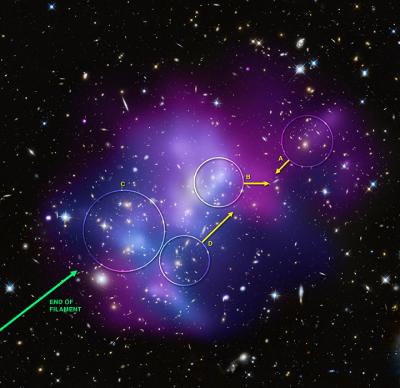
The most crowded collision of galaxy clusters has been identified by combining information from three different telescopes. This result gives scientists a chance to learn what happens when some of the largest objects in the Universe go at each other in a cosmic free-for-all.
Using data from NASA's Chandra X-ray Observatory, Hubble Space Telescope and the Keck Observatory on Mauna Kea, Hawaii, astronomers were able to determine the three-dimensional geometry and motion in the system MACSJ0717.5+3745 (or MACSJ0717 for short) located about 5.4 billion light years from Earth.
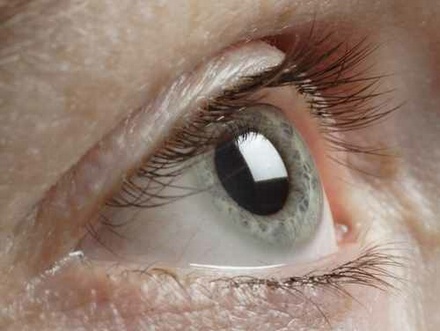
What's different about nocturnal mammals that have 'night vision'? According to a Cell report, the DNA within the photoreceptor rod cells responsible for low light vision is packaged in a very unconventional way. That special DNA architecture turns the rod cell nuclei themselves into tiny light-collecting lenses, with millions of them in every nocturnal eye.
There's a perception among some that it's a man's world and they get all the attention. If you've ever been in a bar or a library or a baseball game, you know this is not true - have a woman drop a napkin and see what happens whereas a man could be bleeding out his eyes and be unnoticed. But women want to keep men on their toes by pretending they are in charge.
Now the gig may be up, thanks to biology.
University of California, Berkeley biologist Doris Bachtrog and her colleagues say that the history of the X chromosome offers important clues to the origins and benefits of sexual reproduction. X even compensates for the degeneration of Y, which will get people talking.
Take that, much-studied male-determining Y chromosome.
What? NASA wants to make Earth Day about space?
Not at all, NASA is instead asking the public to vote for the most important contribution the space agency has made to exploring and understanding Earth and improving the way we live on our home planet. That's right, they call this our home planet, which means there may be a vacation planet on the way. That's thinking big, people.
Combating several human pathogens, including some biological warfare agents, may one day become a bit easier thanks to research reported by a University of Iowa chemist and his colleagues in the April 16 issue of the journal Nature.
Amnon Kohen, associate professor of chemistry in the UI College of Liberal Arts and Sciences, said that the study indicated a new mechanism by which certain organisms manufacture the DNA base thymidylate. This new mechanism is so very different from the way humans synthesize this base that drugs targeting this biosynthetic path in the pathogens are unlikely to affect the human path, thus resulting in very reduced side effects or no side effects at all.
An unmapped reservoir of briny liquid chemically similar to sea water, but buried under an inland Antarctic glacier, appears to support unusual microbial life in a place where cold, darkness and lack of oxygen would previously have led scientists to believe nothing could survive, according to newly published research.
After sampling and analyzing the outflow from below the Taylor Glacier, an outlet glacier of the East Antarctic Ice Sheet in the otherwise ice-free McMurdo Dry Valleys of Antarctica, researchers believe that, lacking enough light to make food through photosynthesis, the microbes have adapted over the past 1.5 million years to manipulate sulfur and iron compounds to survive.
Scientists have found an ancient ecosystem below an Antarctic glacier and learned that it survived millions of years by transforming sulfur and iron compounds for growth.