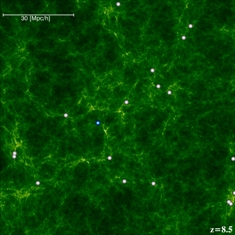
Scientists have used a computer simulation to predict what the very early Universe would have appeared like 500 million years after the Big Bang.  The images, produced by scientists at Durham University's Institute for Computational Cosmology, show the "Cosmic Dawn" - the formation of the first big galaxies in the Universe.


Universe 590 million years after the Big Bang. Credit:Alvaro Orsi, Institute for Computational Cosmology
Demands on telescope technology are rapidly increasing as astronomers look at fainter and fainter objects in the night sky. The large amount of light collection area required to view very dim objects poses a number of significant engineering problems to future telescope designers. To collect short-wavelength radio waves, for instance, an antenna miles across would be required. This has led engineers to construct multiple small telescopes whose signals can be integrated, providing the necessary level of detail.
Physicians have known for years that there exists a link between cardiac surgery and a subsequent decline in cognitive function of patients.  According to recent research, “previous studies have reported an 11% to 75% incidence of postoperative cognitive decline among cardiac surgery patients” (Slater et. al). However, until recently, the cause for this link was largely unknown.  Coronary Artery Bypass Grafting (CABG) surgery, continues to produce clinical results demonstrating cognitive decline in some patients despite improved surgery practices.

What do men want?

Biology’s simple answer is that men want to survive to pass on their genes. But when you throw this goal into a complex society of competing men, discerning women and morality, biology gets confused.

For better or for worse, behavioral economics has the answers.
I have been working in research for 36 years now.  As the millennium turned, and our department found itself being starved of staff like the Hodja’s Donkey, I found myself being called upon to assume some small teaching roles.  I found two incompatible things: one, that I really enjoy teaching, even more than research; two, that there is so much physics that I never had learned properly.
There's no question younger scientists who have only really known the Bush presidency believe that Bush was a problem in science, despite the budget increases and the fact that a lot of really terrific science got done in the last 8 years - so they may not see that a stimulus package in science under a president everyone has enthusiasm for could be setting us up for the very same funding bubble (and collapse) that occurred under Bush.
You mat have read recently about chemical fossils discovered in sedimentary rocks in Oman.   Those fossil steroids, remnants of a type of sponge known as Demosponges, are between 635 and 750 million years old. They date back to around the time of the Marinoan glaciation, the last of the huge ice ages at the end of the Neoproterozoic era.

Many of the world's cultural treasures are creations made of organic materials such as paper, canvas, wood and leather which, in prolonged warmth and dampness, attract mold, micro-organisms and insects, causing decay and disintegration.

Show Me The Science Month Day 12

Natural selection is often much like Goldilocks - an organism's traits shouldn't be too hot or too cold; natural selection likes them just right. In other words, traits are under pressure to remain near an optimum. If they deviate too far, natural selection will not-so-gently prod things back to the center. This phenomenon is known as stabilizing selection.

Stabilizing selection has to push against another powerful evolutionary force - random drift. Much of our genetic makeup is influenced by non-adaptive processes, that is, processes that are not particularly favored or disfavored by natural selection, and which do not perform some function that improves the fitness of the organism. Selection and drift have been especially hard to tease apart when it comes to gene regulation. Related species regulate their genes in different ways, but how many of those differences are simply due to random divergence? Trevor Bedford and Daniel Hartl at Harvard University take a crack at this question in a recent paper. They use a mathematical model based on Brownian motion (the kind of random motion you see when you watch pollen grains buffeted about in a drop of water) to determine how well stabilizing selection counteracts the battering of random drift.
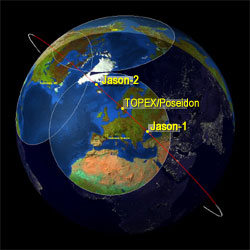
Right now we have a tandem situation. Jason-1 and Jason-2 are flying in tandem above our heads. Sounds like fun perhaps, but who cares? And who are Jason and what's with the numbers, anyways?