





I was astonished to find out that the BBC linked to this “paper” in a recent article about eco-anxiety without explaining to the reader that it is just “crap”. There I'm quoting the distinguished climate scientist Michael Mann, director of the Earth System Science Center at Pennsylvania State University. This BBC article is here:

All they say about it is

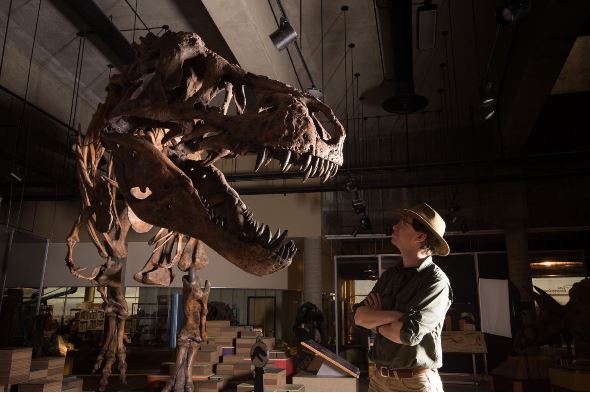
The largest Tyrannosaurus rex skeleton discovered so far, and therefore the largest carnivore on land currently known to science, was discovered in 1991 in Saskatchewan, Canada, but the extremely hard matrix surrounding the bones, in combination with the size of the skeleton of Tyrannosaurus rex (RSM P2523.8), made it especially difficult and time-consuming to remove, assemble, and study. 

Since is is relatively complete (roughly 65 percent), RSM P2523.8 has finally been described in The Anatomical Record: Advances in Integrative Anatomy and Evolutionary Biology.
The Scandinavian wolf population is a bit of an evolutionary mystery. In the hoped for descent with modification scenario, textbook natural selection, there would be signs that hybrids of dog and wolf have contributed to this population, but none have been found.

 Wolf-dog hybrids – crosses between wolf and dog – are known from many parts of the world and have mainly been the result of male dogs mating with female wolves. One such hybrid was found south-west of Stockholm, in 2017; another turned up near Oslo 20 years ago. In the Storting, the Norwegian parliament, the question has been raised of whether the wolves returning to Scandinavia in the 1980s, after they had been virtually exterminated, even had some elements from dogs in their genetic ancestry.
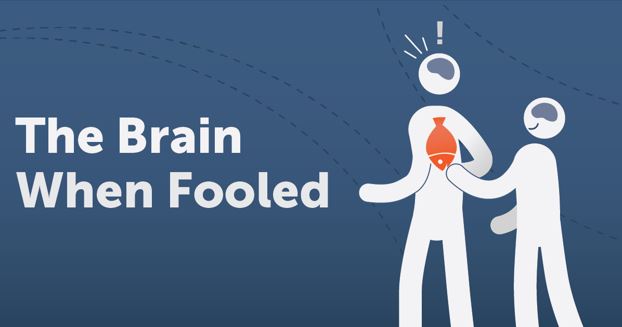
I enjoy hearing about or even falling for a good harmless prank — and I certainly enjoy pulling a child or two’s string, in a cheerful, happy way, just to keep them on their toes — so, April Fools’ is one of my favorite days of the year.

The holiday underscores how important surprises are for our brains. Of course, one hopes those surprises will be delightful ones!
I sometimes like to read the arXix preprint physics site. It's where a lot of papers go before they are in journals. It was open access, a way to see what scientists were working on before the results were locked behind a corporate journal paywall, before open access was even a thing.
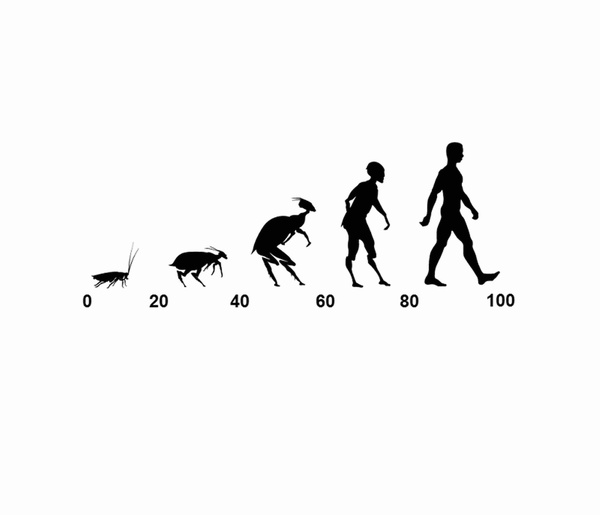
A small survey in Australia (n=442) found that more than half of car drivers think cyclists are not really human, and many admit to intentionally driving too close to them. 

The survey says it is the first to look at a road-user group with the problem of dehumanization, which is typically studied in relation to attitudes towards racial or ethnic groups. The authors state that cyclists have been conceptualized as a minority group and a target of negative attitudes and behavior - but if drivers can put a human face to cyclists, researchers say it could reduce aggression directed at cyclists and road trauma involving riders.
Americans with more formal education fare better on science-related questions, minorities fare worse, and Republicans and Democrats are roughly similar in their overall levels of science knowledge. according to a new study released today by Pew Research Center. 
Since the oldest millennials are now nearing 40 it may be time for sociologists and psychologists to stop writing papers on how much nurturing they will need when they arrive. They are already here. Yet papers will keep coming, perhaps until people stop wanting to read them.

A new paper in The Journal of Social Psychology claims that how well parents or guardians support millennials' psychological needs prior to their transition to college is an important predictor of their psychological well-being as they adapt to college life.

Last Monday and Tuesday I gave a few lectures on Machine Learning at a Data Science school (IDPASC) in Braga, Portugal. I think that this topic has received so much attention in the last few years, with heaps of excellent resources now freely available online, that it is very difficult to be original and provide useful information to any student who is proactive enough to google "auto-encoders" by herself.


As if mothers don't get blamed for enough, a new paper claims attention deficit hyperactivity disorder (ADHD)may have been caused by her diet during pregnancy.

The results of a study led by a team from the Barcelona Institute for Global Health (ISGlobal), a centre supported by "la Caixa", suggest that the risk of a child developing symptoms of attention deficit hyperactivity disorder (ADHD) may be modulated by the mother's diet during pregnancy. The study, published in the Journal of Pediatrics, analysed samples of umbilical cord plasma to quantify the levels of omega-6 and omega-3 that reach the foetus. The statistical analysis showed a higher omega-6:omega-3 ratio to be associated with a higher risk of ADHD symptoms at seven years of age.

