







Speciation, where different populations of the same species split into separate species, is central to understanding evolution.
As would be expected in a complex process like evolution, it's difficult to observe in action. A new study in
American Naturalist says they have captured two populations of monarch flycatcher birds just as they arrive at that 'evolutionary crossroads' of speciation - and it involves a change in a single gene.
Dogs aren't the only animals that bark, they are just the most famous. Deer, monkeys and even birds also bark but what makes dogs different is a subject of interest in a new evolutionary biology study.
In a recent Behavioural Processes paper, researchers have provided scientific literature with what they say is the first consistent, functional and acoustically precise definition of this household animal sound.
Kathryn Lord, a graduate student in organismic and evolutionary biology at University of Massachusetts Amherst, says, “We suggest an alternative hypothesis to one that many biologists seem to accept lately, which seeks to explain dog barking in human-centric terms and define it as an internally motivated vocalization strategy.”
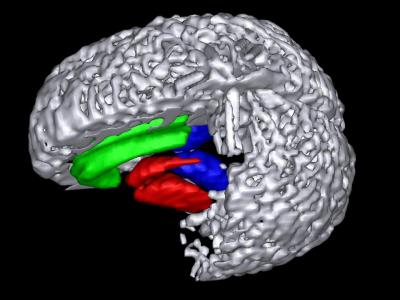
As teenagers' drive for peer approval begins to eclipse their family affiliations, things change in their brains - literally. Brain scans of teens sizing each other up reveal an emotion circuit activating more in girls as they grow older - but not in boys.
So that urban legend about girls maturing faster than boys is true, if by faster maturity we mean becoming overly emotional drama queens.
A new study says emotion circuitry diverges in the male and female brain during a developmental stage in which girls are at increased risk for developing mood and anxiety disorders.
It is known that memory begins during the prenatal period but little has been discovered about the exact timing or for how long memory lasts. A new study done in Holland has found fetal short-term memory in babies at 30 weeks in the womb.
The study provides insights into fetal development and may help address and prevent abnormalities, say researchers at Maastricht University Medical Centre and the University Medical Centre St. Radboud who published their results in Child Development.
A new study says both the tiger stripes and a subsurface ocean on Saturn's moon Enceladus are the result of the moon's unusual chemical composition and not a hot core, as previously believed.
shedding light on the evolution of planets and guiding future space exploration.
Dr Dave Stegman, a Centenary Research Fellow in the School of Earth Sciences at the University of Melbourne, led the study and says that part of the intrigue with Enceladus is that it was once presumed to be a lifeless, frozen ice ball until a water vapour plume was seen erupting from its surface in 2006.
Do our genomes look designed? Let's address this point, hoisted from the comments of
this post:
Actually, shared genetics between chimps and humans is agnostic with respect to evolution or "intelligent design". In software engineering, you often find shared code (or even junk code) in the source of various projects as it develops from "Product 1.0" to "Product 2.0" to "Product 3.0". I.e., it's a strawman argument to assume the "intelligent designer" started from scratch for chimps and humans. That doesn't sound intelligent at all.
Like a software designer, the "designer" would have hacked up whatever existing code base he had to
...waiting for a piece I will post tomorrow, to stimulate your curiosity -and allow me to travel from Venice to Patras by ship, with no internet connection.
The subject is not only the Higgs mass, but the top quark mass. Which top mass ? The "pole" mass -the real part of the pole in the perturbative top-quark propagator. Have I lost you ? Ok, do not worry -definitions are for theorists. Let us just say that the top quark, being a complicated coloured object which thus cannot live free of the influence of strong interactions,
is measurable at a hadron collider like the Tevatron only within uncertainties of the order of a constant called "Lambda QCD", which is of the order of 200 MeV.
Australia's top models are going to be on the main stage in Cairns this week but don't get too excited. They're only here to show new ways to understand climate change, improve air safety and enhance agricultural sustainability - the small stuff unless you care about life as we know it. Fortunately, these numerical models understand those things much better than actual supermodels.
The gathering is the IMACS/MODSIM Congress and will attract more than 650 experts in modelling and simulation from Australia and overseas to the Cairns Convention Centre from July 13-17, 2009.


