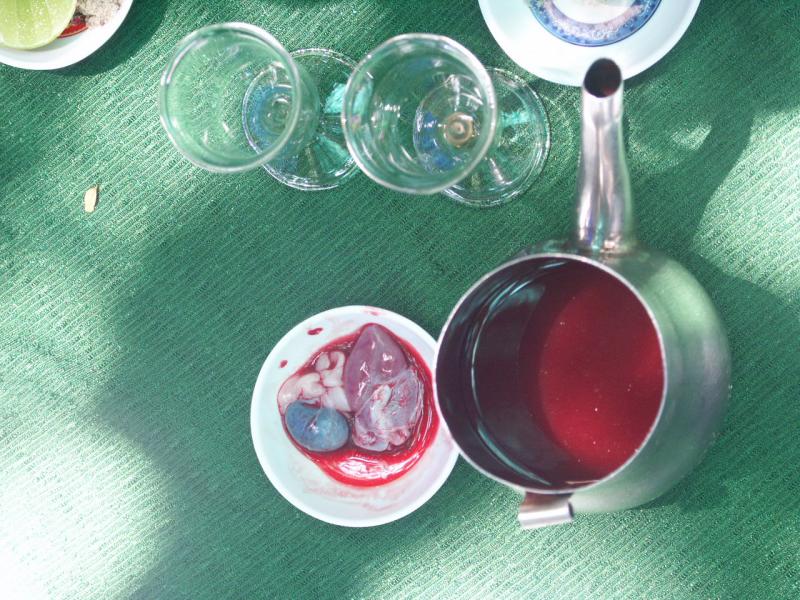







Puffer fish might kill, oysters are slimy and salmon skin is uncommon to eat, but around the word there are some even more unique drinks and delicacies that tests ones sensory analysis and may take customary valor to a new universe.

The scorpion drink—Is made by soaking a scorpion in vodka for three months after it has gone through a special detoxification process. Originated in China, sold in the U.K. supposedly improves libido, lowers toxins in the blood stream and lowers blood pressure.

Fried Spiders—The recent Cambodian craze involves frying Thai Zebra Tarantula’s as big as a hand in a mixture of MSG, sugar, salt and garlic. This spider dish began in the 1970’s after people had little to eat during the rule of Khmer Rouge.

Cobra blood—Though research on the effects of cobra blood is limited, it can be found in restaurants and bars in places like Indonesia. The potent delicatessen is consumed in a shot-glass amount and is reported to cause vivid dreams.

As Albert Einstein once said about balance, "Life is like riding a bicycle. To keep your balance you must keep moving." The same is true of bone mineral density in testing for breast cancer—balance is better.

The September 2008 issue of “CANCER” journal of the American Cancer Society published findings that higher bone density hints at higher frequency of breast cancer in premenopausal women, meaning normal or even lower bone mass points to a lower breast cancer rate.


As a futurist, I think, speak, and write about the future. A large part of what I do is to make forecasts on the future and what might happen. This forecasting is based upon analysis of trends and the underlying forces and flows that create and shape these trends. The more specific the forecast or the further out the forecast, the higher probability of error in the forecast. When I look 5, 10 or 20 years out I look at the macro forces at play in the world to predict the overarching changes and reorganizations that will occur. Here in this column the future focus is 3 months to 3 years and is much more specific and news related.

Visit any youth soccer field, baseball diamond, basketball court or football field and you will likely see them:  parents behaving badly.  Take a look at this Good Morning America report on "sideline rage".  Sometimes, these are the extremes, but at most games, you can find at least one adult making comments at the referee, shouting at their child, or having a verbal exchange with another parent.  Thankfully, these parents represent only a small percentage of those attending the game.  Does that mean the others don't become upset at something during the game?  Usually not, as there are lots of opportunities to dispute a bad call or observe rough play or react to one of these loud parents.

 The difference is in our basic personality psyche, according to Jay Goldstein, a kinesiology doctoral student at the University of Maryland School of Public Health.  His thesis, recently published in the Journal of Applied Social Psychology (see reference below), hypothesized that a parent with "control-oriented" personality would react to events at a game more than a parent with an "autonomy-oriented" personality.

For years, sport science and motor control research has added support to the fundamental assertions that "practice makes perfect" and "repetition is the mother of habit".  Shooting 100 free throws, kicking 100 balls on goal or fielding 100 ground balls must certainly build the type of motor programs in the brain that will only help make the 101st play during the game.  K. Anders Ericsson, the "expert on experts", has defined the minimum amount of "deliberate practice" necessary to raise any novice to the level of expert as 10 years or 10,000 hours.

Exposure to ultraviolet light can contribute to skin cancer and, despite increased education about sunscreens, farmers, construction workers and others who spend long hours exposed to sunlight are among those most at risk. Plus, sunscreens are not alway effective for these high-risk people because they have to be re-applied frequently.

Professor Chandradhar Dwivedi, head of the Pharmaceutical Sciences Department in the College of Pharmacy at South Dakota State University, says their group is working with new types of molecules that will not only boost sunscreen protection but even reverse sun damage. Dwivedi said the work could be commercialized within 10 years.

Here’s a look at SDSU’s research of skin product components:

Proposals to reign in gasoline prices by curbing speculation in oil markets would likely increase costs at the pump instead of trimming them, a University of Illinois economist says.

Scott Irwin argues congressional efforts to curb trading by speculators is a "misguided witch hunt" that ignores the root of America's energy problem – a finite global oil supply that has been stretched thin by surging demand in China, India and other developing countries.

"There's a tendency to look for a scapegoat, and speculators are the convenient scapegoat," he said. "But, really, it's a supply and demand issue."

A team of European scientists working with COROT have discovered an exoplanet orbiting a star slightly more massive than the Sun. After just 555 days in orbit, the mission has now observed more than 50 000 stars and is adding significantly to our knowledge of the fundamental workings of stars.

The latest discovery, COROT-exo-4b is an exoplanet of about the same size as Jupiter. It takes 9.2 days to orbit its star, the longest period for any transiting exoplanet ever found.

An aerosol mass spectrometer developed by chemists from Aerodyne Research Inc. and Boston College is giving scientists who study airborne particles the technology they need to examine the life cycles of atmospheric aerosols – such as soot – and their impact on issues ranging from climate change to public health.

BC Chemistry Professor Paul Davidovits and Aerodyne Principal Scientist Timothy B. Onasch say their novel spectrometer allows researchers to better understand what happens to these sub-microscopic particles that can absorb and scatter light and influence the lifetime of clouds.

Researchers at Wake Forest University Baptist Medical Center have disproved a long-standing clinical belief that the hepatitis C virus slows or stunts the immune system's ability to restore itself after HIV patients are treated with a combination of drugs known as the "cocktail."

Hepatitis C (HCV) infection is more serious in HIV-infected people, leading to rapid liver damage, according to the Centers for Disease Control. Intravenous drug use is a main method of contraction for both HIV and HCV and 50 to 90 percent of HIV-infected drug users are also infected with HCV.


