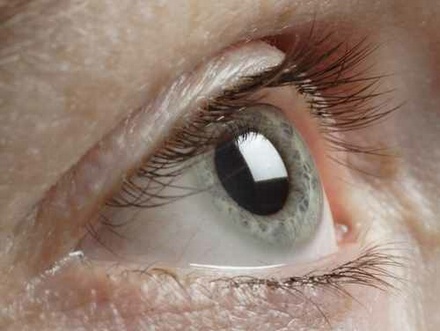


A new paper says that words can play a powerful role in what we perceive.What we see is a function not only of incoming visual information, but also how that information is interpreted in light of other visual experiences, and may even be influenced by language.

"Perceptual systems do the best they can with inherently ambiguous inputs by putting them in context of what we know, what we expect," says lead author and University of Wisconsin–Madison psychology professor Gary Lupyan. "Studies like this are helping us show that language is a powerful tool for shaping perceptual systems, acting as a top-down signal to perceptual processes. In the case of vision, what we consciously perceive seems to be deeply shaped by our knowledge and expectations."

A neuropeptide named natalisin regulates the sexual activity and reproductive ability of insects, according to a new study in which the neuropeptide is observed and named Natalisin is composed of short chains of amino acids in the brain of insects and arthropods and the finding may open new possibilities for environmentally friendly pest management.

Hot off of revolutionizing ground-based transportation with the electric car company Tesla and proposing to revolutionize slightly-above-the-ground-based transportation with the Jetsons-esque Hyperloop, eccentric billionaire genius Elon Musk (of PayPal fame) appears to believe he has risen above the law.  

Or rather, he believes his Space Exploration Technologies Corporation (SpaceX) Grasshopper rocket has risen above the law.


Worries about the amount of salt you consume may be misplaced.

A new study documents in humans what neuroscientists have reported for some time: animals’ sodium (salt) intake is controlled by networks in the brain and not by the salt in one’s food. The findings have important implications for future U.S. nutrition policy directed at sodium intake.

Manganese, the second-most common metal in the earth's crust, rapidly changes between oxidation states while reacting with other elements in the environment. It is an element critical to many life processes and helps plants produce oxygen during photosynthesis. 

Manganese is present in the environment in three forms — manganese(II), manganese(III) and manganese(IV) — the difference related to the oxidation state, or number of electrons present. When elements lose or gain an electron, the oxidation state changes in a "redox reaction," like when iron turns into rust by losing electrons to oxygen in air.

Yesterday CMS published the results of a new search for a heavy partner of the bottom quark, by looking for the decay b' -> bZ: that is, the heavy b' is sought in a so-called Flavour-Changing neutral current process. The "neutral current" is an old but still used terminology to indicate the emission of a neutral vector boson, the Z.

Tracking a fish is not as easy as you might think. The radio signals that are the backbone of traditional GPS cannot pass through seawater.

But sound travels remarkably well and scientists often use acoustic telemetry to estimate an individual fish’s location. That means attaching an acoustic transmitter to a fish and then using a network of stationary underwater listening stations to monitor for the short clicking sounds that these tags emit. When a fish swims near to a receiver, its click is heard, and its individual code number is recorded.

The annual melting of sea ice in the Arctic is approaching its yearly "minimum," the time when the floating ice cap covers less of the Arctic Ocean than at any other period during the year, and there is some good news -   this year's summer low is not going to be too bad. 

The concerning news is that this year's melt rates are in line with the sustained decline of the Arctic ice cover observed by NASA and other satellites over the last several decades.

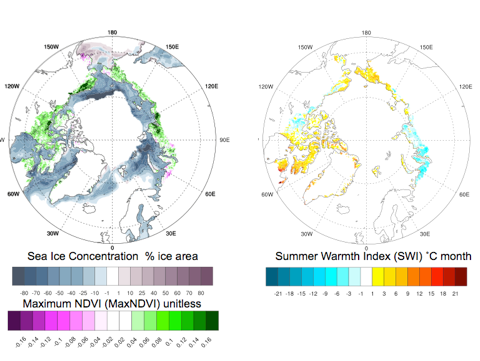
A recent review of research on the response of plants, marine life and animals to declining sea ice in the Arctic found that sea ice decline and warming trends are changing the vegetation in nearby arctic coastal areas.

In my previous article, you learned how to use the 555 test circuit as a cable tester. It can also be used to test whether different materials conduct or don’t conduct electricity such as plastic, glass, cloth, wood, a coin from your pocket, a house key, aluminum foil, or any number of materials from around the house. You can also use it to see how well you conduct electricity to demonstrate one of the measurements, skin conductance, of a polygraph, or lie detector.

In the demonstration video I touch the snaps together to get a base line tone. Next I hold the snaps on the red and black Jumper Wires between my fingertips to demonstrate that your skin does indeed conduct electricity.


