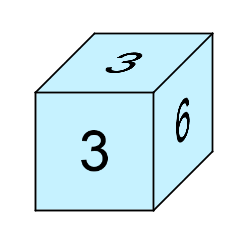


Alice wants to play a game with Bill. She has just bought some new and rather strange dice. The average of each die is 3.5, just like a normal playing die, but the numbers on each face have an unfamiliar distribution.

Die P has the numbers 3, 3, 3, 3, 3, 6.
Die Q has the numbers 2, 2, 2, 5, 5, 5.

The game itself is very simple: whoever rolls the highest total wins a sweet from the candy box. If the box becomes empty, the winner can take one from the other player’s pile.
Since today is a celebration of St. Patrick, the religious figure who 'drove the snakes out of Ireland' (meaning Paganism), a whole lot of people got drunk last night.  

Yeah, Protestants getting drunk the night before before a Catholic religious festival makes as much sense as anything else about St. Patrick's Day. In addition, kids in California get something magical in their shoes, which puzzles me too. I never heard of that when I was a kid but the rural area I grew up in was a delightful mix of people descended from residents of Scotland and Eastern Europe so there weren't a lot of magical pots of gold lying around - if an Irishman came along asking about our shoes the reply was going to be sent at muzzle velocity. 
The title should be: Reformulating the Postmodern Core Insight versus Consistency as Absolute Meta-Truth:  Last Bastion against New Totalitarianism - or some such, however, the software does not support the length.  Anyway, let us start:

Can anything fundamental be described and what is the, potentially undesired, outcome if we should succeed?


The Lazarus Project team says they have been able to recover cell nuclei of the extinct gastric-brooding frog, Rheobatrachus silus,
from tissues collected in the 1970s and kept for 40 years in a conventional deep freezer. 

The genome of
Rheobatrachus silus, extinct since 1983, has been revived and reactivated by a team of scientists using
somatic cell nuclear transfer
to implant a "dead" cell nucleus into a fresh egg from another frog species.
 

Rheobatrachus silus is famous for swallowing its eggs, brooded its young in its stomach and giving birth through its mouth. The "de-extinction" project aims to bring the frog back to life.
 

The 2010 BP Deepwater Horizon Oil spill dumped more than 200 million gallons of oil into the Gulf of Mexico yet government assessments have been unable to account for all of it.

Microbes likely processed most of the oil within months of the spill, but not all of it. A new hypothesis suggests the oil acted as a catalyst for plankton and other surface materials to clump together and fall to the sea floor in a massive sedimentation event - what they have termed a "dirty blizzard."

On Jupiter, cloudless patches are so rare that the larger visible ones get the special name 'hot spots.'

How do these clearings form and why they are they only found near the planet's equator?

It's a mystery, by Jove, but using images from the Cassini spacecraft, scientists have found new evidence that hot spots in Jupiter's atmosphere are created by a Rossby wave, a pattern also seen in Earth's atmosphere and oceans. The team found the wave responsible for the hot spots glides up and down through layers of the atmosphere like a carousel horse on a merry-go-round.

Being Pope may mean good things in the afterlife but here on Earth, it doesn't count for a lot on the Internet. On the day Cardinal Jorge Mario Bergoglio was elected Pope Francis, over 600 domain names were registered by cybersquatters. They must be evangelicals.

Even mistaken names like Francis I were taken.

So Popefrancis.org is not available to the Roman Pontiff, along with most of the country-specific domains, like popefrancis.fr. Even popefrancisi.com was scooped by someone.

Oddly, at the time of this writing, his Argentina country-specific domain was still available - so if you want to grab Popefrancis.ar.com, you still can. Look for domain company GoDaddy to have scantily-clad nuns stripping in the enclave advertising that one real soon.

The presentations of the last few days at the Neutrino Telescopes conference in Venice allowed me to get to full speed with the developments, new ideas, and new experiments taking data or just in design phase in this fascinating, relatively young field of investigation at the crossroads of particle physics and astrophysics.

The talk slides are online in the conference site, but as usual by just flipping them one usually does not manage to get the most important points. So I am providing summaries of every talk, at the conference blog site.

Yesterday I posted several articles there. Here is a list with links:

- Status of Gerda

How does the human brain 'decodes' letters on a page to read a word?

Psychologists are trying to help neuroscientists unravel the subtle thinking mechanisms involved in reading, which could provide solutions for helping people who find it difficult to read, like dyslexics.

In order to read successfully, readers need not only to identify the letters in words, but also to accurately code the positions of those letters, so that they can distinguish words like CAT and ACT. At the same time, however, it's clear that raeders can dael wtih wodrs in wihch not all teh leettrs aer in thier corerct psotiions.

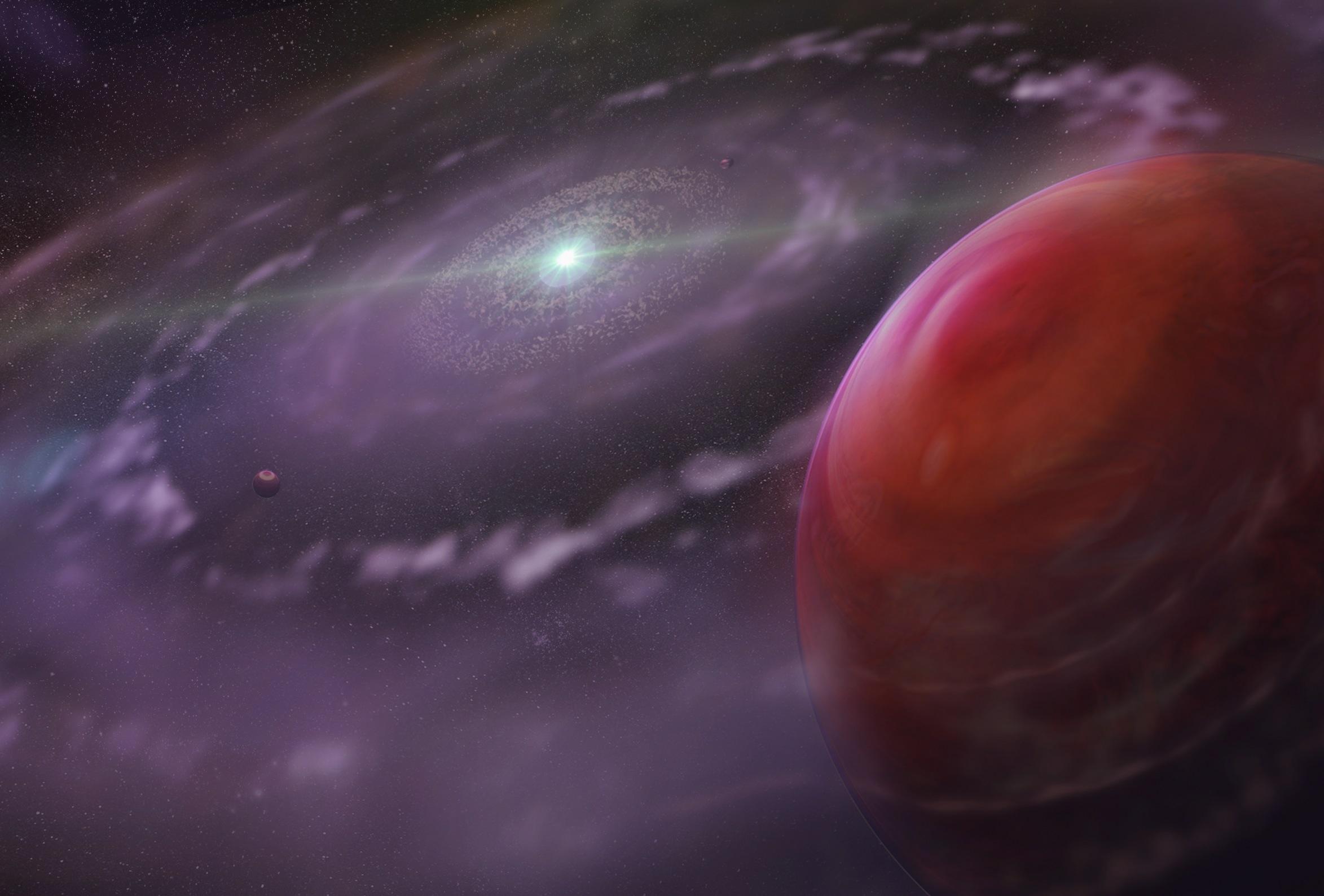
A team of international scientist has made the most detailed examination yet of the atmosphere of a Jupiter-size like planet beyond our solar system.

