




Recognition of early-career women scientists helps encourage participation in medical research, builds strong research cultures, and inspires a new generation of scientists.

 In that light, five medical and life science researchers from Africa, the Middle East, Asia, Latin America and the Caribbean Basin today received the 2013 Elsevier Foundation Awards for Early Career Women Scientists in the Developing World for work that could contribute to life-saving knowledge and therapies worldwide. The prizes were awarded by The Elsevier Foundation, the Organization for Women in Science for the Developing World and TWAS, the academy of sciences for the developing world, to build research capacity and advance scientific knowledge throughout the developing world. 

Given the enormous increase in government funding and control of science and technology in the U.S. during the last few decades, it is surprising that more attention isn't paid to the policy decisions that drive the enterprise, said Daniel Sarewitz, 
Arizona State University
co-director of the Consortium for Science, Policy and Outcomes (CSPO) at the AAAS meeting in Boston. What appears to be missing from the equation, he added, is a focus on outcomes. 

Sarewitz has commented for more than 20 years on science policy, dating back to his time working on Capitol Hill as a staff member for former Democratic congressman George E. Brown, Jr., and has written numerous articles and books on this subject. 

You can bet that if I don't have my Double Black Diamond Extra Bold tomorrow morning, I am writing me a letter to Congress. Guatemalans take their coffee just as seriously and have already gone to Def-Con 1 over coffee rust, which is affecting 70% of the country's crop.

Roya is a fungus that grows on the leaves of the coffee plant and that starves the beans. It's caused by too much rain, which is a recurring problem and always has been but coffee is big business now.  In 1982, the world used 2.6 billion pounds of coffee beans but in 2011, that number was 17.6 billion pounds, according to the U.S. Agriculture Department.  Meanwhile, a growing human population and heavy rains there have caused Colombian output to drop 36% in the last seven years.

The National Football League is facing lawsuits by 4,000 former players who allege the organizations failed to protect them from the long-term consequences of concussions.

A psychologist that consulted with the Montreal Canadiens hockey team and treated players with concussions for 15 years undertook research into the effects of concussions on children and young athletes as well as older athletes. 

To study the effects of concussions,
Dr. Maryse Lassonde, a neuropsychologist and the scientific director of the Quebec Nature and Technologies Granting Agency
had athletes perform specific visual and auditory tasks and also mapped their brains with the help of EEG and MRI equipment, in addition to testing brain chemistry.

A shooting star brighter than the sun on the very day an asteroid flyby is predicted. A most remarkable coincidence. And to add to our amazement, the rock whizzing through the skies didn't illuminate a distant ocean or some remote desert, but rather showed its spectacle above one of the very few areas in the world populated by people driving dashcams around 24 hrs a day. No screenwriter would get away with such an unlikely scenario.

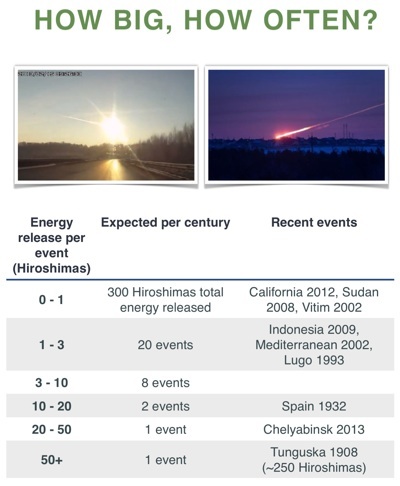
But how likely are meteor event like the one in Russia? What are the chances a similar event will occur this century? And what about even bigger events? What was the power of the blast from the Russian meteor? How does it compare to the explosions we humans create?
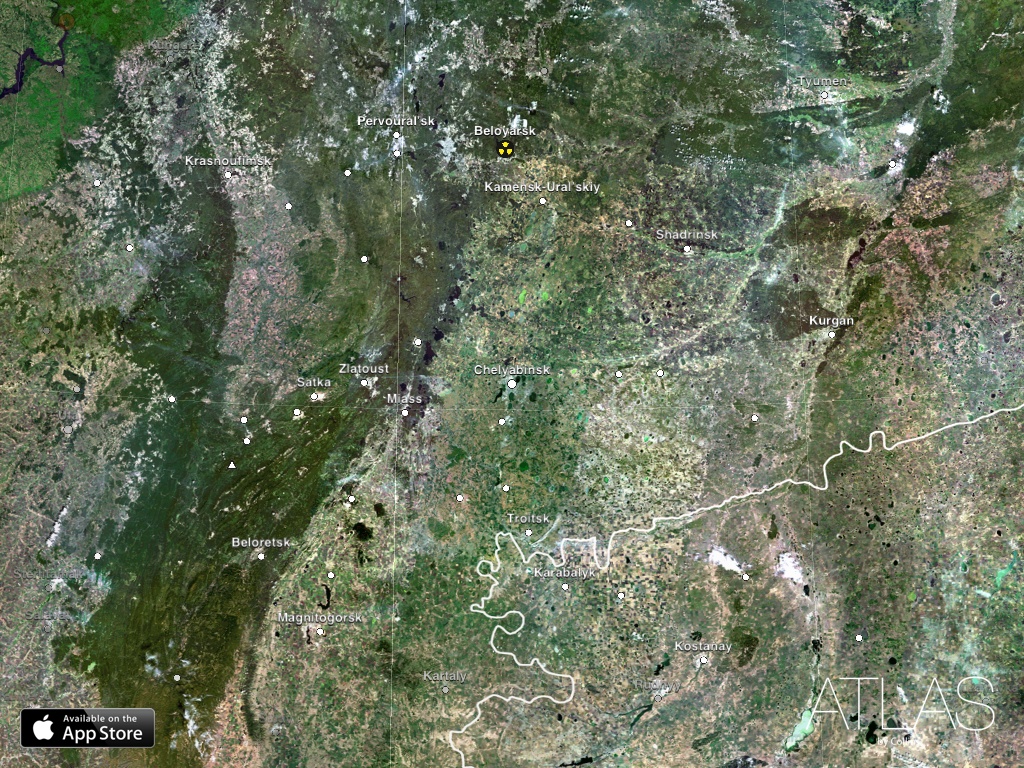
As most of the entire world knows by now, Mother Nature gave us a bit of a surprise this week - a meteor exploded in the atmosphere and shattered windows and injured hundreds of people in the  Chelyabinsk region of Russia.

With just the concussive force of the meteorite explosion shattering things, you can imagine what would have happened if a meteorite hit a building - one meteorite did land, thankfully in a lake near Chebarkul rather than on a house.
The Signal Analysis and Interpretation Laboratory (SAIL) at the University of Southern California, US, is one of the few, perhaps the only human-centered information processing lab to have built and tested an ‘Automatic Sarcasm Recognizer’.

Heightened regulation, increased lawsuits and a resulting lack of venture capital has meant the western pharmaceutical industry faces a looming crisis but companies outside America and Europe may pick up the slack - new targets/drugs remain an evergreen medical idea elsewhere, especially to address the unmet need of drug resistance in the treatment of cancer.  

Bisphenol A, widely known as BPA, has recently become a controversial science issue, along with climate change and every food, energy and medicine study. In the modern world, the only legitimate science is the science that agrees with well-funded activist organizations. BPA is a component of plastic bottles and canned food linings that have helped make the world's food supply safer but has recently come under attack because some studies have found it has the potential to mimic the sex hormone estrogen if blood and tissue levels are high enough.

An analysis of almost 150 BPA exposure studies shows that in the general population, people's exposure may be many times too low for BPA to effectively mimic estrogen in the human body. 

The world produces a lot of food, but it is not produced equally. Agriculturally rich areas like American and Europe can fret about whether natural or synthetic toxins are on their food, and how much water a toilet flush should be, while a billion people elsewhere have inconsistent diets.

Paul Ehrlich, legendary doomsday prophet, now has a new concern that will kill the planet if it is not addressed - equal rights for women.


